

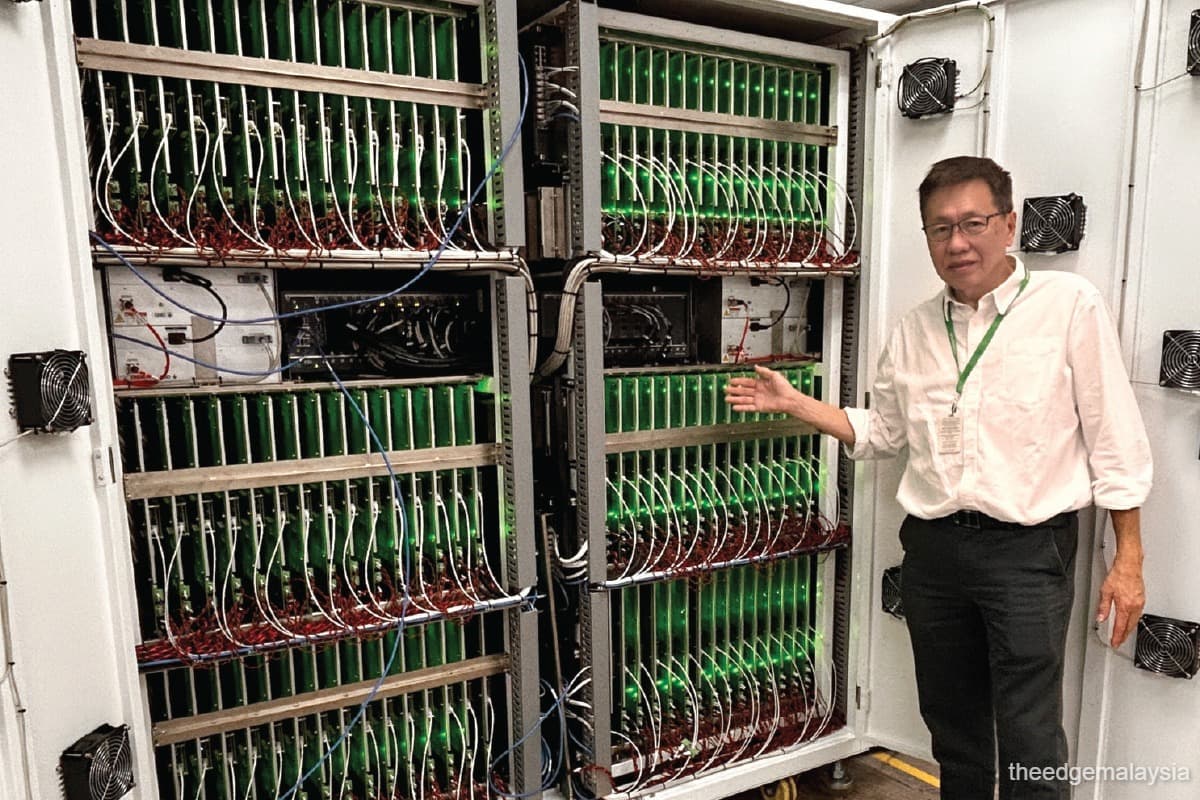
This article first appeared in The Edge Malaysia Weekly on March 3, 2025 - March 9, 2025
PENANG-based automated test equipment (ATE) maker and automation house Pentamaster Corp Bhd (KL:PENTA) is in the process of privatising its Hong Kong-listed, 63.9%-owned subsidiary, Pentamaster International Ltd (PIL) with partners.
And if everything goes according to plan, PIL will be delisted from the Stock Exchange of Hong Kong (HKEX) on March 19. The privatisation is seen as positive for Pentamaster as the Bursa Malaysia-listed technology firm could lock in higher earnings contribution from PIL.
Pentamaster co-founder and executive chairman Chuah Choon Bin hinted that the move goes beyond financial consolidation, suggesting that strategic opportunities lie ahead for the group and its Taiwanese partners post-privatisation.
“We have announced the privatisation of our Hong Kong unit but since the process is ongoing, I can’t share too much about our future plans at this stage. However, what some may not have noticed is that our privatisation partners include prominent names in Taiwan’s semiconductor industry.
“While I can’t elaborate for now, we do have strategic plans post-privatisation, and investors should keep an eye on what’s ahead,” the 64-year-old automation veteran tells The Edge in an interview in Penang that took place first at Pentamaster’s plant in Bayan Lepas and then at the company’s new site in Batu Kawan across from the Penang Second Bridge.
Pentamaster had, on Dec 19, 2024, proposed to take PIL private at HK$0.93 per share (RM0.54), representing a 16.25% premium to its last traded price of HK$0.80 (RM0.46) before trading was suspended on Dec 4.
Interestingly, Pentamaster is not going solo in this exercise. Instead, it is teaming up with Puga Holdings Ltd. Pentamaster will acquire a 7.1% stake in PIL while Puga will take up 29%.
As part of the deal, PIL will issue a special dividend of HK$0.07 per share (RM0.04) to shareholders, amounting to HK$168 million, and cancel shares not held by Pentamaster at HK$0.93 each.
This effectively means PIL’s minority shareholders will receive HK$1 per share upon exiting the company, leaving Pentamaster with a 71% stake and Puga with 29%.
Incorporated in the British Virgin Islands, Puga is 17.38%-owned by Beacon Path, 67.02% by Supari, 6% by Digimoc Holdings Ltd, 3.6% by Fortune Venture Capital Corp, 3% by Taiwanese private investor Chen Hsin-Yu and 3% by his brother Chen Hsin-Tso.
Puga’s sole director is Wang Li-Wei, who currently serves as a partner of private equity (PE) investment firm Achi Capital GP Ltd and has over 15 years’ experience in corporate finance and accounting. Both Beacon Path and Supari are indirectly wholly owned by semiconductor-focused PE fund Achi Capital Partners Fund LP.
Achi Capital manages assets totalling US$723 million (RM3.22 billion) across a diversified portfolio of global semiconductor and technology companies, such as Taiwan-listed chip design house owner ITH Corp and fabless semiconductor company Alchip Technologies Ltd.
Meanwhile, Digimoc is controlled by MediaTek Inc, another Taiwan-listed fabless semiconductor giant with a market capitalisation of TW$2.43 trillion (RM329 billion).
As for Fortune Venture Capital, it is a venture capital investment firm wholly owned by United Microelectronics Corp (UMC), a semiconductor foundry powerhouse that is dual-listed in Taiwan and New York and has a market capitalisation of TW$548.9 billion.
In short, Puga is a special purpose vehicle backed by Achi Capital, MediaTek, UMC and several Taiwanese individuals.
According to Chuah, these technology companies are not only well established in Taiwan but also have a strong global presence in their respective fields.
“As artificial intelligence (AI) continues to reshape the technology landscape at a rapid pace, Malaysia is working to strengthen its position within the tech ecosystem.
To stay competitive, Pentamaster must take a bold and strategic approach, leveraging collaborations and engagement with these companies to drive innovation and revenue growth,” Chuah remarks.
PIL undervalued?
PIL — a Cayman Islands-incorporated investment holding company that was listed on HKEX’s Main Board in January 2018 — fully owns four Malaysian subsidiaries, namely Pentamaster Technology (M) Sdn Bhd, Pentamaster Instrumentation Sdn Bhd, Pentamaster Equipment Manufacturing Sdn Bhd and Pentamaster MediQ Sdn Bhd.
PIL essentially controls Pentamaster’s main operating subsidiaries in Malaysia, China, the US, Germany, Singapore and Japan. The Hong Kong unit contributed more than 95% to Pentamaster’s turnover and earnings in the latter’s financial year ended Dec 31, 2024 (FY2024).
Pentamaster closed FY2024 on a weak note as its full-year net profit dropped 26.9% to RM65.21 million — its lowest since FY2018 when it posted a net profit of RM57.12 million — down from RM89.13 million in FY2023, as revenue declined 10% to RM623.02 million from RM691.94 million.
Over the past five years, PIL’s share price has declined 16% to HK$0.97, giving it a market capitalisation of HK$2.33 billion (about RM1.34 billion). The counter is currently trading at a trailing 12-month price-earnings ratio (PER) of 10.7 times on HKEX.
In comparison, its parent company, Pentamaster, which has a market capitalisation of RM2.22 billion, is trading at a higher historical PER of 31 times on Bursa Malaysia.
Indeed, Chuah had in September 2021 told The Edge that “Essentially, PIL and Pentamaster were the same company. But from a stock investing perspective, I would say PIL is a steady stock while Pentamaster is a more exciting one.”
A check on AskEdge shows that Pentamaster’s PER is slightly higher than that of its local ATE peers, Greatech Technology Bhd (KL:GREATEC) at 29.3 times and MI Technovation Bhd (KL:MI) at 25.2 times, but lower than ViTrox Corp Bhd (KL:VITROX) at 71.8 times.
Chuah, who is the single largest shareholder in Pentamaster with a 19.74% stake, acknowledges that PIL’s consistently low trading volumes and absence of public equity raising since its listing on HKEX highlight the inefficiencies of its listing status.
“PIL’s shares have been trading at a significantly lower PER than the shares of Pentamaster, which is listed on the Main Market of Bursa. Given that PIL represents a substantial portion of its parent company — accounting for over 85% of its assets — the disparity in their PERs underscores PIL’s significant market under-valuation on the stock exchange,” Chuah explains.
Considering these factors, along with the limited benefits derived, Chuah is of the view that the costs and regulatory requirements of maintaining a listing on the HKEX are no longer justified.
‘No comment’ on Ocado suit
Separately, Pentamaster is currently embroiled in a legal dispute with Ocado Innovation Ltd, a subsidiary of UK-based online grocery technology company Ocado Group, over allegations of patent infringement involving warehouse automation and robotics technologies.
In the lawsuit filed with the Kuala Lumpur High Court, Ocado alleges that Pentamaster developed, used, or facilitated the use of such systems that infringe its intellectual property rights.
When asked about the suit, Chuah would only say, “I have no comment.”
Pentamaster had on Jan 2 vehemently denied the allegations, stating its intention to file an application to strike out the suit, which it considers to be founded on baseless allegations.
“Pentamaster maintains that it has no involvement with the specific technologies or systems described in the claim. Pentamaster will take the necessary steps to make the application to strike out this claim against them,” the company says in a Bursa filing.
Pentamaster offers ATE for the semiconductor industry and factory automation solutions (FAS) tailored for the medical technology industry. The ATE division accounts for 45% of the group’s revenue while the FAS division contributes about 55%. Medical automation, a subset of factory automation, contributes 70% to the total FAS share.
Chuah says Pentamaster’s goal is to achieve a balanced contribution from its three major sectors, each accounting for about one-third of its revenue.
“This does not mean we are shifting focus away from semiconductors. Instead, we will continue expanding in this sector while also growing the other two, ensuring our revenue remains resilient against industry cycles.
“By diversifying, we aim to drive sustainable growth without engaging in price wars. In the semiconductor sector, we will focus on SiC (Silicon Carbide), CIS (CMOS Image Sensor) and advancing packaging technology to differentiate ourselves and avoid competing in over-saturated markets,” he explains.
Pentamaster operates on three sites in Penang. Campus 1, located in Bayan Lepas, covers 150,000 sq ft and is dedicated to semiconductor operations. Campus 2, spanning 100,000 sq ft in Batu Kawan, focuses on factory automation and medical industries. The largest, Campus 3, also in Batu Kawan, occupies 700,000 sq ft and serves the same sectors.
Regulatory risks and fierce competition
Chuah points out that the semiconductor and tech industries face increasing uncertainty in 2025 due to pricing competition, AI regulations, potential US tariffs and escalating US-China tensions.
“Supply chains may shift to mitigate risks while China accelerates AI and semiconductor self-sufficiency. As Trump returns, stricter trade policies could further drive decoupling. Pricing competition and regulation on AI and chips will be key to shaping global innovation,” he says.
Chuah opines that Malaysia, as a key semiconductor hub, must remain adaptable by expanding trade partnerships, investing in local talent and offering financial support to local outsourced semiconductor assembly and test companies and equipment makers — similar to Singapore, China, Taiwan and South Korea — to strengthen local intellectual property and R&D.
“The semiconductor test equipment sector is becoming increasingly competitive and subject to stricter local regulations. To ensure continued growth, Pentamaster must expand into new areas such as medical and consumer market factory automation. Since 2023, our FAS division has grown significantly, contributing over 50% to the group’s total revenue in FY2024,” he reiterates.
Chuah also observes that the Chinese ATE companies dominate in cost-efficient standard equipment and mass production, creating intense pricing competition for non-Chinese firms like Pentamaster.
“However, factory automation requires greater customisation and engineering expertise — areas where Chinese companies are less focused due to lower production volumes — giving Pentamaster a strong opportunity to expand its market presence,” he says.
Despite the year-to-date decline of 26% in Pentamaster’s share price to RM3.09 last Friday, Chuah says the group’s fundamentals remain strong, with a positive long-term outlook.
“We continue to drive innovation, enhance efficiency and expand in key sectors like semiconductors, factory automation, and medical technology. Market fluctuations are normal, but our strong potential project pipeline and global expansion have positioned us well for future growth.
“While we do not provide investment advice, investors may consider our strong fundamentals and industry potential when evaluating opportunities,” he concludes.
Save by subscribing to us for your print and/or digital copy.
P/S: The Edge is also available on Apple's App Store and Android's Google Play.