

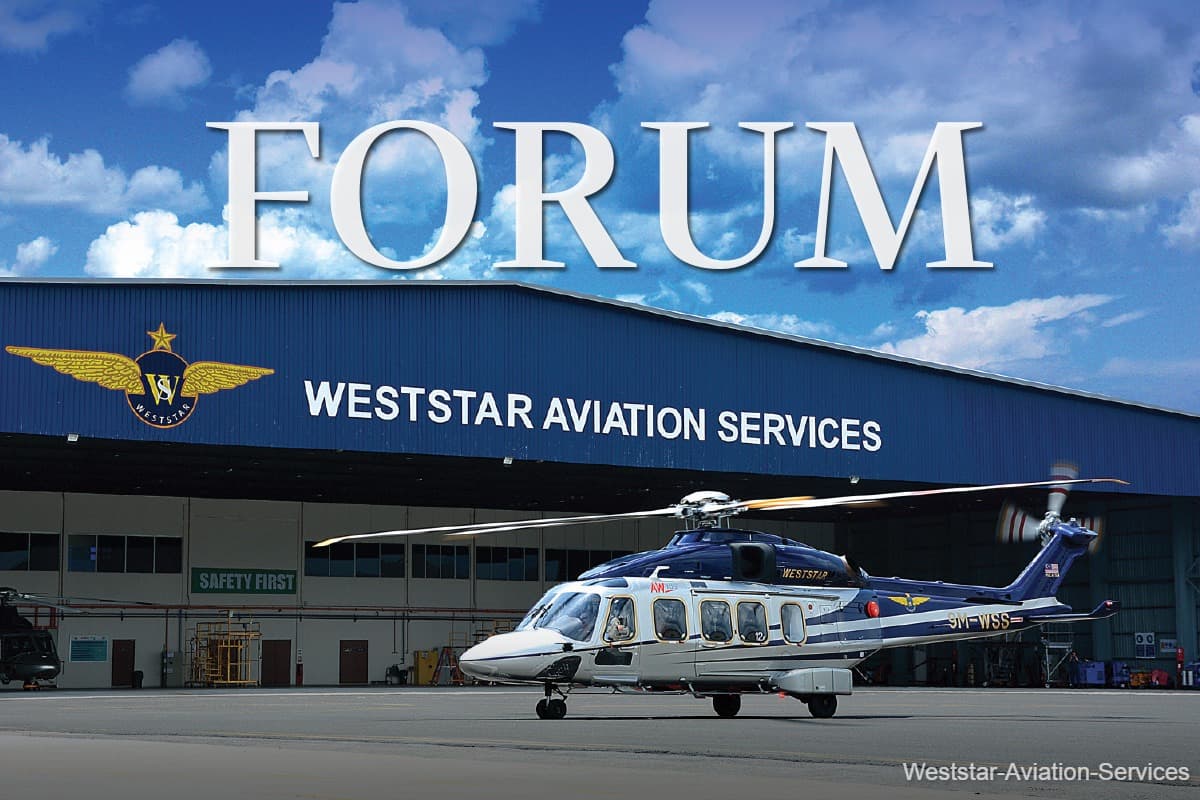
This article first appeared in Forum, The Edge Malaysia Weekly on March 3, 2025 - March 9, 2025
When the prime minister himself comes to parliament to defend a corporate transaction, the message is clear that the deal is being driven by Putrajaya.
That was the case with the privatisation of Malaysia Airports Holdings Bhd. Despite the nagging voices of opposition, the deal went through.
Two weeks ago, Prime Minister Datuk Seri Anwar Ibrahim defended a RM16.8 billion agreement between the government and Weststar Aviation Services Sdn Bhd for the lease of 28 helicopters over 15 years.
Under the contract, the defence forces and enforcement agencies, including the police, will use and operate the helicopters but Weststar Aviation will be responsible for maintaining the assets. This is known as a government-operates-company-owns-and-maintains model. The leasing charges include insurance and training for over 1,300 personnel.
Weststar Aviation’s other responsibilities are to ensure an 85% availability rate for the helicopters and after the 15 years of lease to give the government an option to purchase the helicopters for a nominal sum.
The prime minister disclosed several details in parliament, such as how Weststar Aviation was chosen, the government’s current maintenance cost of helicopters and the fact that the deal was a government-to-government (G-to-G) transaction without intermediaries.
According to Anwar, Weststar Aviation was chosen after a request for proposal in which four companies participated. As for the maintenance cost, the government currently spends RM1 billion per annum on it.
He said it was a G-to-G deal with the Italian government, which has a 30% stake in Leonardo SPA, the company that supplies the helicopters, giving an undertaking on the maintenance of the helicopters.
Although the prime minister has dwelt on the matter, there are nevertheless some questions that can be answered if there was more transparency about the opaque leasing contract.
Weststar Aviation was chosen following a recommendation by the Public Private Partnership Unit (UKAS) in the Prime Minister’s Department. UKAS evaluates all privatisation proposals, looking at the finances, cost and benefit analyses and other merits of the proposals.
Considering the hue and cry over the deal, the government should disclose the details of UKAS’ recommendation. It does not have to go into the technical aspects of the helicopters or their capabilities, but what the public would want to know is how the figure of RM16.8 billion came about and was it recommended by UKAS? Or did UKAS suggest a lower number?
UKAS would surely have done a cost-benefit analysis between a leasing model and an outright government purchase of the helicopters from Leonardo. What was the outcome of the analysis?
Or, was the government in favour of a leasing arrangement due to the historically poor procurement and maintenance track record of defence assets? One needs no reminder of the disastrous RM9.1 billion littoral combat ship deal.
Most defence procurements are obscure. The price and the terms of contract are hardly made public.
Based on the limited public information on previous helicopter purchases, it would have been cheaper for the government to buy the helicopters directly from Leonardo rather than go through a leasing arrangement.
For instance, the government’s cost of borrowing is certainly lower than Weststar Aviation’s. Access to cheap funds itself serves as a major advantage for an outright purchase of big-ticket item such as 28 helicopters.
Of the 28 helicopters, seven are Bell 429 while the remaining 21 are various AugustaWestland (AW) models. There have been reports in the past of the government procuring AW helicopters at between RM80 million and RM135 million.
The latest was in May last year when the Malaysian Maritime Enforcement Agency was reported to have purchased four AW189 medium lift helicopters for RM530 million. This means each helicopter cost RM132 million.
In 2022, the Royal Malaysian Navy was reported to have signed an agreement at a defence exhibition to procure three AW139 helicopters for a total of RM228 million, or less than RM80 million each.
To be noted here is that some helicopters under the leasing agreement are more advanced than the AW189 and AW139.
Assuming the 28 helicopters cost an average of RM150 million each, the total bill for an outright purchase should have been less than RM4.5 billion.
As for the maintenance cost, there are no real numbers to compare with.
The closest to any public information on this is an in-service support and performance based contract awarded to a joint venture of Boustead Heavy Industries Corporation Bhd (KL:BHIC) for RM378 million in August last year. The contract covers the Royal Malaysian Air Force’s EC725 helicopters for five years.
The announcement did not state the number of EC725 helicopters. However, according to reports, the air force has 12 such helicopters.
This works out to less than RM80 million a year for the entire fleet of 12 helicopters. Going by the BHIC’s announcement, the maintenance cost for 28 helicopters should easily come closer to RM190 million per year and this increases as the assets get older.
Without knowledge of the details, the critics are justified in their reasoning that the RM16.8 billion deal is grossly over-valued.
This is why there is a need for a higher degree of transparency in the helicopter leasing agreement.
UKAS would have looked at the numbers and weighed the various options. The report would have gone through many layers of the civil service before being presented to the cabinet.
Is it necessary to keep the UKAS’ recommendation away from the public eye? Why can’t the Anwar government be different from the past administrations and reveal the UKAS recommendation?
There have been cases in the past when the opinion of UKAS was made available. An example is the Immigration Department’s use of the Foreign Worker Centralised Management System (FWCMS) and the payments to Bestinet Sdn Bhd.
The details of what had transpired over the last 10 years with regard to FWCMS and the government’s rationale for undertaking an agreement with Bestinet came to light only after a Public Accounts Committee (PAC) meeting late last year.
Does the helicopter leasing contract need to be scrutinised by PAC before the details come out?
M Shanmugam ([email protected]) is a contributing editor at The Edge
Save by subscribing to us for your print and/or digital copy.
P/S: The Edge is also available on Apple's App Store and Android's Google Play.