

This article first appeared in The Edge Malaysia Weekly on February 17, 2025 - February 23, 2025
THE Securities Commission Malaysia (SC) is in talks with investment bankers, stockbroking companies, rating agencies and other market participants, as it is looking to revamp existing fee structures and impose a levy — an additional sum that in some instances may go up as high as 1.5% — on revenue derived from regulated activities.
A document sighted by The Edge states that, “Revenue refers to gross revenue that is directly or indirectly derived as a result of holding a licence for the relevant regulated activity.” The examples mentioned include dealing in bonds, brokerage income (including platform fee), underwriting fee, placement fee, commission including success fee, completion fee, advisory fee and commission fee from the distribution of unit trust products.
Plans for a revamp of fee structures and a levy on the requisite players’ revenue were mooted in March last year when the SC and Ministry of Finance (MoF) undertook a review of the regulator’s financial sustainability.
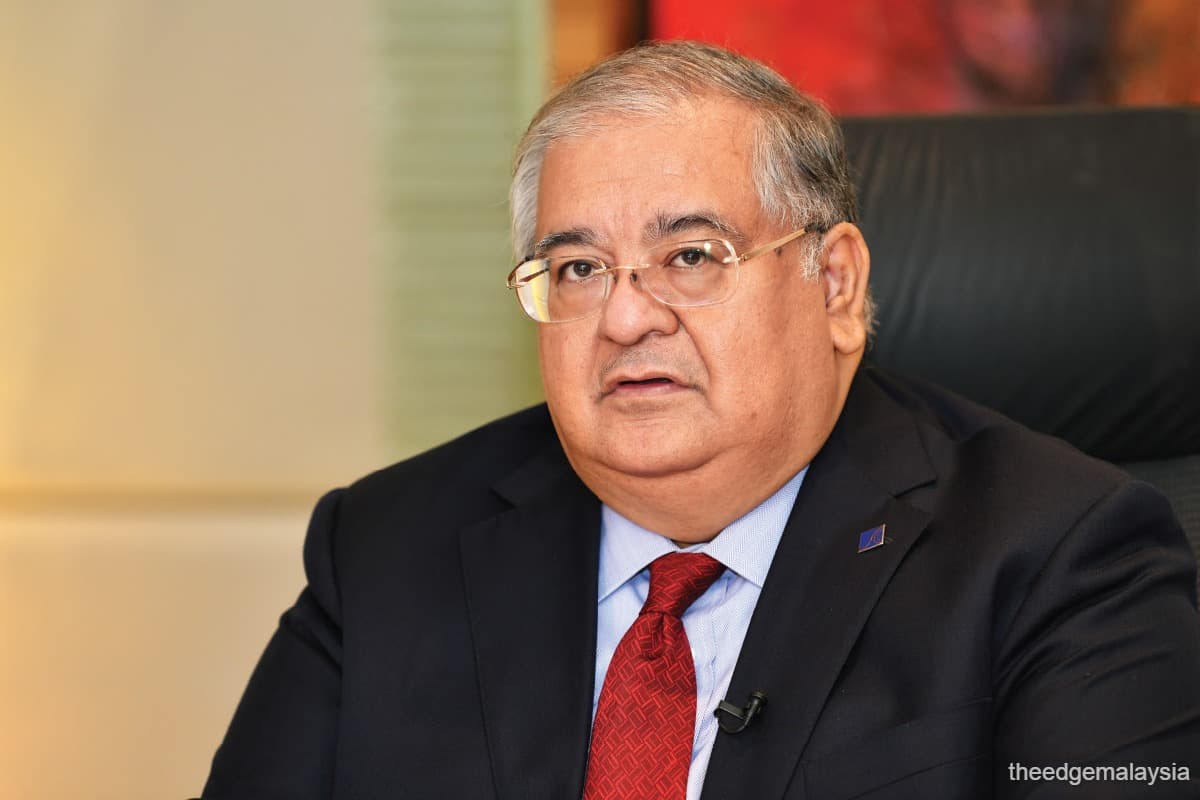
In an exclusive interview with The Edge, SC executive chairman Datuk Mohammad Faiz Azmi explains, “Something like 80% of my revenue is variable, but [most] of my costs are fixed … My revenue varies with the market.
“So [in relation to the fee structure review, we are not proposing] a set percentage for everything. Of course, in the negotiation, we start at a number, then we find [an agreed figure] somewhere in between. But it goes back to fairness. If your revenue is in the billions, [I am only proposing a levy of a] few million.]
“And actually, [we have] done a stress test. For most of the entities, it’s less than 1% of their revenue. Profit is [of course] a different story because some are profitable, some are [less so]. And then we [realised there was some arbitrage] going on. For example, in a banking group, I might only regulate the stockbrokers. But there’re also all kinds of transfer pricing going on, so the [profit] of the stockbrokers may not be reflective of what they’re really doing.”
At press time, there was no response to emails sent to the Association of Stockbroking Companies Malaysia (ASCM), the Malaysian Investment Banking Association and the Federation of Investment Managers Malaysia (FIMM) seeking their comments on the revised fee structure.
To put things in perspective, there has been no change in the framework on levies for more than 30 years.
However, in a letter dated Nov 6, 2024, that was addressed to Mohammad Faiz, ASCM says: “The proposed 1.5% revenue-based fee, combined with the existing SC levy of 0.0075% of the contract value on all share transactions, effectively imposes a double burden on brokers, taxing the same income stream at multiple levels. This cumulative regulatory pressure raises significant concerns for both larger and smaller firms, especially in an inherently volatile securities market where profit margins are already thin.
“Such excessive fees could lead to brokers passing on costs to clients, potentially undermining investor confidence and reducing retail and institutional participation in the market. This could ultimately harm market liquidity and accessibility, counteracting the SC’s objectives of fostering a vibrant investment landscape.”
The letter, which was sighted by The Edge, was signed by the association’s chairman Datuk Ahmad Azman Abdul Manaf and president Chew Sing Guan.
When asked about the opposition from market players, Muhammad Faiz says, “Of course there [is some] opposition. No one likes paying more.”
Nevertheless, he adds, the SC will have to come up with guidelines and principles, such as requiring every participant to fork out some amount, and that on a negotiated basis, the payments could be spread out over time, rather than doing it all at once. Also, there could be caps put in place where the levy seems excessive.
The revision of the fee structures and imposition of a levy hinges on the SC posting its largest net operating deficit in at least a decade, of RM54.64 million, in 2023.
In a nutshell, the SC is a statutory body established under the Securities Commission Malaysia Act 1993 for the regulation and development of capital markets and has the responsibility to supervise and monitor the activities of market institutions, including the exchanges and clearing houses, and regulating all persons licensed under the Capital Markets and Services Act 2007. Other sources of income are from penalties for failing to comply with any provisions or conditions and recovery of investigation and proceedings costs that are recognised at a point in time, among others.
Mohammad Faiz says, “As an illustration, 2023 was a bad year — we made a loss of RM109 million. 2024 was a good year, but I still made a loss of RM2 million. So clearly, there’s a problem. The other thing about the fees is that 80% of these are from the equity levy — RM144 million in 2023 and RM210 million in 2024. But that’s to cover a cost base of [just below] RM300 million.
“But that equity levy does not just cover equity enforcement. It covers bond enforcement, auditors, Islamic and structured products. And I also have to worry about scammers.”
Considering that market players are not in the B40 (bottom 40% income group) but more in the M40 (middle 40%) and T20 (top 20%), seeking government funds to regulate the capital markets is out of the question.
The SC’s revenue in 2023, which was derived from levies, fees and charges, licence fees and registration fees, amounted to RM167.28 million. The regulator’s other income of RM5.89 million was from penalty income, recovery of investigation and proceedings costs, residual sums and net fair value gain or loss on financial assets at fair value through profit or loss.
Together with an income of RM36.74 million from fixed deposits, bonds and unit trusts, the SC’s total income in 2023 was RM209.91 million (RM167.28 million + RM36.74 million + RM5.89 million).
However, the regulator’s total expenditure was RM266.36 million. Staff costs alone — which include remuneration, bonus, medical, training and overtime, defined contribution plan, other employee benefits and post-employment benefits — came up to RM209.66 million.
“It should be that people who gain or benefit should contribute [to the cost of maintaining a fair and orderly market],” says Mohammad Faiz. “So if I give you [an example], there was a recent application for trading licences for a securities company. They paid us RM50 to submit the application and RM4,000 for three licences annually.
“Apparently, the first licence is RM2,000, then you get a discount for the next two licences. So they [can trade in equities], they can trade in derivatives and they can give advice for RM4,000 … [Does that seem fair?] I looked at some of the bigger companies. There was one making [a few billion] in revenue … We [charge them a total of] RM4,000 annually.”
The SC’s board approved the charging of the levy two weeks ago and is looking to engage all the associations and also some of the companies. It hopes to submit its final request to MoF by the end of next month. However, even if the ministry approves the levy the following day, there is still a process to get the rules changed and maybe even have the law amended.
“So, the impact of [the fee structure review]may not be seen this year … But the devil is in the details,” says Muhammad Faiz.
Save by subscribing to us for your print and/or digital copy.
P/S: The Edge is also available on Apple's App Store and Android's Google Play.