

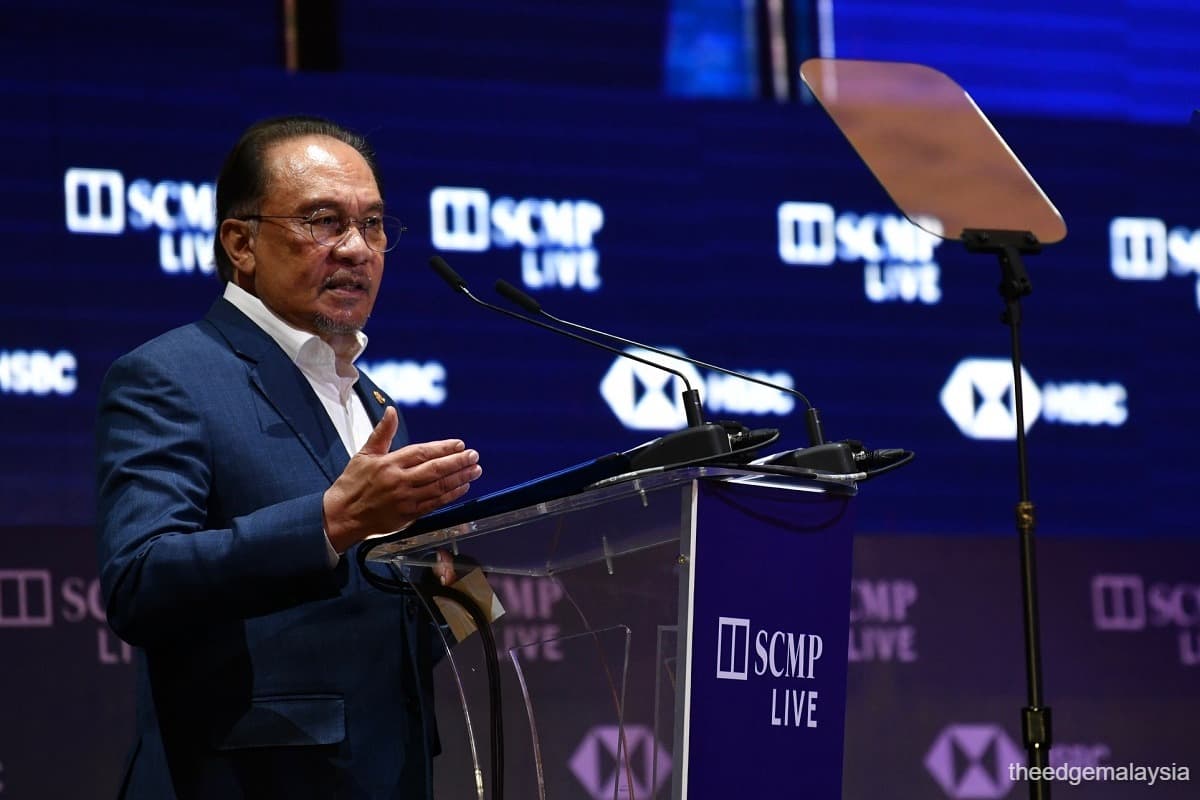
KUALA LUMPUR (Feb 17): Southeast Asian countries must expand their global engagement beyond traditional partners amid the US-China trade war, said Malaysia’s Prime Minister Datuk Seri Anwar Ibrahim.
Malaysia will host a summit with the Association of Southeast Asian Nations (Asean), China and Gulf Cooperation Council (GCC) in May, he said at the China Conference Southeast Asia 2025 organised by the South China Morning Post. Strengthening ties with GCC, BRICS, and other emerging economies will ensure the strategic relevance of Asean, he added.
“By diversifying its partnerships, Asean can enhance its economic resilience, tap into new investment opportunities, and play a more proactive role in shaping global governance frameworks,” he said in his keynote address.
BRICS is a loose grouping of Brazil, Russia, India, China, South Africa, Egypt, Ethiopia, Indonesia, Iran and the United Arab Emirates, while member states of the GCC are the United Arab Emirates, Kuwait, Oman, Qatar, Saudi Arabia and Bahrain.
China is the biggest trading partner of Asean, the 10-nation group that comprises Malaysia, Singapore, Thailand, Indonesia, the Philippines, Brunei, Cambodia, Laos, Myanmar and Vietnam. Together, Asean is one of the world’s largest economic blocs and home to more than 600 million people.
However, “Asean’s connectivity with China must also extend beyond enhancing trade efficiency; it must drive shared prosperity”, Anwar said. He also stressed that Malaysia remains non-aligned and will not be drawn into great power rivalries.
Malaysia rejects economic coercion and unilateral actions that undermine regional stability, and “we support a rules-based multilateral system that ensures fairness, transparency and representation for all, particularly for the Global South”, he said.
Challenges for Asean
There are critical challenges for Asean ahead, Anwar said at the conference attended by government officials and business executives, flagging supply chain disruptions and diversification.
“Asean must become a reliable hub for global trade and investment by reducing vulnerabilities to external shocks,” he said. “Strengthening our industrial base through investments in advanced manufacturing, semiconductors and green technologies will be essential.”
The region must also contend with energy security and sustainability, Anwar said, noting that Malaysia’s target of 70% renewable energy by 2050 will serve as a benchmark for Asean’s broader sustainability efforts.
Further, he stressed that governance over artificial intelligence, cybersecurity, and digital inclusivity is crucial for progress. “We must establish common standards for data protection, facilitate seamless cross-border digital trade, and invest in capacity-building initiatives that bridge the digital divide,” he added.
Read also:
Zafrul: US tariffs on steel, aluminium to have minimal impact on Malaysia’s exports
BNM governor says ringgit on right track, but risks remain amid trade war fears
Malaysia can drive Asean-China synergies in achieving Asian Century, says Zafrul
Zafrul: Malaysia will not let any nation dictate its policies
Malaysia-Asean relationship with China should be based on mutual respect, trust, says Zafrul
Local semiconductor industry to benefit from US-China trade tensions, says association