

This article first appeared in The Edge Malaysia Weekly on January 27, 2025 - February 2, 2025

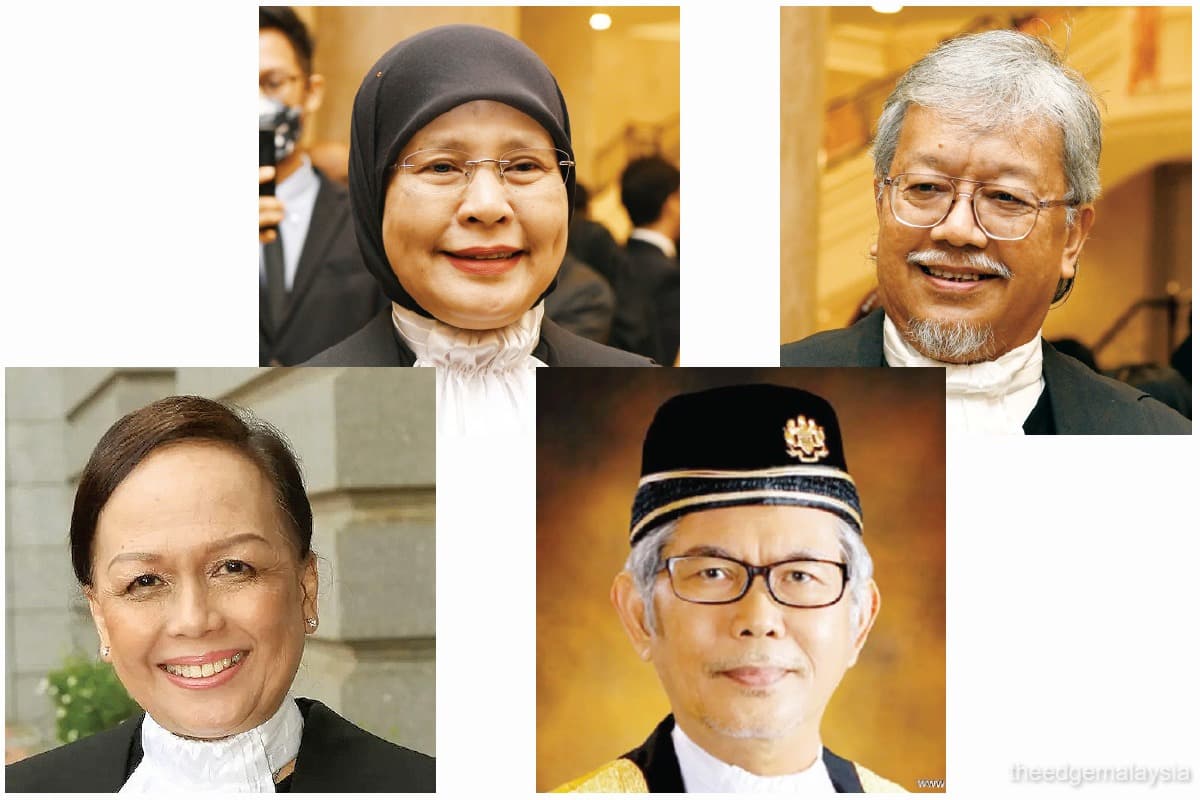
THE judicial line-up will see many changes this year given the imminent retirement of nine of the country’s top judges, including Chief Justice Tun Tengku Maimun Tuan Mat. Legal practitioners and observers of the profession are understandably wary of the vacuum the judges’ impending departure will leave. At the same time, they remain hopeful that judicial independence will continue to be upheld by Tengku Maimun’s successor.
Tengku Maimun who became the first female Chief Justice in 2019, and the country’s 16th succeeding Tun Richard Malanjum, turns 66, the mandatory retirement age for judges under the Constitution, on July 2.
At most, her tenure can be extended for six months, which would then make Jan 1, 2026, her last day.
Apart from Tengku Maimum, a number of other top judges of the apex court, namely her top three, are also due to retire.
Court of Appeal president Tan Sri Abang Iskandar Abang Hashim turns 66 a day after Tengku Maimun, while newly appointed Chief Judge of Malaya, Datuk Seri Hasnah Mohamed Hashim, will do so in May.
Chief Judge of Sabah and Sarawak Tan Sri Abdul Rahman Sebli turned 66 last Friday. It is not clear if his tenure has been extended.
But the string of retirements does not stop here as five other apex court judges — Tan Sri Nalini Pathmanathan, Tan Sri Harmindar Singh Dhaliwal, Datuk Zabariah Mohd Yusof, Datuk Abdul Karim Abdul Jalil and Datuk Hanifah Farikullah — also reach their age limit this year.
Having turned 66 last October, Harmindar’s tenure was extended for six months.
The Federal Court being the apex court should consist of at least 14 judges apart from the top four. So the upcoming retirement of nine judges this year will leave a vacuum to be filled by the existing five judges and those elevated from the Court of Appeal.
Tipped to fill the top four posts are federal court judges Datuk Rhodzhariah Bujang, 64, Datuk Abu Bakar Jais, 63, Datuk Nordin Hassan, 62, Datuk Vazeer Alam Mydin Meera, 63, and former Attorney General Tan Sri Ahmad Teriruddin Mohd Salleh, 57, who was appointed a federal judge in November last year.
Rhodzhariah, being from Sarawak, is tipped to take over from Abdul Rahman.
Fill vacancies quickly
The imminent vacancies in the top four posts will need to be filled as soon as possible to ensure that the judicial system and process continue to run smoothly.
But have the powers that be set the wheels in motion in identifying suitable candidates at the very least?
This is because when Tan Sri Mohamad Zabidin Mohd Diah stepped down last February as Chief Judge of Malaya (CJM), it took an interminable nine months before Hasnah was appointed to the position.
While it is understood that several names were proposed to the Malay rulers to replace Zabidin, a decision was only arrived at in November after the go-ahead was obtained at a meeting of the Malay Rulers a month earlier.
The Judicial Appointments Commission notwithstanding, judicial appointments are made on the recommendations of the sitting prime minister after consulting with the CJ. The premier then puts forward the name to the Malay Rulers.
Granted, the delay in the appointment of Zabidin’s replacement may have been the result of the JAC, the PM and the rulers not agreeing on the recommended individual, resulting in a stalemate.
Such a situation could also give rise to judicial interference in the appointment of judges, say legal experts who are keeping a close watch on how the top four posts will be filled in the coming months as there are already strong rumours that Ahmad Teriruddin, the most junior of the Federal Court judges may be promoted to one of the top three positions as he is viewed by the executive as a potential CJ even though he has never served as a High Court judge, nor at the Court of Appeal but was directly elevated to the Federal Court.
His quick ascension has been attributed to his time as AG, say lawyers, noting that there was a precedent in the late Tan Sri Mohtar Abdullah who retired as an AG in 2000 and was subsequently appointed a Federal Court judge a year later. But Mohtar had served as a high court judge for about four years prior to becoming the AG.
It is to be noted in the history of the judiciary that two luminaries, namely the late Datuk Seri Gopal Sri Ram and Tun Zaki Azmi joined the judiciary directly from legal practice after being appointed to the Court of Appeal and Federal Court respectively. Sri Ram retired as a Federal Court judge while Zaki retired as the CJ.
Keep judiciary independent
In her outgoing speech at the official opening of the 2025 Legal Year (OLY) about a fortnight ago, Tengku Maimun was quick to remind all stakeholders, particularly the executive and future administrations, that the independence of the judiciary is sacrosanct and not to be tampered with as it would have dire consequences for the rule of law and confidence in the judiciary as witnessed following the judicial crisis of 1988. In what remains a black mark day for the nation, the then Lord President Tun Salleh Abas was dismissed by the then Prime Minister Datuk Seri Mahathir Mohamad, closely followed by the subsequent sacking or dismissal of five supreme court judges for not toeing the executive line.
Malaysian Bar president Mohamad Ezri Abdul Wahab also reiterated at OLY 2025, “The adage, “Justice must not only be done but must also be seen to be done,” serves as a timeless reminder that the judiciary must remain beyond reproach, embodying integrity and impartiality. Society’s trust hinges on this perception, and it is our collective duty to ensure that the judiciary remains, as the saying goes, whiter than white.”
“To achieve the ideal of “whiter than white,” we must confront the overlap between politics, the judiciary, and the rule of law in Malaysia. Public trust in our institutions is fragile, and restoring it requires transparency and decisive reforms,” Ezri stressed.
The need for transparency in the appointments and decisions aside, Tengku Maimun also observed that an independent judiciary would better ensure a country’s economic growth.
Since the judicial crisis of 1988 until present time, the judiciary has been on the road to recovery in terms of perception of judicial independence, she said.
“Incidentally, 15 years ago, before the Judicial Appointments Commission Act 2009 was enforced, the then leader of the opposition made comments on the appointment of judges and judicial independence.
“I am certain that now, as prime minister, Datuk Seri Anwar Ibrahim and his government will remain true to those comments by continuing to unreservedly remain committed to upholding the cause of judicial independence,” Tengku Maimun reminded, referring to Anwar’s speech as then opposition leader in 2008 following the infamous Datuk V K Lingam tape-recording scandal that seemed to indicate that judicial appointments were more often than not fixed.
Anwar observed then that there was a perception that persons who had decided in favour of the then government were promoted — an observation Tengku Maimun said related directly to the fundamental aspect of judicial independence.
“One cannot deny that the 1988 judicial crisis was a blemish on Malaysia’s history. This one crisis itself tarnished the independence of the judiciary and paved the way for further incursions into the institution. In its aftermath, we also witnessed completely unsettling events like the Lingam tape.
“Most heinously, revelations were made that certain persons were literally deciding on who should become judges, specifically as a means of reward, as though appointments of judges can be used as bargaining chips. This event called for an independent judicial appointments process to ensure that tarnished candidates do not stand a chance of appointment,” Tengku Maimun stressed.
Having served under four prime ministers, from Mahathir who appointed her to Anwar, Tengku Maimun said that not once had the bench been seen as bowing to political pressure.
“During this time, judicial panels led by me have made what we firmly believed to be correct decisions on the law and facts, regardless of the heated political overtones and undertones that clothed some of these cases.
“This alone should dispel any baseless notion that I have ever been partial to any particular prime minister or any political party,” she said, noting that Malaysia had improved in the rule of law and judicial independence indices by leaping 23 notches to be ranked 55th out of 142 countries in 2023, compared to being placed 88th in 2016.
She also remarked that she slept well at night content that her decisions had been based on the Constitution, regardless of political or religious pressures.
Legal fraternity’s hopes and concerns
The concerns over a further erosion of judicial independence prompted nine former Bar Council presidents to issue a statement last week warning of pressure by external forces. “It is widely perceived that the previous three governments valued and respected judicial independence more than the current government, which is extremely disappointing, to say the least.”
They also pointed out that not everyone is qualified to be a judge as excellent qualifications aside, the individual also has to have the “ability to hand down judgments without fear or favour, and without succumbing to pressure.”
Lawyer and Professor (Adjunct) at Universiti Malaya and School of Business, Monash Malaysia University, Philip TN Koh said the retirement of top judges in a constitutional democracy is of special interest to all concerned.
“The imminent retirement of the CJ and three other senior Justices (and their predecessors) who have distinguished themselves in many spheres of law and who have engendered respect for the administration of justice have raised some anxieties.
“The retiring judges in carrying out the legacy of the past precedents have not allowed the dead hand of the past to shackle their decisions but have demonstrated courage and creativity in navigating the ordering of power in public governance and resolving of often fierce contestations between State and the individual and disputes between parties involving business, market economy and human rights.”
Koh told The Edge that for decades the judges have devoted their professional life in service of such ends.
“As Malaysians look to future appointees, it is a legitimate expectation that the executive (together with the JAC and wisdom of the Yang di-Pertuan Agong) will appoint justices (and there are many waiting in the wings) who have distinguished themselves similarly and who will uphold the many virtues of judicial impartiality and integrity and fidelity to the rule of law,” he said.
He noted that the judges take the solemn oath in undertaking to uphold the Federal Constitution and rule of law, and in reflecting back they may ask, “have I done so with fidelity to the integrity of law and justice?
“The retiring judges have honourably done so and no less we expect the incoming appointees to do the same,” Koh said of the high expectations and standards to be met by the incoming judges.
Asean Law Association of Malaysia council member, S Saravana Kumar told The Edge.: “The judicial institution as well as judges must be free to make their own decisions. In this regard, the CJ emphasised that judicial decisions must be made based solely on the facts and the law without any other considerations.”
“For me, an independent judiciary is the cornerstone of the legal system in Malaysia as the judiciary operates as a vital mechanism in the checks and balances of democratic governance.
“Judges are bound to uphold their judicial oath steadfastly and constantly remind themselves that their decisions have a profound impact on society”, Saravana said, quoting Negeri Sembilan ruler Tuanku Muhriz Tuanku Munawir who had published a foreword to the book on reported decisions by former Court of Appeal judge titled Hishamudin Yunus: Celebrating Judicial Independence.
Save by subscribing to us for your print and/or digital copy.
P/S: The Edge is also available on Apple's App Store and Android's Google Play.