

This article first appeared in City & Country, The Edge Malaysia Weekly on January 27, 2025 - February 2, 2025
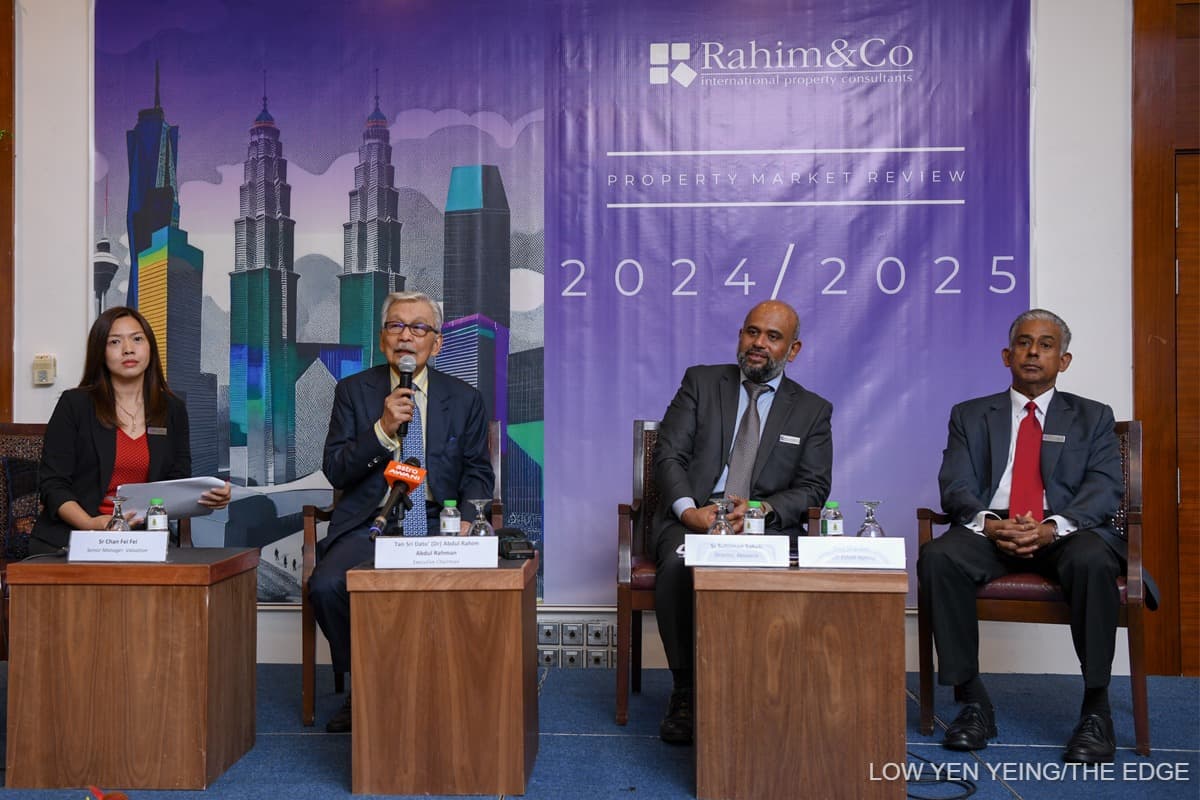
The property sector is expected to see a full recovery by 2026, according to Rahim & Co International Property Consultants Sdn Bhd executive chairman Tan Sri Abdul Rahim Abdul Rahman.
Speaking to City & Country after the launch of Rahim & Co Research Sdn Bhd’s Property Market Review 2024/2025 report on Jan 16, he said, “Although we may not have reached pre-Covid [figures], I expect that by 2026, we would witness a full recovery for the property sector.”
According to the report, the Malaysian property market witnessed a strong 2024. For the first half of 2024 (1H2024), the property sector clocked 198,906 transactions valued at RM105.6 billion across all subsectors. This was the highest level recorded since the market peak of 2011/12.
The momentum continued in the first nine months of 2024 (9M2024) with 311,211 transactions recorded, up 6.2% year-on-year (y-o-y). Transaction value stood at RM163 billion, an increase of 14.4% over the same period in 2023.
Nevertheless, despite the positive numbers, he reckoned that market sentiments among buyers are mixed, varying by location, asset class and pricing bracket. Concerns over living costs, purchasing power and global economic uncertainties persist, leading to diverging trends within the market.

These trends include environmental, social and governance (ESG) awareness, growing demand for integrated urban living and affordable housing, among others.
However, Abdul Rahim believed that the property sector remains resilient as it adapts to new demands while navigating the complexities of a recovering market. The growth across all key property sectors and the expanding potential in regional economic hubs highlight the industry’s current vibrancy.
“Shifts towards more sustainable and tech-driven property solutions are also reshaping how developers and consumers view real estate. Looking forward to 2025, we anticipate the market will continue to grow steadily, driven by residential development, emerging sectors such as data centres and renewable energy, as well as key infrastructure projects that will rekindle past interests and open up new investment opportunities,” said Abdul Rahim.
Resilient residential market
The residential sector recorded growth in 9M2024. During his presentation of the report, Rahim & Co International Property Consultants director of research Sulaiman Saheh noted that transaction volume for residential properties increased 4.9% y-o-y to 192,484 units while value increased 6.9% y-o-y to RM78.17 billion.
“Buyers are regaining interest but are still cautious, with affordability remaining an issue. The house price index has consistently grown over the past two years and into the first quarter of 2024, but the pace has moderated to 0.4% in the third quarter,” said Sulaiman.
The distribution of new housing launches saw a shift. “New launch units priced below RM500,000 had accounted for over 70% in the past, but the number reduced to 63% for 1H2024. This indicates a higher share of [housing] units priced above RM500,000,” said Sulaiman, attributing this trend to the deferred launches due to Covid-19.
On another note, the number of overhang residential units (including serviced apartments and SoHo) in 3Q2024 reduced 10.8% y-o-y to 44,057 units worth RM31.58 billion.

Evolving landscape for offices
The office sector continues to face challenges due to the large supply of office space. The report highlighted that as at 1H2024, there was a supply of 110.4 million sq ft of purpose-built office space with a 71.8% occupancy rate. Additionally, some six million sq ft of new office space is in the pipeline.
“The overall occupancy of purpose-built offices is still challenging. In the Klang Valley, for example, occupancy declined with the influx of new office spaces growing faster than the take-up rates of those spaces.
“As such, we saw the consolidation of agencies’ functions like InvestKL and Mida (Malaysian Investment Development Authority) as at June 2024 aimed to create a more efficient and effective mechanism to attract more multinational companies to the country,” the report said.
Furthermore, according to Sulaiman, the shift towards remote and hybrid work models is transforming demand for these spaces.
“Companies are prioritising flexibility, with offices evolving into collaborative hubs rather than traditional workspaces. ESG considerations, amenity-rich locations and easy transport access are key drivers of future demand. However, with supply outpacing demand in areas like the Klang Valley, the sector will need to align new developments with market needs to ensure sustainable growth, aided by more attractive government initiatives,” said Sulaiman.
“Despite ongoing oversupply challenges in office and retail spaces, trends like ‘flight-to-green’ and ‘flight-to-quality’ will likely reshape demand as tenants increasingly seek sustainable, high-quality buildings that align with their corporate values.”

Retail sector to pick up
The Klang Valley retail sector saw a gradual y-o-y growth in 3Q2024 with a 2.4% increase in total space to 80.1 million sq ft. Similarly, the occupancy rate increased to 83.3%, up 2.3%.
Meanwhile, the total incoming retail supply stood at 2.4 million sq ft for Kuala Lumpur and 3.6 million sq ft for Selangor as at 3Q2024, the report said.
As for the overall occupancy across the country, it displayed a slight improvement to 75.8% in 3Q2024, up from 75.1% a year ago.
“The retail sector is poised for gradual revitalisation, with new malls and stores thriving, particularly on weekends and public holidays. Successful malls flexed unique designs, experiential features and seasonal events such as bazaars and entertainment to attract foot traffic. In competitive markets like the Klang Valley, malls that adapt to changing consumer preferences are thriving, while others struggle to keep up,” said Sulaiman.
“The occupancy rate of shopping centres is expected to improve as operators embrace innovation and mall interactiveness to increase visitors’ experience for both locals and returning tourists.”
The report, citing data from Retail Group Malaysia, forecasts retail sales growth of 4% in 2025 amid rising cost-of-living challenges.
It further mentioned that consumers are bracing themselves for a higher cost of living as a result of policy measures such as subsidy rationalisation for RON95 petrol by mid-2025, coupled with the remaining global geopolitical uncertainties.

Robust demand for industrial properties
Sulaiman said industrial property transactions in Malaysia showed positive growth in 2024, with a 6.5% y-o-y increase in transaction volume as at 3Q2024. Transaction value, meanwhile, increased 22.8% y-o-y to RM20.7 billion.
He noted that demand remains strong, and there is growing interest in technologically advanced, well-connected industrial parks with innovative, smart facilities.
As such, he said the Ministry of Investment, Trade and Industry has teamed up with Mida and Sirim Bhd to create a star rating system for industrial parks. “Set to be launched in 2025, the system will evaluate key aspects of an industrial park encompassing ESG, infrastructural support and business competitiveness and enlist the parks on a digital platform for a more transparent and systemised search for potential industrial investors. Aligned with the green agenda, new industrial parks are expected to incorporate sustainable design features.”
Hence, he noted that the sector is expected to grow further, especially in the data centre segment amid increasingly competitive logistics and warehousing segments, which will be further driven by the New Industrial Master Plan 2030.
Save by subscribing to us for your print and/or digital copy.
P/S: The Edge is also available on Apple's App Store and Android's Google Play.