

This article first appeared in The Edge Malaysia Weekly on January 13, 2025 - January 19, 2025
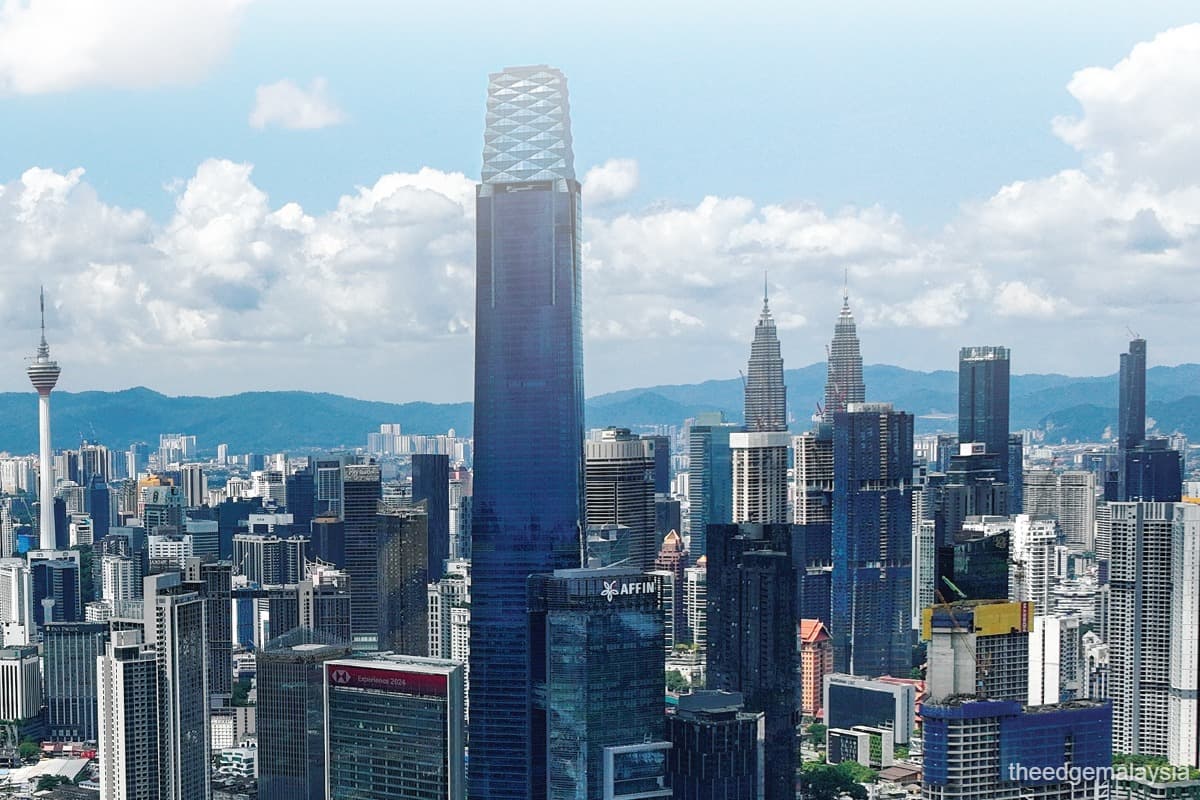
EXCHANGE 106 was touted as the country’s new signature tower when the multibillion-ringgit Tun Razak Exchange (TRX) was launched in 2012 by then prime minister Datuk Seri Najib Razak. But when the 1Malaysia Development Bhd (1MDB) scandal blew up three years later, the construction of the building ran into a problem when the Indonesia-based developer that had pumped in RM1.2 billion could not raise further financing.
This forced the Malaysian government to salvage the situation by coming in as a 51% shareholder in 2017 and to act as the guarantor, enabling the tower to be completed in December 2019 just before the outbreak of Covid-19.
Although Exchange 106 was eventually built, all is not well between the two shareholders who are now locked in a legal dispute, with Indonesia-based Mulia Group alleging that the Malaysian government’s latest move is tantamount to a breach of the Asean Treaty.
The Ministry of Finance (MoF), via its subsidiary MKD Signature Sdn Bhd (MKD), is seeking a court order to take over the 49% stake held by Mulia International Pte Ltd. Mulia Group, in turn, wants the matter to go to arbitration at the International Centre for Settlement of Investment Disputes (ICSID), as provided for under the Asean Treaty.
The Edge has pieced together how the dispute, which has so far been kept under wraps, came about after going through the court documents filed by the two parties.

Background
After the TRX project was announced in 2012 to great fanfare, the government invited Indonesia-based Mulia Group to build Exchange 106. The group, via Mulia International, set up a local entity Mulia Property Development Sdn Bhd (MPD) to undertake the construction.
According to its court filings, Mulia International owner Eka Tjandranegara said he had met representatives of the Malaysian government, including Najib, who wanted him to help with the development of TRX, which had been hampered by adverse publicity surrounding 1MDB. He said he agreed to do it “based on agreements, assurances and representations by the government”.
MPD then bought 3.42 acres of land from KLIFD Sdn Bhd, an indirect wholly-owned subsidiary of MoF, through TRX City Sdn Bhd, which was previously known as 1MDB Real Estate Sdn Bhd.
According to the court filings, Tjandranegara said the group had injected a total of RM1.2 billion into the Exchange 106 project, including land purchase. He also said MPD had transferred RM509 million, of which RM201.4 million was paid directly to 1MDB Energy Holdings Ltd upon instruction of the Malaysian government, for the land acquisition, the filings show. In total, Tjandranegara claimed that the Malaysian government “was able to secure advance and expeditious payment of at least RM577 million (excluding GST) from the Mulia Group” to fast-track the land purchase.
It was subsequently reported that more than RM3 billion was diverted to 1MDB from the TRX project.

Why construction of the tower ran into a problem
According to Tjandranegara, the project was to be done on a “fast-track basis” and Mulia Group agreed to take it on as the government at the time committed to procure at least 50% of the tenants from various government agencies, including Bursa Malaysia, the Securities Commission Malaysia, Khazanah Nasional Bhd, Kumpulan Wang Persaraan (Diperbadankan) and Bank Pembangunan. But this did not happen.
As a result, Mulia Group could not secure external financing prior to starting construction in December 2015. Tjandranegara claimed that another reason for not being able to obtain financing was because of the project’s association with 1MDB. The group had to keep injecting internal funds amounting to RM1.2 billion to support the project, he added.

Government stepped in to help in 2017
To save the project, several meetings were held with MoF, whose help was needed to secure financing for MPD to complete the tower. Eventually two agreements — a sales and purchase agreement and a shareholders’ agreement — were signed on July 19, 2017.
Under the two agreements, Mulia International was to transfer a 51% stake in MPD to MoF unit MKD for RM1. At a stipulated time down the road, it was to buy back the stake from MKD at a stipulated price. If it failed to do so, MKD would then have the right to buy Mulia International’s 49% stake in MPD for RM1.
Essentially what happened was that once MoF/MKD became a 51% shareholder, MPD was able to secure bank financing with the government acting as guarantor. But MoF/MKD was never meant to be a long-term shareholder and therefore a call option agreement was in place requiring Mulia International to buy back the 51% stake.
According to court documents filed by MKD, on Sept 15, 2017, it helped to obtain a RM2 billion Islamic financing facility from HSBC. But over the next few years, Mulia International kept postponing the exercise of the option requiring it to buy back the 51% stake at the pre-determined price, which ranged from RM100 million to RM200 million depending on when the option is exercised.
Under the shareholders’ agreement, Mulia International had to buy back the 51% stake at a predetermined price of RM100 million within two years of the date of the principal financing agreement and RM200 million if the call option is exercised between two and three years.
This did not happen. So, to address the matter, the parties entered into a supplementary agreement in 2022 to extend the call option to June 26, 2023, with a price tag of RM250 million.
Again, nothing happened.
As a result, MoF/MKD is now seeking the court to compel Mulia International to transfer the 49% stake in MPD that would give the government 100% ownership of Exchange 106.
Court data showed that MoF/MKD started legal action in May 2024. Prior to that, Mulia International tried to block MoF from appointing a receiver and manager (R&M) to manage MPD. The appointment of an R&M came after MoF called a default on the MPD loan it had helped to procure (see accompanying story).
In response to MoF/MKD’s claim, Mulia International/Tjandranegara attributed the missed deadline and its request for extension of time to operational hiccups caused by the Covid-19 pandemic. The property group also said it wanted to make the current joint venture with MoF a permanent agreement.
Tjandranegara also claimed that he never agreed to the clause that allowed MKD to buy its 49% stake for RM1 if the option was not exercised, but was assured that it would not be executed and that the clause was put in for “political reasons and good optics”.
The group argues that the dispute should be referred to arbitration administered by ICSID as it involved the Malaysian government and Mulia Group, an investor from Indonesia.
Mulia International/Tjandranegara has described the attempt to take the 49% stake in MPD as a “blatant attempt to expropriate the entire investment (including the fruits, profit and/or yields thereof) without any proper compensation” to the group, “in breach of the Asean Treaty which guaranteed fair and equitable treatment, full protection and security and non expropriation and non nationalisation”.
Mulia International claims that the value of the Exchange 106 project and the land was worth RM5.01 billion as at Oct 26, 2022, and that it had invested RM1.2 billion.
In its affidavit in reply, MoF/MKD said the shareholders’ agreement is not a matter for arbitration under the Asean Treaty and there was “no investor-state dispute within the meaning and scope” of the treaty. It further said that what had happened was a straightforward dispute between two shareholders of a company and that MKD was only seeking to enforce its rights under a contract following the alleged breach by Mulia International.
Shearn Delamore is representing MoF/MKD while Mulia International is represented by Chooi & Co. The case is set to be heard on March 3, 2025.
Back in 2018, then finance minister Lim Guan Eng said MoF’s stake in Exchange 106 was not reflective of the financing it had provided. “They [Mulia Group] did put in some money, a substantial sum, but there was a need for capital injection from MoF to keep the project going,” he told The Edge in an interview.
He also said there was a stipulation that the money forked out by MoF had to be returned after a certain time frame. “If they can’t do that, the whole building belongs to MoF,” he added.
Lim stressed that the government wanted to honour its contractual agreement to provide capital injection for the project, but was also seeking certain guarantees, safeguards and assurance.
Exchange 106, comprising a 92-storey tower and a five-storey annex that includes a retail floor, was the first project to be completed in TRX. It has about 2.5 million sq ft of net lettable area and currently has an occupancy rate of 57%. Ant International, Huawei (its regional office), Accenture, Agoda and Principal Asset Management Bhd are among its key tenants.
A check with the Companies Commission of Malaysia showed that MPD posted a loss of RM170.05 million on the back of RM24.38 million in revenue for the financial year ended Dec 31, 2022. The group had total liabilities of RM2.85 billion and retained losses of RM513.39 million.

Who is Mulia Group’s Eka Tjandranegara?
Mulia Group ventured into the Malaysian market in 2015 when the government announced the development of Exchange 106, the centrepiece of the Tun Razak Exchange.
Despite its involvement in this significant project, there is little information on the privately owned Indonesian company. According to its website, the group is a property developer in Indonesia that was founded in 1982, with most of its projects ranging from luxury hotels to shopping malls and residential property.
The website says Mulia Group specialises in high-rise developments, demonstrated by projects such as Wisma Mulia 1, a 57-storey office tower with a striking reflective blue glass façade in Jakarta. This architectural style bears a resemblance to Exchange 106 in Kuala Lumpur.

In total, the group has six high-rise commercial buildings and a business park — consisting of five office towers, 40-storey hotel Mulia Senayan and a shopping mall in Jakarta. Furthermore, the group owns a renowned beachfront resort in Nusa Dua, Bali, recognised as the largest in the area, with 526 rooms and villas spread across the sprawling 74-acre estate.
Exchange 106 in Kuala Lumpur is the only overseas property project by Mulia Group, the website shows.
It is also involved in the glass, ceramic and metal manufacturing business under PT Mulia Industrindo Tbk, which is listed on the Indonesia stock exchange. Mulia Group was founded by billionaire Eka Tjandranegara with his father and two brothers.
Legal trouble forced one brother, Djoko Tjandra, to flee the country in 2009 for the safer confines of Papua New Guinea, according to various news reports. Djoko fled to Port Moresby, Papua New Guinea, a day before being sentenced to two years’ imprisonment for facilitating the transfer of US$78 million from Bank Bali to one of his companies.
There are no financial details on Mulia Group, whose real estate unit PT Mulialand Tbk was taken private and delisted from the Indonesia stock exchange in September 2007.
Meanwhile, PT Mulia Industrindo, in which Tjandranegara and his family hold 67.25% equity interest, has a market capitalisation of IDR2.04 trillion (RM580 million). In 2023, the group posted a profit of IDR562.629 billion (RM163.56 million) on the back of IDR4.81 trillion (RM1.39 billion) in revenue.
Save by subscribing to us for your print and/or digital copy.
P/S: The Edge is also available on Apple's App Store and Android's Google Play.