

This article first appeared in The Edge Malaysia Weekly on December 30, 2024 - January 12, 2025
IN 2024, the performance of Malaysian semiconductor-related stocks was a tale of two halves, reflecting the sector’s exposure to global economic shifts and geopolitical uncertainties.
In the first half, technology stocks generally delivered positive returns, driven by the artificial intelligence (AI) boom sparked by US chipmaker Nvidia, increased investments in advanced technologies and optimism surrounding the launch of the National Semiconductor Strategy (NSS).
For example, the share price of outsourced semiconductor assembly and test (OSAT) firms Inari Amertron Bhd (KL:INARI) and Malaysian Pacific Industries Bhd (KL:MPI) logged notable gains of 24% and 38%, respectively, in the the first six months of the year.
Unfortunately, that did not last. Many tech stocks entered a correction in the second half, rattled by macroeconomic concerns, persistent trade tensions, a stronger ringgit and softer global consumer demand, all of which weighed on the sector’s earnings prospects.
Inari’s stock declined 17%, while MPI experienced a steeper drop of 35% during theperiod. On a year-to-date basis, the divergence became clear — while some companies remained in positive territory, others ended the year in losses.
Despite these fluctuations, the semiconductor sector continued to expand in terms of market size, supported by substantial foreign direct investments and positive business sentiment.

Global technology giants demonstrated strong confidence in Malaysia’s role in the semiconductor supply chain. US chip manufacturer Intel Corp invested US$7 billion (RM31.3 billion) in advanced packaging facilities in Penang, while Germany’s largest semiconductor manufacturer Infineon Technologies AG committed RM25 billion to expand its fabrication capacity.
Google, Microsoft and Oracle also announced billion-dollar plans to set up their data centre and cloud facilities here.
The resilience of the local tech sector was further reflected in industry sentiment. According to the Malaysia Semiconductor Industry Association (MSIA), 53% of companies in the electrical and electronics (E&E) and semiconductor sectors expressed optimism about their business prospects for the fourth quarter of 2024.
Backed by government initiatives such as the NSS and sustained foreign investments, Malaysia’s semiconductor sector is projected to grow at an annual rate of 11.41% from 2024 to 2029, reaching an estimated market size of US$27.48 billion by 2029.
The NSS, unveiled at SEMICON Southeast Asia 2024 on May 28, outlines five ambitious headline targets as part of a road map to position Malaysia as a key player in the global semiconductor industry. Spanning three phases over the next decade, the strategy aims to drive growth, innovation and long-term competitiveness in the sector.
To kick-start its implementation, the government has allocated RM25 billion in targeted incentives under the NSS.
However, following the announcement of Budget 2025 in October, reactions from industry players have been mixed.
While some industry leaders believe the government is taking a meaningful step towards strengthening the country’s role in the global semiconductor supply chain, others have raised concerns about the lack of clarity on the previously announced RM25 billion allocation for the NSS.
Are the goals set out in the NSS highly ambitious? Does Malaysia have the framework, resources and policy execution capabilities to turn this long-term vision into a tangible reality?
NSS should be creative and bold
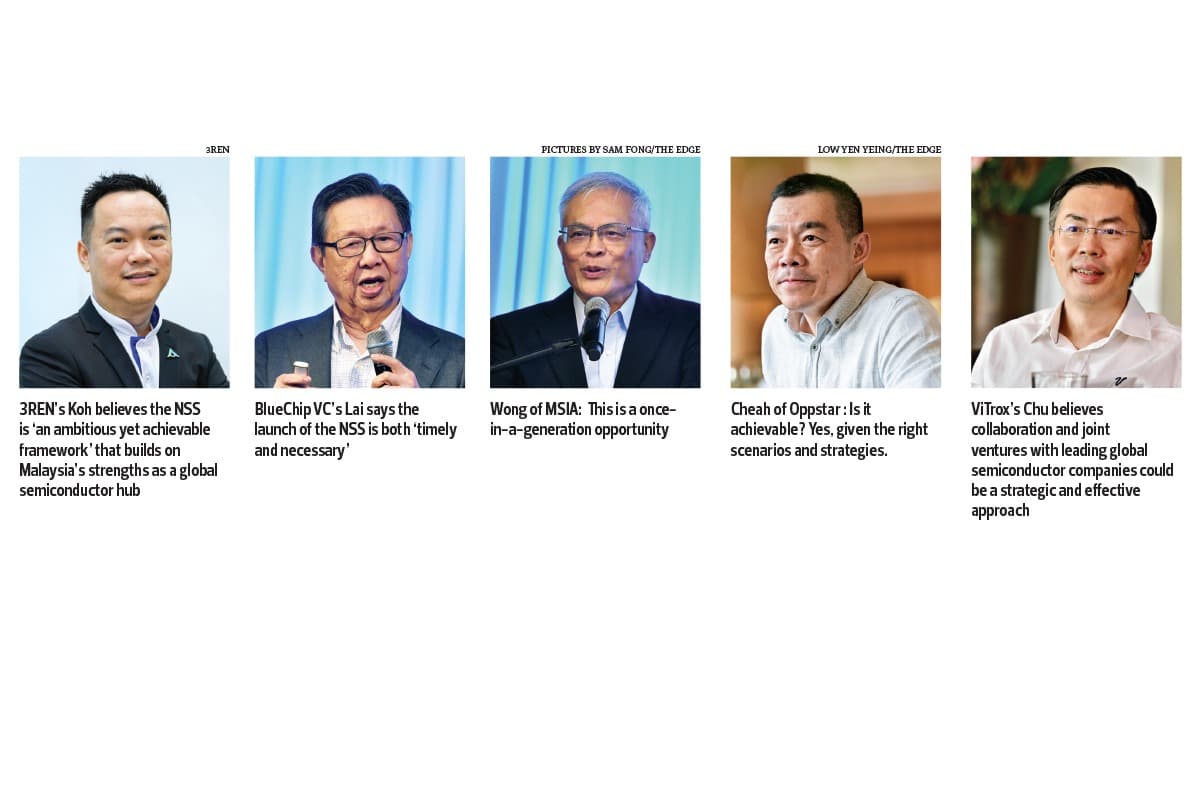
According to Malaysia Semiconductor Industry Association (MSIA) president Datuk Seri Wong Siew Hai, the NSS should be creative, bold and ambitious.
“As the new oil, the semiconductor industry can and should be Malaysia’s future engine of growth. The industry has grown by leaps and bounds over the past 50 years without much government intervention and investment.
“Malaysia can be a semiconductor powerhouse if the whole-of-nation approach can be galvanised to maximise and capture this immense market. The opportunity is now and Malaysia needs to work harder, faster and smarter to stay ahead of competition,” he tells The Edge.
Wong says timing is everything in the semiconductor industry. “Many countries such as the US, China, Taiwan, South Korea and Japan have announced equally ambitious plans to strengthen their own semiconductor ecosystem. Therefore, Malaysia must move quickly in all areas to keep pace with the competition.
“This is a once-in-a-generation opportunity and the industry is at the inflection point whereby Malaysia can leapfrog our competitors and emerge stronger as a top-three semiconductor nation. We can and we need to do more as our country has the capability and the talent to achieve this vision,” he adds.
However, Wong is reluctant to describe the tech stocks’ performance as a year of two halves.
“Using E&E exports as a barometer of the industry, the sector has performed steadily throughout this year, without a significant divergence between the first half and second half. I would like to think that 2024 has been a remarkable year for Malaysia’s E&E sector, characterised by consistent growth,” he notes.
For perspective, Malaysia’s E&E exports in the first quarter of 2024 amounted to RM134 billion. They rose to RM148 billion in the second quarter, and further increased to RM156 billion in the third quarter.
This consistent quarter-on-quarter growth illustrates a steady upward trend. From January to October 2024, the total E&E exports reached RM491 billion, a 1.5% increase from RM484 billion during the same period last year.
Wong is hopeful that the sector will breach RM600 billion for the full year, marking it the highest export figure ever achieved by the industry in Malaysia.
Moreover, the sector continues to attract significant investments. From January to September 2024, approved investments for the E&E sector totalled RM47 billion, accounting for 53% of the total approved investments in manufacturing.
Since January 2021, the E&E sector has attracted an impressive RM309.7 billion in approved investments. Wong observes that these investments reflect strong confidence in Malaysia’s position as a global E&E hub and will drive further growth in exports and employment over the next few years.
Success of NSS depends on timely execution
BlueChip VC Sdn Bhd founder Datuk Seri Lai Pin Yong believes the launch of the NSS is both “timely and necessary”.
The ex-Intel semiconductor veteran points out that Malaysia’s semiconductor industry has historically focused on OSAT, which was driven mainly by foreign companies over the past five decades.
However, the global semiconductor landscape is rapidly evolving, and without scaling up the supply chain to include high-value areas such as integrated circuit (IC) design, AI and advanced packaging, Malaysia risks being outpaced by other Asian nations.
“The timing of the NSS also aligns strategically with the current geopolitical environment. The intensifying technology tensions between the US and China, coupled with the decoupling of global supply chains, present a rare and significant opportunity for Malaysia.
“As a neutral player with a reputation for political stability and balanced diplomacy, Malaysia is well-positioned to attract foreign investment and strengthen its role in the global semiconductor ecosystem. This is a critical moment that the country must capitalise on to remain competitive,” Lai tells The Edge.
He is of the view that the NSS offers a clear road map to elevate the semiconductor sector, but success will depend on timely execution, strategic collaboration and the ability to address gaps in talent, infrastructure and innovation.
While 2024 presented a volatile landscape for Malaysia’s semiconductor sector, it strong performance and strategic direction suggest a positive outlook for the coming years.
Lai says the NSS’s goal to train 60,000 engineers underscores the shortage of professionals in advanced roles such as IC design and high-end manufacturing. In 2024, 50.83% of upper secondary students enrolled in science, technology, engineering and mathematics (STEM) streams, an increase from 40.95% in 2021.
“While Malaysia has made commendable strides in increasing STEM enrolment and recognising the need for a skilled workforce to support the NSS, further efforts are essential. By prioritising education reforms, fostering industry collaboration and investing in infrastructure, Malaysia can build a robust talent pipeline to meet the ambitious goals of the NSS,” he adds.
NSS goals attainable
ViTrox Corp Bhd (KL:VITROX) co-founder and president Datuk Chu Jenn Weng acknowledges that 2024 has been a challenging year filled with uncertainties and volatility that have affected the performance of semiconductor-related companies.
“As far as ViTrox is concerned, it has shown quarterly revenue improvement since the beginning of the year. This shows the company’s resilience and adaptability amid a challenging business environment due to trade tensions and a slowing economy. We believe the worst is over and are cautiously optimistic that the next three to six months will continue to show improvement,” he says.
Chu believes the NSS’ ambitious goals are attainable if there are cohesive efforts to strengthen the local semiconductor ecosystem through innovative policies, incentives and co-investment in talent pipeline development and technology development.
“Compared to the leading semiconductor firms both in the OSAT and ATE (automated test equipment) sectors around the world, Malaysian companies still need to be more prominent in terms of revenue and profits. Hence, the NSS should focus on supporting these companies to move up the value chain and be competitive in emerging areas such as advanced packaging and AI,” he says.
To accelerate Malaysia’s semiconductor ecosystem and secure a stronger position in the emerging technology supply chain, Chu says collaboration and joint ventures with leading global semiconductor companies could be a strategic and effective approach.
Oppstar Bhd (KL:OPPSTAR) co-founder and joint CEO Cheah Hun Wah believes that the rollout of NSS is important, given the fact that semiconductors have become a strategic resource in today’s world.
“Many major countries around the world, including the US, China, Japan, Germany, South Korea and India, are looking to aggressively support their semiconductor industries. Developing countries like us, Vietnam and India are also jumping in. What does this mean?
“To me, to retain our relevance, the NSS is something that is needed to retain and improve our standings and our likelihood to succeed. We are competing with leading nations, as well as hungry developing nations. If we do not up our game, others will and we will be left behind,” he says.
On whether the NSS will be able to achieve its intended outcome, Cheah says this is subject to many variables.
“Is it achievable? Yes, given the right scenarios and strategies. Is the NSS realistic? Well, to many industry veterans, the goals set look far-fetched, but not impossible. My view is that the NSS’ goal post may need [continued fine-tuning] as we progress and learn about our strengths and [shortcomings].”
Cheah adds that the NSS should not be too simplistic to chase what is trendy.
“(First,) it was smart phones, then IoT (Internet of Things), Industry 4.0 and 5G; and now it’s AI. If we chase one, we might miss future opportunities. Thus, the NSS should emphasise the importance of not just chasing current trends but building long-term capabilities in leading semiconductor technologies.
“This includes focusing on areas such as design, fabrication, advanced packaging and creating end-user solutions. By developing these capabilities, Malaysia can be better prepared for future technological waves,” he reiterates.
While the NSS is a positive move by the government, Cheah admits that the infrastructure for improving academic capabilities in semiconductors is not something that can be achieved overnight.
“It is a journey which we need to be on for the long run in both investment as well as continuous talent development. We hope NSS will be a good first step that sets out the foundation and momentum for long-term success.
“In the immediate future, there is a limit to what our local universities are able to offer. They will still need a lot of industry support and it would be beneficial for the government to continue their support for industry-academia initiatives,” he explains.
A year to remember
3REN Bhd (KL:3REN) executive director and CEO Koh Dim Kuan sums up 2024 as “a year to be remembered” for Malaysia’s semiconductor sector with several interesting developments that present both challenges and opportunities.
For 3REN, 2024 has been a good one filled with exciting developments following its listing on the ACE Market of Bursa Malaysia in November.
Koh says the NSS is a bold and strategic initiative to position Malaysia as a key player in the global semiconductor industry. However, the industry faces several structural challenges that could hinder the realisation of these goals, with Malaysia’s talent pipeline being one of the key areas that need to be addressed in order to meet the growing demand for specialised skills in IC design, advanced chip testing and AI integration.
Besides, research and development (R&D) investments remain relatively low compared with leading semiconductor hubs and existing manufacturing infrastructure. As such, he recommends that immediate actions focus on three key areas.
First, greater emphasis on education and vocational training is critical to developing a steady pipeline of semiconductor-ready talent. Second, industry-academia collaboration must be strengthened to align skill development with real-world requirements. Finally, enhanced government incentives for R&D will encourage innovation in high-value semiconductor applications.
Koh highlights that the global adoption of AI has transformed the semiconductor industry, driving demand for chips optimised for machine learning, deep learning and edge computing.
While Malaysia is well-positioned in the global supply chain, it has yet to fully capitalise on AI-driven innovation.
“The NSS can bridge this gap by promoting AI-specific research initiatives, incentivising start-ups in the AI-semiconductor space and fostering collaborations with global leaders in AI technologies,” he says.
Koh believes that the NSS is “an ambitious yet achievable framework” that builds on Malaysia’s strengths as a global semiconductor hub, but its success will depend on effective implementation, sustained investments in talent and R&D, and fostering partnerships with key global players.
“I think addressing challenges such as talent shortages and the need for advanced manufacturing capabilities, which include wafer foundry and advanced packaging, will be the most crucial parts for NSS.”
While challenges persist, Koh believes Malaysia’s semiconductor industry has the resilience and potential to achieve the NSS’ vision.
“By actively contributing through our innovation, infrastructure development and workforce training, we are part of this transformative journey [of] reinforcing Malaysia’s position as a leader in the global semiconductor ecosystem.
“We look forward to the long-term outlook of Malaysia’s semiconductor supply chain as it moves up the value chain and establishes itself as a regional powerhouse,” he concludes.
Save by subscribing to us for your print and/or digital copy.
P/S: The Edge is also available on Apple's App Store and Android's Google Play.