

This article first appeared in The Edge Malaysia Weekly on December 30, 2024 - January 12, 2025
In the last six decades, Malaysia has experienced five major rice crises: 1972-73, 1999, 2008, 2020-21 and 2023. On each occasion, Malaysia’s policy responses were mainly quick fixes in nature rather than promoting structural reformation. This stance led to solutions that were quick to produce results but did not improve the sector’s resilience.
From time to time, the country saw the recurrence of food crises, which showed signs that they could develop again. The anatomy of these crises is more or less similar. The catalysts of the crises were largely imbalances in the fundamentals of supply and demand. However, technical factors, which mainly concern the herd behaviour of the market participants, have determined the severity of each crisis.
The 1972-73 crisis was triggered by supply constraints due to dry weather in grain-producing regions in the Soviet Union and US. In addition, the newly formed Organisation for Economic Co-operation and Development (OECD) flexed its muscles by increasing the petrol price, resulting in the high cost of fertiliser in rice-producing countries. These two market forces caused prices to surge beyond the average range.
In 1998, the Asian financial crisis triggered a price hike in the international market that was later transmitted to the local market. In the 2008 crisis, speculative activities in commodity futures caused extreme price hikes, when the price reached an all-time high of US$1,015 per metric ton (pmt) in April 2008, causing panic in the domestic market.
The market reaction to each of the crises was quite similar. The price spike encouraged stocking up among rice traders who wanted to take advantage of the short-term price differences to make a quick profit. Hoarding created artificial deficits, causing price escalation loops and more imports were needed to stabilise the situation.
The big difference between the price of local rice, which was supported by a price guarantee scheme, and imported rice was another push factor for hoarding. In 2008, the government allocated RM4.6 billion in subsidies or RM650 pmt to millers, including Bernas’ millers, to produce ST15% grade rice for low-income consumers.
Despite the subsidies, this rice was not available in the market, indicating hoarding activities were at work again. As in the 1972-73 crisis, the low-quality rice was mixed with high-quality rice to take advantage of the high price during the crisis.
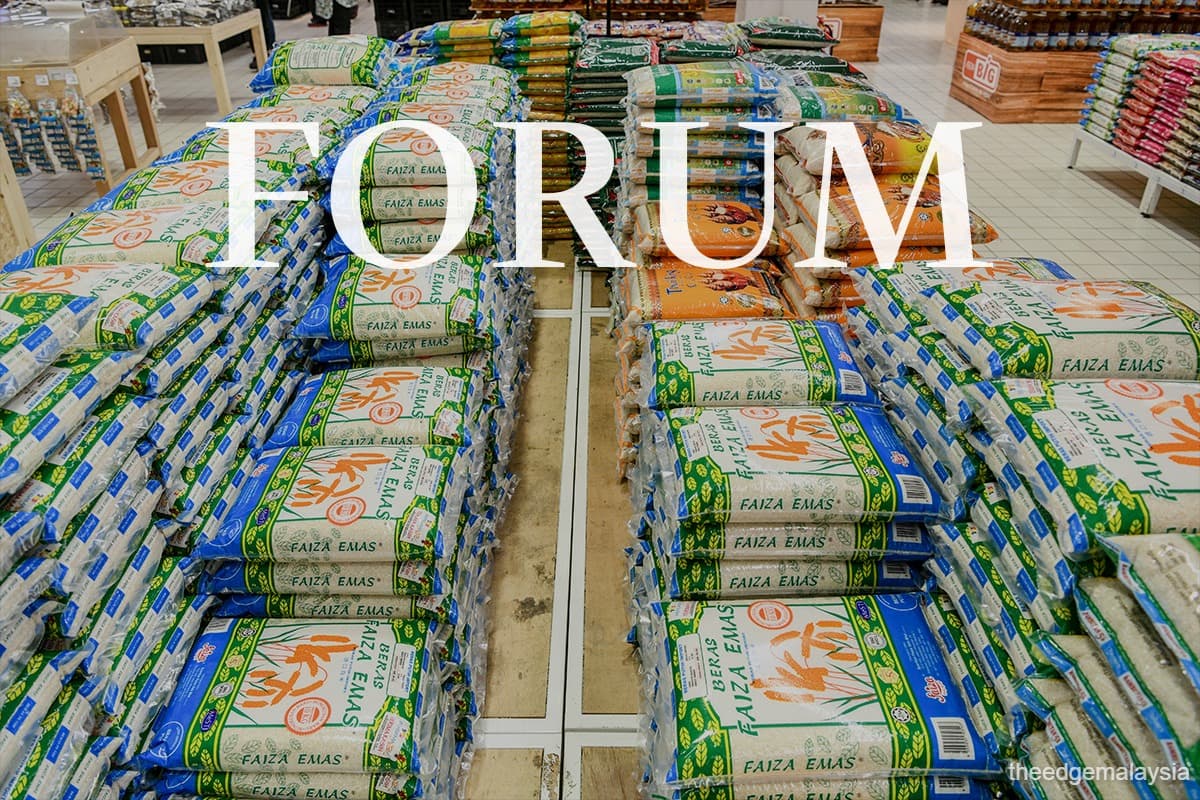
Similar market behaviour was repeated in 2023 but this time it had lasting ramifications. Hoarding was rampant, causing a months-long hiatus in the supply of local rice. Due to the price difference — local rice was fixed at RM2.60/kg compared to RM3.60/kg for the imported variety — local millers and traders were induced to mix them both for profit. Attempts to disallow rice mixing failed. Hence, the market is now left with only one choice of local rice, that is, “mixed rice”.
The latest crisis has unmasked the structural problems besetting the rice industry. First, control of the ceiling price for local rice has failed to protect consumers from the increase in the price of imported rice, which rose by more than one-third. In past crises, the situation normalised when imports, which were in the range of 20% to 30% of the local requirement for rice, made up for the shortfall in the supply. However, in 2023, the share of imports compared to total consumption increased to almost 40% as domestic production shrunk due to climatic and institutional factors. Hence, the overwhelming inflow of imported rice has made the retail price control mechanism ineffective.
Second, the increase in demand for local rice has resulted in an increase in the price received by the farmers. This is currently at RM1,800 pmt, whereas the guaranteed minimum price is RM1,300 pmt. With the retail price remaining at RM2.60/kg, the millers suffer losses and have to revert to mixing rice and resort to temporary hoarding in order to get a good price for their produce. In short, price control cannot accommodate the dynamics of the market and encourages market malpractices among the sector’s participants for their own survival, all at the expense of consumers.
Third, these malpractices have caused a homogeneous type of rice to be available for all consumers; that is, “mixed rice”. This is clearly a failure of the system where it does not cater for the diverse needs of the population. Each subsector of the population requires rice of a different quality to meet their nutritional needs and consumption preferences. For instance, young children and people with illnesses may need certain types of rice. Similarly, rice for the food and beverage sector may vary, depending on the consumer taste and preference.
Fourth, as has been written in many research reports, including by the World Bank, extensive market control not only causes serious market distortions but also deindustrialisation. Symptoms of the latter are overwhelming. They include productivity decline, absence of new players at all levels (farms, millers and importers), stalling of the emergence of new SMEs, minimal value addition and overall sluggish growth. This scenario is in contrast to that in our neighbouring countries, which are enjoying rapid growth and innovation. India, for instance, has succeeded in becoming the world’s largest rice exporter within the last decade with minimal protection from the government but strong support with digital applications introduced in the industry.
The popular quick fix of relying on imports reduces the deficit in the local supply but does not rectify the structural deficits of the industry. For sure, higher imports will benefit the monopoly holder Bernas while weakening the already underperforming rice industry.
Structural changes are imminent and unavoidable along the supply chain. Reform is arduous in the short term but beneficial in the long term. The reforms urgently needed are:
First, the monopolistic environment in the input segment and import market needs to be dismantled to encourage young entrepreneurs to enter the sector, allow competition and foster digital innovations in the supply chain.
Second, imports should be used as an instrument for protecting the domestic industry and revenue generation. High import tariffs may foster investment in local production in the long term.
Third, the input subsidies regime has outlived its usefulness as yield is on the way down and the agency responsible for distribution is rife with inefficiencies and corruption after 50 years in existence. Output subsidies are relatively effective as they allow farmers to decide for themselves the optimum combination of inputs that is best for their farms while minimising incidental costs to the government.
Fourth, the social support and capacity-building of the farmers have to be increased in all dimensions. These include better infrastructure and infostructure, better education and health services, entrepreneurship programmes for the young, training in and extension of new digital technologies, cooperative management and agroecology, among others.
Fifth, small-scale farmers have to be empowered with small farm-friendly machines, rice mills and gadgets that are smart, efficient and sustainable to enable them to benefit from value addition.
Sixth, collective effort should be encouraged among farmers through cooperatives for better bargaining power and sharing of resources.
Seventh, paddy and rice prices should be floated to ensure a competitive market and make farmers more resilient. To protect farmers from the market’s vagaries, the government should implement alternative approaches such as deficiency payments, a price stabilisation fund, insurance and a diversification programme.
In a nutshell, it is ripe now to treat rice like any other commodity; that is, as an economic and not a political commodity.
Professor Datin Paduka Fatimah Mohamed Arshad ([email protected]) holds the food security chair at Universiti Putra Malaysia
Save by subscribing to us for your print and/or digital copy.
P/S: The Edge is also available on Apple's App Store and Android's Google Play.