


This article first appeared in Wealth, The Edge Malaysia Weekly on December 30, 2024 - January 12, 2025
Bursa Malaysia RAM Capital Sdn Bhd (BR Capital), a joint venture between Bursa Malaysia Bhd and RAM Holdings Bhd, allows the man in the street to invest directly in debt paper issued by mid-tier companies with an annual revenue of RM50 million to RM500 million. This initiative opens the door for retail investors to easily access a much broader universe in the local bond market, including debt instruments issued by the subsidiaries of public-listed companies and rated by RAM Holdings.
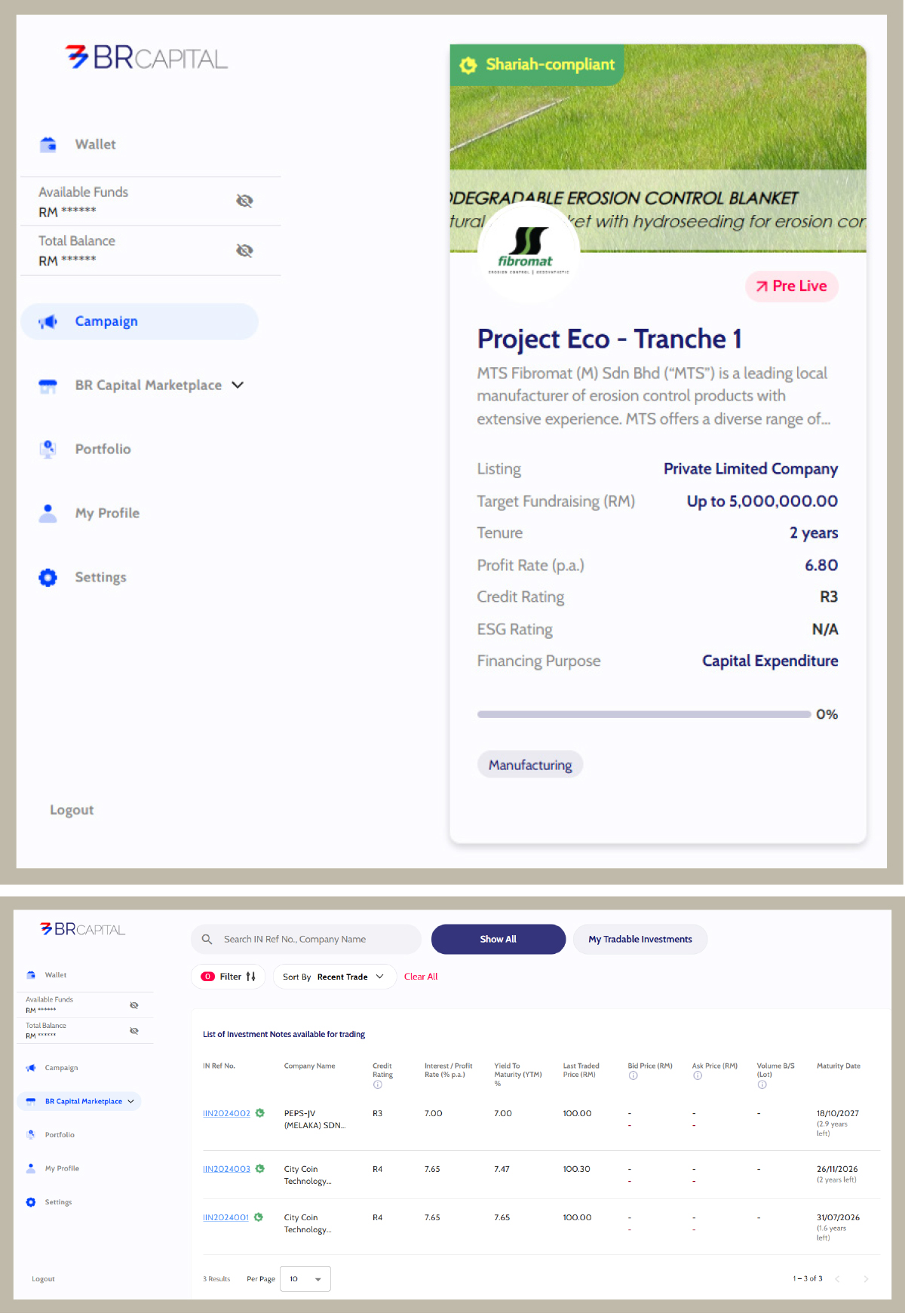
Launched in December last year, BR Capital, termed as a “debt fundraising platform”, allows investors to put their money in investment notes for returns of 7% to 7.65% per annum (as at Nov 25), with a tenure of two to three years. The minimum investment amount is a mere RM100.
Investment notes are debt paper akin to bonds. The key difference is that bonds are regulated by the Securities Commission Malaysia (SC) and Bank Negara Malaysia under different sets of laws, including the Capital Markets and Services Act 2007 and Central Bank of Malaysia Act 2009. Most investment notes, however, are issued through peer-to-peer (P2P) financing platforms registered and regulated under the SC’s Guidelines on Recognised Markets. Both are debt paper that provide investors with fixed income.
At the time of writing, the platform issuers are PEPS-JV (Melaka) Sdn Bhd, a wholly-owned subsidiary of automotive parts manufacturer EP Manufacturing Bhd (KL:EPMB), and City Coin Technology Bhd, a subsidiary of integrated operator of self-service laundry outlets City Coin Holdings Sdn Bhd. MTS Fibromat (M) Sdn Bhd, the subsidiary of erosion control product manufacturer, supplier and installer Fibromat Bhd (KL:FBBHD), is in the process of raising funds through the platform.
“As far as traction is concerned, we have seen encouraging interest from both issuers and investors since going live in December 2023. We are targeting to host several campaigns in the coming months,” says BR Capital CEO Ng Keng Sing.
BR Capital is one of the 13 P2P financing platforms licensed by the SC but it has a unique value proposition, unlike its peers, he and Chong Kwee Siong, technical director of RAM Rating Services Bhd, tell Wealth.
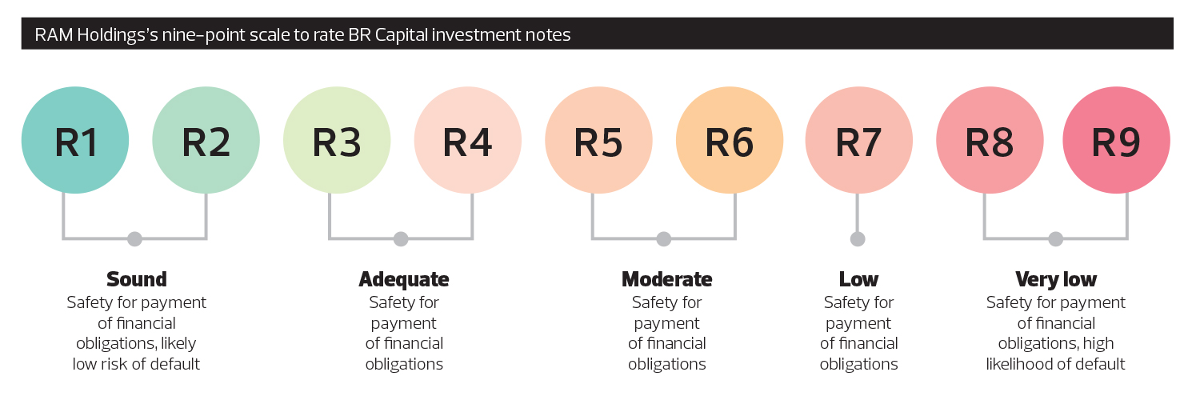
For one, investment notes listed on the platform are rated by RAM Holdings, an independent credit rating firm established in 1990 and one of the two credit rating agencies (the other being Malaysian Rating Corp Bhd) approved by the SC. Most, if not all, of its P2P peers rate their respective investment notes based on its proprietary rating system.
While BR Capital welcomes all types of businesses to raise funds via its platform, it sets a minimum financing amount of RM5 million with a minimum tenure of a year, suggesting that it is targeting bigger companies that are looking for larger amounts of financing.
Why would Bursa Malaysia and RAM Holdings launch BR Capital? Ng says it is in line with Bursa’s aspiration of evolving into a multi-asset exchange that facilitates not just share trading, but other asset classes too.
“Bursa Malaysia has evolved into a multi-asset exchange, offering a diverse range of investment opportunities and services. As one of the new opportunities and services, the BR Capital platform provides an alternative avenue for both listed and unlisted small and mid-sized companies to raise funds through the issuance of credit-rated investment notes while providing more fixed income investing opportunities to all investors, including retail players,” he says.
As for RAM Holdings, the objective is to facilitate the growth of the credit rating industry and debt market. Chong says the industry and market need more participation from mid-tier companies and retail investors to become more robust.
Reviving public interest in the debt market
When asked, Ng agrees that Bursa Malaysia has observed and learnt some lessons from the Exchange Traded Bond and Sukuk (ETBS) initiative that has not garnered much traction in the market since it was launched in January 2013.
The first issuer on the ETBS was DanaInfra Nasional Bhd, the government’s fundraising arm for the Klang Valley mass rapid transit project. Based on news reports, the RM300 million retail sukuk was Malaysia’s first publicly listed fixed income instrument for retail investors and the first sukuk in the world to be traded on an exchange.
According to Bursa Malaysia’s website, DanaInfra’s three ETBS issuances offered investors an annual return of 3.74% to 4.58% when it was issued, with tenures ranging from seven to 10 years and a minimum investment amount of RM1,000. These issuances were backed by the government of Malaysia, which partly explains why the rates were slightly higher than fixed deposit rates.
Today, Bursa Malaysia’s official website shows only three issuances on the ETBS, with the sole issuer being DanaInfra. One of the three issuances, which has not matured, has very little trading activity, according to Bloomberg, partly reflecting a lack of investor interest.
Ng says the lack of interest in ETBS could be due to various factors. Bond issuers with good credit ratings looking to raise RM1 billion, for instance, would opt to place their bonds over-the-counter (OTC) through dealers to a few institutional investors. Doing so would be more cost and time effective compared with raising funds through the ETBS.
ETBS involves the participation of retail investors. As such, its issuers are required to draft a prospectus for the SC’s approval, which takes additional time and effort. They will also need to run roadshows and campaigns to educate investors on the company to raise funds from the public.
This means issuers may find the process more challenging from an administrative standpoint. If an issuer can raise RM1 billion through OTC from a handful of investors, it would not want to wait the 14 days needed for retail investors to participate, says Ng.
On the other hand, smaller companies wanting to raise, let’s say, RM50 million could view the ETBS option as costly. The fees they need to pay for legal and advisory services are high on the back of the much lower amount of funds they intend to raise.
As for retail investors who have a higher risk appetite, the returns of the ETBS issuances may not be attractive. Ng observes that they usually ask for at least 6% to 8% return per annum, benchmarking the rate of a debt paper against returns generated by fixed deposits, Amanah Saham Bumiputera and the Employees Provident Fund.
Hence, BR Capital works on a different model, clearly targeting mid-tier companies and retail investors. It has a more streamlined process for those companies to raise funds through the issuance of investment notes, making it faster and less costly.
For instance, large companies wanting to raise funds by issuing bonds through the OTC market would need to engage several parties, such as an investment bank, rating agency and trustee for their services. All this is taken care of under one roof at BR Capital, making the process faster and less costly.
“BR Capital works on a non-intermediated basis, whereby issuers can come directly to our platform to apply for financing. The same applies to investors, who can register and invest directly on our platform, very easily. There is no need to go through an intermediary, such as a broker,” says Ng.
He says the whole fundraising process takes about two to three months, a little quicker than going through the OTC market. It is fast also because the firm only facilitates the issuance of “plain vanilla debt paper”, which are debt paper with a simple structure to fund a company’s business needs, such as for working capital, refurbishment, building a factory and so on. The companies borrow the money for those purposes and pay investors a fixed rate of return plus principal over a period.
Another reason that mid-tier companies are engaging BR Capital is because their owners need funding for business expansion, but are not willing to dilute their shareholdings.
Growing the mid-tier company segment in bond market
From the perspective of RAM Holdings, it emphasises creating a more vibrant debt market, says Chong.
It is partly due to historical issues that mid-tier companies are not as active as their bigger peers in the debt market, which is largely dominated by the OTC market. Other than funding cost, it is because institutional investors are more risk averse.
These institutional investors, such as fund managers and insurance companies, tend to look for bonds issued in large amounts and are highly rated, which offer lower returns but are more secure, he says.
As a result, the demand for debt paper offered by mid-tier companies with relatively higher rates but are less secure is not strong. Such a situation discourages them from entering the bond market and issuing securities with a relatively lower credit rating.
“The credit spectrum in the Malaysian bond and sukuk market was wider in the 1990s, when issues rated BBB or A were not uncommon. However, investor appetite for lower investment grades disappeared after the Asian financial crisis,” says Chong.
However, it also means that the Malaysian debt market can grow further if there is a platform such as BR Capital to address those issues.
“Since 2017, total annual issuances of corporate bonds and sukuk have ranged between RM100 billion and RM120 billion. The outstanding amount stood at about RM860 billion as at Nov 28, 2024. Almost 92% of the rated bonds and sukuk carry a rating of AA3 or higher,” he says.
“There is a relatively narrow investor base for bonds and sukuk, which comprise mainly institutional and sophisticated investors, which tend to prefer higher rated paper, even though the yields may be lower. The issuance size of bonds and sukuk has become much larger over the years, commonly at RM500 million or RM1 billion today.
“Thus, smaller companies have found it challenging to access the bond market given their small funding despite a decent credit profile. Retail investors have also been missing out on the opportunity to invest in the bond market to a certain extent, due to the high minimum investment amount.”
Chong hopes BR Capital can broaden the investor base of the debt market by including retail investors and offering smaller lot sizes and higher returns that match their needs. On the other hand, mid-tier companies can pay a reasonable sum to raise funds by issuing debt paper through the platform.
Save by subscribing to us for your print and/or digital copy.
P/S: The Edge is also available on Apple's App Store and Android's Google Play.