

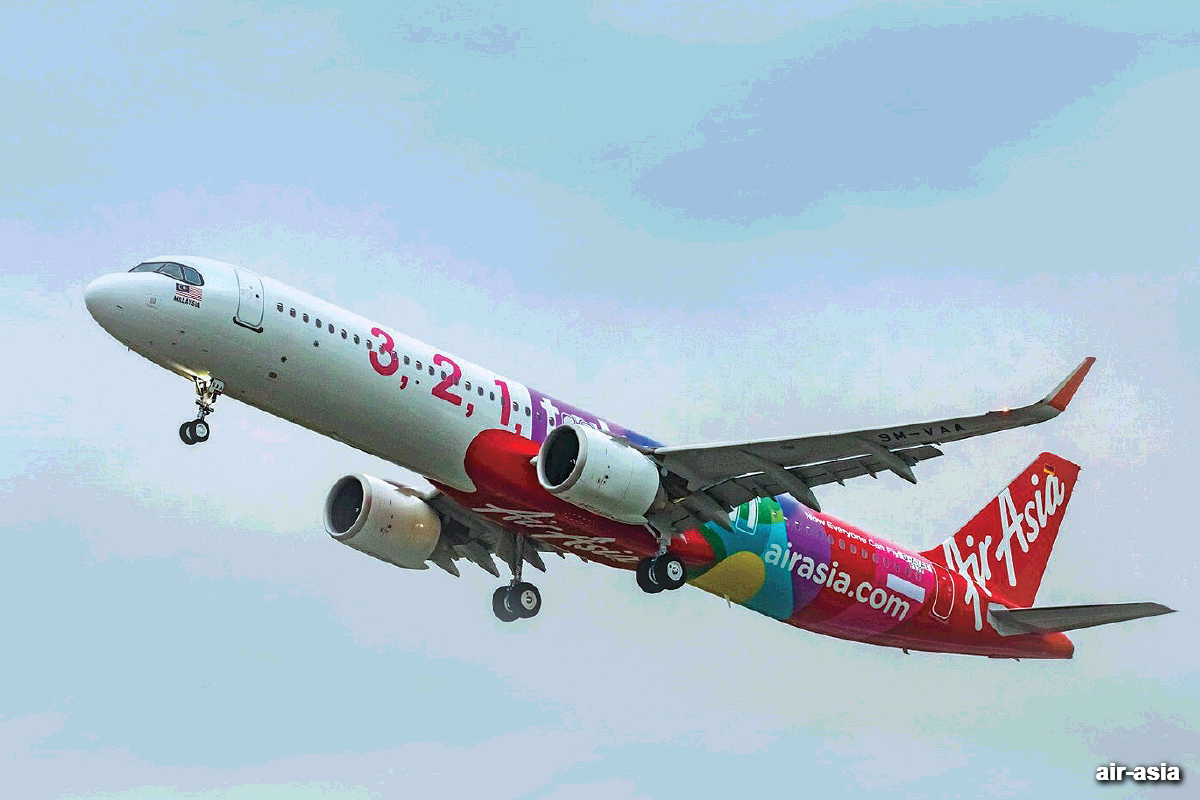
This article first appeared in The Edge Malaysia Weekly on December 30, 2024 - January 12, 2025
Most of the demand for carbon credits are currently voluntary, unless the entity is required to pay a carbon tax. Even then, there is a limit to the amount that can be offset via carbon credits from voluntary carbon markets.
There is an emerging source of demand for carbon credits that comes from mandatory requirements though — global airlines.
The aviation sector accounted for 2% of global energy-related emissions in 2022, and it is a fast-growing source of emissions. To address this, the International Civil Aviation Organization (ICAO) introduced the Carbon Offsetting and Reduction Scheme for International Aviation (Corsia) in 2016, which caps emissions of international flights by requiring airline operators to report and reduce emissions once it exceeds the baseline (85% of 2019 levels).
After each three-year compliance period, starting from 2024, airline operators have to purchase Corsia-eligible carbon credits to offset any increase in emissions that they cannot reduce via other actions. Malaysia volunteered to be part of the first phase, ending in 2026, alongside 114 other countries.
Based on ICAO’s forecast of air travel, the emissions threshold will be breached by the end of 2024, thus kicking off global airlines’ Corsia commitments.
“ICAO tracks three long-term growth scenarios: low, medium and high growth. Under every single scenario, the industry is expected to exceed the baseline, and it’s just a question of by how much. Based on its forecast, we are actually on the high-growth trajectory right now, so the amount that we exceed the baseline is likely to be on the high side,” says Yap Mun Ching, chief sustainability officer at Capital A Bhd.
Yap is a member of ICAO’s Committee for Aviation Environmental Protection’s working group on Corsia and the chairperson of the National Corsia Task Force.
Essentially, this means Malaysian airlines that fly global routes — as well as airline operators around the world — will be scouting for Corsia-eligible carbon credits by 2028, which is when they are expected to complete their reporting and offsetting requirements for the first phase of Corsia.
Corsia’s standards for carbon credits are known to be strict. Only in November did it approve four more carbon standards — including Gold Standard and Verra — for participation in Corsia. Even then, not all methodologies are considered Corsia-eligible.
Another bottleneck for airlines to secure Corsia-eligible credits is that from 2024 onwards, carbon credits sold for Corsia purposes must receive authorisation from the country of issuance. That is because Corsia is used to offset emissions of international flights and thus, cannot be used by any country to meet their own climate targets.
“Each government is now protecting what it has to make sure it can fulfil its nationally determined contribution requirements [to reduce emissions]. If they have extra, they will approve it to be sold to another country or for Corsia,” says Yap.
No country has done it so far for Corsia, except for Guyana, which has issued the only Corsia-eligible carbon credits. A total of 7.14 million credits were issued (from its 2021 performance), and 2.5 million of these were sold at a floor price of US$20 per tonne in 2022. In February, 4.64 million credits were available in the international market. According to the ART registry, where the carbon credits are listed, all the available credits have been issued but not retired.
“ICAO has approved four more eligible emissions programmes, so there should be more projects. There are probably around 50 to 60 projects in Asean that meet the sustainability criteria, but there is no indication yet whether they will have authorisation [from the governments] and how many units will be authorised,” says Yap.
In Malaysia, there are no Corsia-eligible carbon credits yet. She says the authorisation process for carbon credits that can be used for Corsia purposes is already being explored by the government. However, it is not known what limit the government might impose on the amount of locally produced carbon credits that can be sold overseas or used for Corsia.
“But our challenge right now is that our projects don’t even meet the sustainability criteria [of Corsia]. Corsia requires permanence of 100 years, which for nature-based projects means your land title has to be for that long,” says Yap.
“And there are other components to prevent leakages, meaning that if you protect this tract of forest, does it lead to more deforestation on other tracts of forests? You have to show that your scheme does not lead to that.”
Guyana was able to meet these strict requirements because it is a national scheme by the government, covering 85% of forests in the country.
Even carbon credits generated from the Kuamut Rainforest Conservation Project in Sabah, which was auctioned on the Bursa Carbon Exchange earlier this year, is not Corsia-eligible because it uses a project-level baseline instead of the jurisdictional approach, like Guyana.
An opportunity for Malaysia’s carbon project developers
Malaysia recognises the demand for carbon credits. States like Sarawak have amended laws to enable the application of carbon trading licences, and a National Carbon Market Policy is in the works.
To meet the demand from airlines, however, it is important for carbon project developers to understand what is demanded by Corsia. Even if their projects are verified by Verra or Gold Standard, it does not mean it is Corsia-eligible.
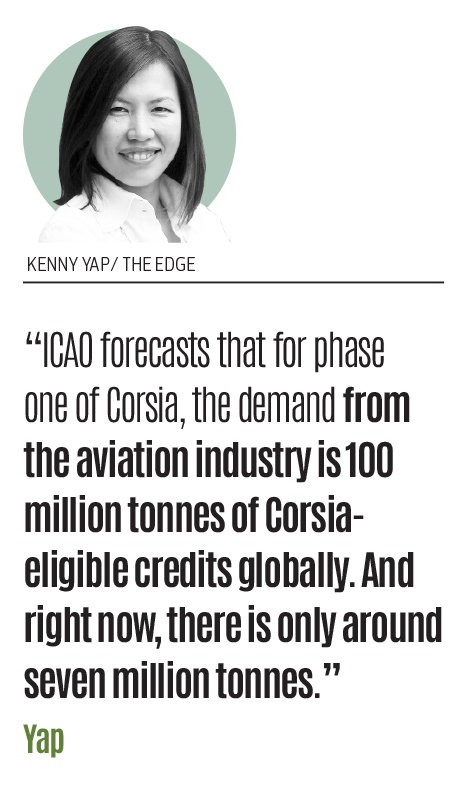
“ICAO forecasts that for phase one of Corsia, the demand from the aviation industry is 100 million tonnes of Corsia-eligible credits globally. And right now, there is only around seven million tonnes,” says Yap.
There are different prices for nature-based projects, which she says is around US$20 per tonne, and tech-based projects such as biogas capture or waste treatment plants could fetch up to US$10 to US$15 per tonne.
Yap did a projection for Malaysia carriers based on past growth trajectory and future expectations. She believes that around 1.8 million tonnes of carbon credits will be needed for the first phase of Corsia. This demand has been conveyed to the government and Bursa Malaysia, she adds.
“We already informed them that the aviation sector would need this much and asked whether they can put it in our domestic planning. If they have this information and plan accordingly, they can come back to us and say, yes, they can give us these credits. But if they decide that they cannot spare these credits, then we can look outside for the balance,” says Yap.
Ideally, the airline would like to purchase carbon credits generated in Malaysia or the region.
“We are a big player in Southeast Asia. We ideally would want the money that we are going to spend on this to be in the region … But there’s only so much we can do if the signals we are sending out are ignored or there is not enough collaborative action to come together and make these solutions available,” she says.
AirAsia’s strategy
According to Capital A’s latest sustainability report in May, the company says its carbon emissions per available seat kilometre was 64.4 gCO2/ASK in 2023, which is its lowest. This was attributed to operational efficiency measures that saved fuel and reduced emissions. The company has plans to replace its fleet with more fuel-efficient models and continue implementing green operating measures.
Most recently in October, it began introducing Combo Units — airport ground equipment that is more fuel- and carbon-efficient — at its main hub in the Kuala Lumpur International Airport, with plans to equip all major domestic hubs by the end of 2025.
Could these actions result in the company not having to purchase carbon credits? Yap says these actions help lower its offsetting needs, especially if the airspace is made more efficient, which could reduce up to 10% of emissions.
The company will continue to collaborate with the government to explore these solutions, she adds. It is also keeping an eye out for Corsia-eligible carbon credits.
The good news is that the Malaysia Aviation Decarbonisation Blueprint that was released this year by the Ministry of Transport covers these areas. Measures that airlines can take include sustainable aviation fuel (SAF) and carbon offsetting, while air traffic management measures, such as the upgrading of equipment and systems, and airport measures to reduce ground emissions were suggested.
Doing all these requires investment. In September, AirAsia announced that it was planning to introduce a mandatory carbon fee on air travel from January 2025. Yap says the amount will be determined based on a forecast of the price of carbon credits required in the next few years, as well as the cost of complying with SAF mandates, if the government decides to implement it.
“Obviously, nobody wants to charge a lot because competitively, you will be killed. Everybody has an incentive to keep the carbon costs as low as possible, and that’s one of the reasons why we work so hard with different governments and projects to get people to understand this,” she says.
Consumers might be unhappy with the extra cost, but such commitments to decarbonise are driven by global demand and trends to respond to climate change, and imposed on airline operators. It is akin to a carbon tax, where the true price of environmental impact is considered.
“Maybe people are consuming more than they need to consume because it’s not priced right. I think that everyone needs to take responsibility, and should not expect somebody else to do it, because we are the consumers at the end of the day,” says Yap.
Save by subscribing to us for your print and/or digital copy.
P/S: The Edge is also available on Apple's App Store and Android's Google Play.