

This article first appeared in The Edge Malaysia Weekly on December 2, 2024 - December 8, 2024
THE nightmare of 2022, when the LRT Kelana Jaya Line experienced multiple service disruptions due to signalling malfunctions, and several MRT Kajang Line trains were removed from operations because of wheel issues, seems to be a distant memory for Prasarana Malaysia Bhd. The operation of the service, on which hundreds of thousands Klang Valley residents depend, has improved by leaps and bounds as a result of Prasarana’s mitigation and rectification efforts over the last two years led by its president and group CEO Mohd Azharuddin Mat Sah.
Now, Mohd Azharuddin is looking ahead, to continue improving the public transport network in the Klang Valley. The aim is to entice more people to switch from car-based mobility to reach the target of a 40% public transport modal share — which represents the percentage of public transport users out of all travellers — by 2030, and 50% by 2040.
“Our role is to become a reliable [public transport] operator, providing good services so people can have trust in our public transport system,” Mohd Azharuddin tells The Edge in an interview at Prasarana’s new headquarters at the Lembah Subang depot.
“First, [our task is to] improve rail services because that’s the spine or the core services that we need to do for public transport.
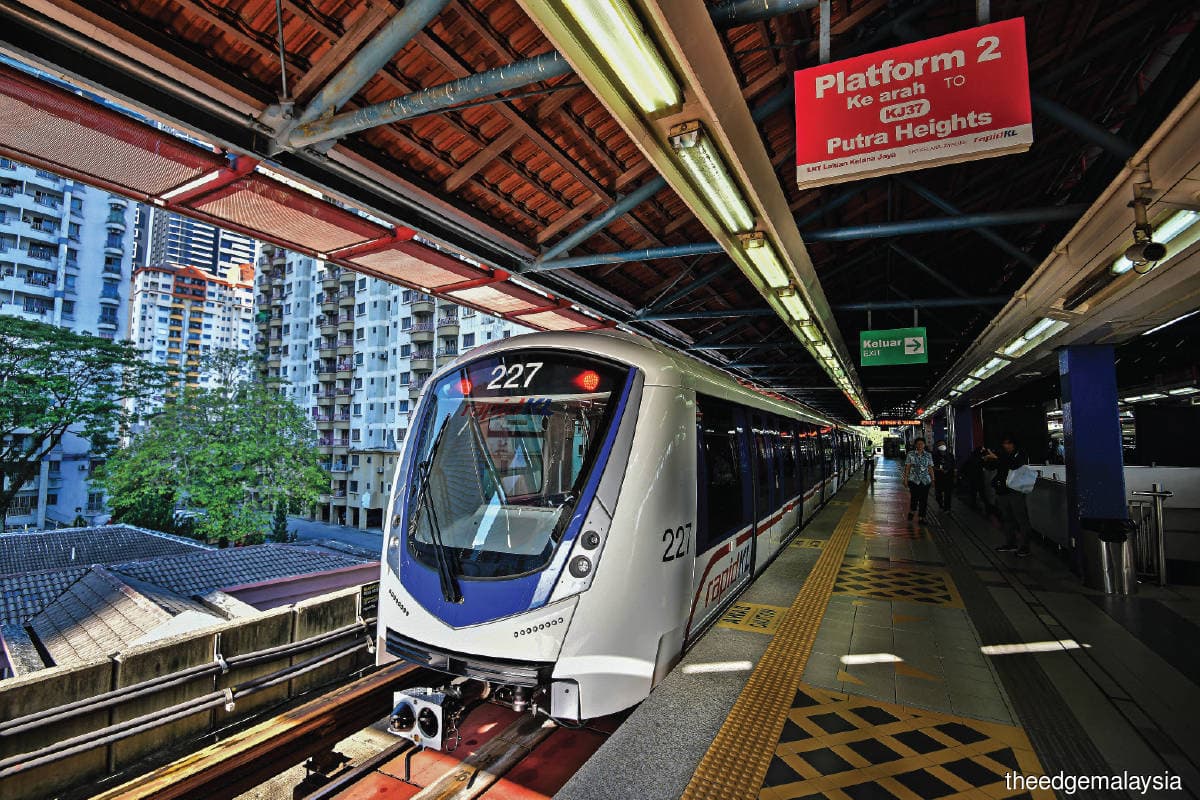
“First is fleet improvement. For example, our new train arrivals for the Kelana Jaya Line are on track and ... six more sets are going to be delivered.”

He is referring to the 27 sets of new four-car trains that were contracted to the Alstom-Hartasuma Consortium in 2017 for RM1.72 billion. The trains have been delivered progressively since 2021, with the remaining six sets to be delivered between now and the first quarter of next year.
With the additional trains and the upgrading of the Kelana Jaya Line’s signalling system, which cost RM150 million for Phase 1, the headways for the line (how long a passenger has to wait for the next train) have improved significantly, from an average peak hour headway of 4.1 minutes in 2022 and 2023, to three minutes currently.
With the 27 new train sets delivered and operational by the first quarter of next year, Prasarana will be able to operate 59 trains on the Kelana Jaya Line during peak hours, with an average peak-hour headway of 2.8 minutes, says Mohd Azharuddin.
The MRT Kajang Line’s train wheel problems that caused multiple service disruptions in 2022 led to Prasarana reducing the number of trains in operation in 2022 and 2023 in order to ensure passenger safety.
The average of trains in operation during peak hours fell from 33 in 2021, to 28 in 2022 and and 29 in 2023. In 2022 and 2023, the MRT Kajang Line had an average peak-hour headway of 5.4 minutes to 5.6 minutes.
The replacement of the train wheels costs RM36.7 million, with the entire set of wheels of the affected fleet expected to be replaced by January 2025. The MRT Kajang Line is now operating at an average peak-hour headway of four minutes, with 39 trains in operation.
“At the moment [for the MRT Kajang Line], we are running about 40 trains, which comes to about four minutes headway. Next year, as the wheel problem is being rectified and with more trains, we will have about 42 trains and a headway of 3.7 minutes,” says Mohd Azharuddin.
Rising ridership
As a result of the rectifications and improvements, the additional trains and the commissioning of Phase 2 of the MRT Putrajaya Line in 2023, ridership numbers on all five rail lines operated by Prasarana today have increased to a daily average of 921,276 from 741,259 last year and 501,909 in 2022.
Together with the Rapid Bus ridership numbers of 250,455 year to date (YTD), total ridership of Prasarana’s network of rail and buses has increased to an average of 1.17 million per day currently, from 919,717 last year and 680,367 in 2022.
Prasarana is targeting an average daily ridership of 1.2 million across its network next year. To get there, the company is focusing more on first and last mile connectivity in the Klang Valley by investing in more buses and demand-responsive transit (DRT) — vans that can be booked via mobile apps for trips from bus stations to train stations.
Prasarana currently has 836 buses in its fleet. This, however, is not sufficient for the Klang Valley, a sprawling urban agglomeration of close to nine million people. As such, with the support of the federal government, it is buying new buses to replace the ageing ones and grow its fleet.
Prasarana is looking at having 906 buses in its fleet, as well as an additional 164 outsourced buses from independent operators, by 2025. This will take the fleet of public buses in the Klang Valley to 1,026 by end-2025. (See sidebar.)
In terms of DRT, Prasarana is adding 300 vans, in addition to the 20 already on the road, by the first quarter of next year. The service has been a much-needed addition to the network, as it carries passengers from door to train station.
With all these improvements, as well as the completion of the LRT Shah Alam Line (LRT3) — whose operational target date has been delayed to September 2025 from 1Q2025 — Prasarana is targeting a modal share of 20% next year, from 18% currently.
Meanwhile, it is also looking to minimise the number of disruptions that last more than five minutes for each line. To do this, Prasarana is working closely with the original equipment manufacturers to ensure sufficient spare parts are available at all times.
The number of disruptions for each of the lines has been reduced substantially from 2022. YTD, the number of disruptions on the Kelana Jaya Line is 19, down from 49 in 2022, while the Kajang Line has experienced 13 disruptions so far, compared with 46 in 2022.
The next test, however, will happen next year when the MRT Kajang Line’s more than 40 trains undergo an overhaul and maintenance programme by asset owner MRT Corp Bhd. This will be carried out in stages from July 2025 to December 2027.
“As far as [rail] capacity is concerned, we will have enough,” Mohd Azharuddin says. “The point is to ensure first and last-mile connectivity, and the [related] ecosystem for people to take the trains and maximise our ridership.”
More buses for Klang Valley, Penang
Those who have travelled to London would have, at least once, taken a ride on the red double-decker buses synonymous with the city.
One reason is convenience. Buses in London, as well as other public transport-friendly cities like Hong Kong and Singapore, have extensive reach, and passengers do not have to wait more than 15 minutes for the next ride.
This is in stark contrast to the Klang Valley bus network, which is operated by Prasarana Malaysia Bhd. While LRT and MRT services have improved and overall ridership has reached a new high, the Klang Valley has 836 buses today, fewer than the 975 in 2019.

The Klang Valley has about one bus for every 5,000 passengers, compared with one for every 1,000 passengers or less in the three aforementioned cities. In the Klang Valley, 92% of the routes see waiting times of more than 15 minutes and about a third have a waiting period that exceeds 30 minutes, Prasarana data shows.
“Our buses are not enough,” says Prasarana president and group CEO Mohd Azharuddin Mat Sah in an interview with The Edge. “If we were to look at our future network to meet a 15-minute [interval], on average we will need additional 2,000 buses.”
While the relevant ministries are aware of this problem, there is currently another pressing priority — replacing the ageing fleet of diesel buses while managing emissions in line with the country’s net zero ambitions.
To that end, the government has committed to procuring 310 diesel buses (each typically priced around RM700,000) progressively from the first quarter of 2025, and 250 electric buses (each typically priced over RM1 million) from 4Q2025. Usage of electric buses will require the installation of charging infrastructure, which is being tendered out as well.
But this is only for fleet renewal. In the interim, Prasarana is outsourcing 164 buses in stages by end-2024 and adding 300 vans — called demand-responsive transit (DRT) — for at least 20 routes following public acceptance after a trial in Jalan Ampang, Jalan Genting Klang and Jalan Klang Lama in the capital. The vans can be booked via mobile apps for trips from bus stations to train stations.
The bus outsourcing and DRT rollout are among options being explored by Prasarana to quickly add capacity and improve both cost efficiency and travel time while discussions on fleet expansion continue, Mohd Azharuddin says.
Concurrently, efforts are being made to improve the entire first and last-mile ecosystem, such as adding more bus lanes.
“What we want to do is keep it simple, keep it straightforward,” he states.
For DRT, the journey time is shorter due to the smaller vehicle size and passenger capacity. The average waiting time is nine minutes, within the 15-minute benchmark as in Hong Kong and Singapore.
Similarly, travel time on existing bus lanes is 10% to 26% faster. That said, a high frequency on bus lanes is a must or other road users would be unhappy if the lanes are empty or underutilised, he adds.
Outsourcing adds buses more quickly while reducing operating costs, although this needs monitoring to ensure service reliability by the outsourced operators. As for the more expensive electric buses, Mohd Azharuddin says the operating cost throughout the asset life is lower, but this too will be monitored closely. Bus leasing is another option being looked at.
Many other options are being explored as Prasarana aims to resolve first and last-mile connectivity issues “in a big way”, Mohd Azharuddin says. This ranges from micromobility to e-hailing partnerships, and upgrading of its onboard fleet tracking system to improve the accuracy of its journey planning app PULSE.
All these supporting efforts are, however, unlikely to substantially improve the bus-to-passenger ratio. The bottom line is more buses are needed, and fast.
“The MRT3 Circle Line, if it does take off, could take years to complete. We need a solution for the road congestion in the interim, and that is putting more buses on the [road] to maximise our rail infrastructure. The important part is to put in the network first,” Mohd Azharuddin says.
At the highest cost of RM1.5 million each, 2,000 electric buses will cost RM3 billion. Add to that the charging infrastructure that some estimate would double the cost, and the overall outlay would be RM6 billion. Bulk purchase and installation would, however, bring the price down.
According to Minister of Economy Rafizi Ramli, the 13th Malaysia Plan, due next year, will focus on enhancing public transport, with a special emphasis on improving connectivity in the Klang Valley.
With extensive network data from Prasarana readily available, and the proven importance of first and last-mile connectivity in supporting a public transport network ecosystem, the government’s future spending decisions on public transport will be closely watched.
Save by subscribing to us for your print and/or digital copy.
P/S: The Edge is also available on Apple's App Store and Android's Google Play.