

This article first appeared in The Edge Malaysia Weekly on December 2, 2024 - December 8, 2024
SOON after Roni Abdulwahab took the helm of Bank Pembangunan Malaysia Bhd (BPMB) as group CEO in April 2022, he and his top people came up with a list of 44 initiatives that the development financial institution (DFI) needed to address, including legacy issues and to strategise its next course of action.
The team acted fast and almost all of the initiatives have been implemented. “It was supposed to be over three years. Today we’re almost complete already, a year in advance,” Roni tells The Edge in an interview.
He says the key initiatives touch on matters such as the business of the DFI, turnaround time, the credit value chain and process improvements on the business front.
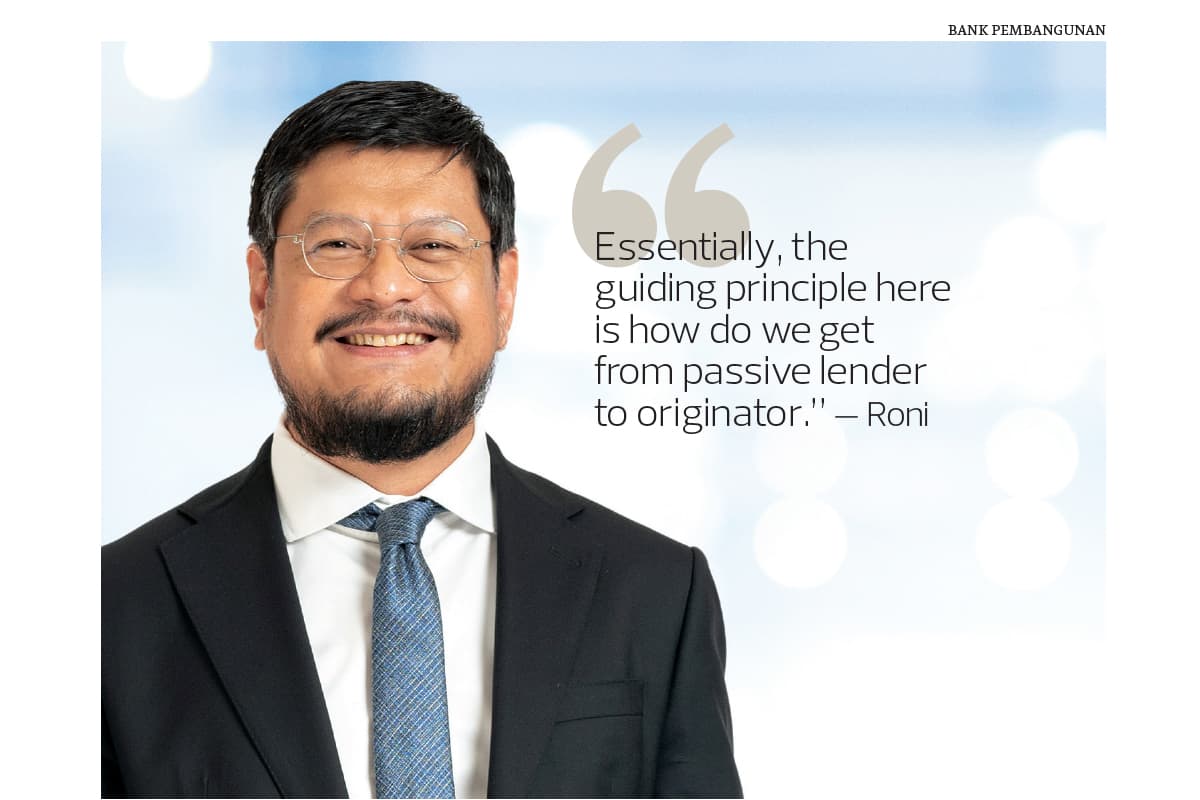
“Well, they’re all equally important ... Essentially, the guiding principle here is how do we get from passive lender to originator. Bank Pembangunan was known and [there] probably still is some perception [that it is] the bank of last resort.
“After going all around town and no one gives them (loan seekers) a loan, only then they come here … We want to change that, from being a passive lender to an active originator. Go out there and find things, talk to people,” Roni says.

Some headway has been made. In January, BPMB approved financing of RM373.5 million for the development of Perlis Inland Port, which is set to commence operations in the first quarter of 2025, handling up to two million 20-foot equivalent units annually, and fostering border trade. This is a public-private partnership joint venture between Mutiara Infra Sdn Bhd and Menteri Besar Inc Perlis.
In a nutshell, Perlis Inland Port is poised to become the sole cross-border freight rail and road point between Malaysia and Thailand.
“The state of Perlis decided, ‘hey, we need a new logistics hub to clear goods and bigger facilities and so on’. They had been looking around (for funding). They even went to Japan to look for funding. Coincidentally, as we are improving the business engine, we found them and they found us,” says Roni. (See table for BPMB’s notable deals.)
His mandate is to improve BPMB, strengthen its business and risk culture and foster a culture of transparency and trust.
“I can safely say, a lot of it (issues) has been fixed, together with the senior management,” says the former investment banker, giving credit to his top brass.
Bank Pembangunan was established by the government in November 1973 with a mandate to develop bumiputera entrepreneurs. In the 2000s, the DFI changed its focus to finance high-growth sectors and notable projects including the Petronas Twin Towers, SMART Tunnel and the Express Rail Link, among others. Today, the group is looking at impact development projects that are aligned with the 12th Malaysian Plan and other initiatives under National Energy Transformation Roadmap and New Industrial Master Plan 2030, among others.
“Next year, we will have to align our plan with the 13th Malaysian Plan,” Roni says.
Better financials
For its financial year ended Dec 31, 2023, BPMB chalked up a net profit of RM400.78 million, a good improvement from RM186.66 million in FY2022. “We managed to get some good deals, some big profitable transactions last year,” Roni explains.
“That profit [of RM400.78 million] means net interest income profit after taking [out] our expenses. The right number is profit before tax and zakat, which is RM558 million (RM557.86 million), an increase from RM359 million (RM358.63 million). So that’s a decent increase.”
BPMB’s total assets grew by 7% in 2023, while loan growth was strong at 14% last year. “[Our loan growth] could be the highest in 10 years. The bank did not grow for a decade. I mean, it was flat for a decade. Some spurts of growth, but compound annual growth rate was flat for a decade.
“So then, after working for a year and changing to improve the business engine, finally, Alhamdulillah, the business engine moved. Last year, we had some interesting transactions with Prolintas (Infra Business Trust). We financed its business trust with a RM2.7 billion loan. We restructured Lekas Highway (Lebuhraya Kajang–Seremban). Then we had KUT (Kuching Urban Transportation System),” Roni says.
BPMB, UOB Malaysia and China Construction Bank (M) Bhd in a club deal offered a syndication programme to extend financing facilities of RM264.5 million to EPR Mobilus GR JV Sdn Bhd, the contractor appointed by Sarawak Metro Sdn Bhd, a unit of Sarawak Economic Development Corp, to develop a hydrogen-powered, autonomous rapid transit in Kuching, which is part of the Kuching Urban Transportation System project.
“We are co-financiers. Essentially, it is contract financing. The state buys the equipment from China and we finance that purchase, and then the state pays us back,” he explains.
Having achieved 14% loan growth, BPMB’s average annual target is around 5% to 6% moving forward.
BPMB’s gross impaired loans for FY2023 stood at 9.95%, down from 11.4% in FY2022 and from 10.5% in FY2021.
“We have a threshold of between 9% and 11% for gross NPL (non-performing loans). [The threshold for NPLs] is larger than many banks, but the nature of development banks is to take developmental risk,” Roni says.

Under scrutiny
Roni succeeded Arshad Mohamed Ismail at a time when BPMB was embarking on its first phase of the DFI merger with Danajamin Nasional Bhd.
Prior to his appointment, Roni was executive director of investment with Khazanah Nasional Bhd. He also had a stint at HSBC Bank Malaysia Bhd as its managing director and country head of global banking.
Before Roni came on board, the DFI had come under fire for giving loans that were deemed risky, largely to politically connected individuals. Many of the loans went bad, raising concerns over its governance.
Another case that drew unwanted attention was the RM62.7 million loan granted to Syarikat Borcos Shipping Sdn Bhd. The company went belly up and appointed liquidators KPMG at end-December 2016. Elsewhere, there was Asian Broadcasting Network Sdn Bhd (ABN), whose business failed and it had to auction off assets to pay creditors, as well as Integrated Nautical Resort Sdn Bhd and Garuda Suci Sdn Bhd, which are linked to Indonesian businessman Tan Sri Peter Sondakh. The two companies built and operated the St Regis Langkawi and Langkawi International Convention Centre.
Another case that hogged the limelight was Aries Telecoms (M) Bhd, formerly known as V Telecoms Bhd. The company undertook a US$5 billion Vasseti South Asia Network (VSAN) project to lay more than 30,000km of terrestrial fibre-optic infrastructure across Asean. BPMB granted a RM400 million loan to finance the Malaysian portion in 2012.
Some years later, following investigations by its appointed receiver and manager of Deloitte Corporate Solutions Sdn Bhd, the DFI alleged that the money from the loan granted to Aries had been redirected to other parties.
“We had five leadership positions in seven years and successive changes of leadership boards and CEOs,” Roni says, describing the anguish people at BPMB had to go through.
“This place needs a kind of visionary board [and leadership]. One that will lead us to 10, 20 years down the road,” he adds.
Agenda 2025
It might not be wrong to say that running a DFI could be more challenging than running a commercial bank, simply because the latter always has to strike a balance between financial sustainability and its social objective.
Having spent 2½ years at BPMB, Roni observes that the DFI needs a “visionary” leadership and board in order to go far in achieving its social objective, namely to fill the financial gaps for national developments.
Roni, who worked in JP Morgan in New York, also understands well that earnings targets aren’t quite the priority. In short, BPMB’s lending strategies have to be in line with the country’s nation-building policies.
“But more importantly, where do you want to be in 20 years as a nation, and then work backwards, what are the preconditions to be there in 20 years, and what kind of roadblocks or speed bumps we need to cross, then we [BPMB] have to move accordingly,” says Roni.
“We established where we play, essentially areas that deliver impact and national policies, and focus on core strengths ... for example, food security is important, right? But is it our space?
“Maybe we can finance an irrigation project or a greenhouse project, for example. Infrastructure is our core, so we can do that. But if it is [getting loans for] working capital to buy seeds and fertilisers, that kind of operational stuff is not our core, we have to partner with Agrobank (Bank Pertanian Malaysia Bhd),” explains Roni.
“Another example is real estate. We don’t do real estate, but we need to be socially inclusive. So, what if it’s an affordable housing project? Do we do that? Do we deploy capital? So, we collectively decided on our three-year road map ... affordable housing, we decided yes [we will participate], because it’s impactful.
“So how do we measure impact? So we’ve got this framework called MIND (measuring impact on national development) … a framework, there’s a mathematical score to it. There’s a positive contribution and negative carry on a particular project, and there’s a composite score. So, if it falls below a certain minimum score that’s required, we walk away,” he says.
Roni points out that the group has conducted a study with a consultant and found that there is about RM750 billion of funding gap for development-related projects for the country to become a high-income nation.
Pending mergers
Much of the change of tack at BPMB is also hinged on the DFI becoming a much larger entity.
At end-September 2021, BPMB acquired Danajamin Nasional Bhd from Credit Guarantee Corporation Malaysia Bhd and Minister of Finance Inc). There was also a plan to bring other DFIs, Small Medium Enterprise Development Bank Malaysia Bhd (SME Bank) and Export-Import Bank of Malaysia Bhd (Exim Bank) under the same umbrella. The merger plan was announced in Budget 2020 by then finance minister Lim Guan Eng. But it has yet to materialise.
While Roni declines to elaborate on the mergers, he says, “Maybe I can share a bit about why [the mergers will take place]. It’s about strengthening the mandate.
“Today, we are just wholesale. We focus on transactions of about RM50 million to RM2 billion in one go.
“[With the merger] then we have all these areas ... Take, for example, someone who has a hotel reaches out to us to build a restaurant. He needs like RM2 million … We can’t do it. We’re not designed to do small loans. SME Bank is designed to do small stuff.
“When you go to SME bank, right? Those guys may do it, but there are other priorities … So it could just get lost in translation somewhere.”
He cites an example of financing a port, which would be right up the DFI’s alley, but 30% to 40% of the financing will be to subcontractors, to small and medium enterprises and subcontractors, which is under the ambit of SME Bank. There will also be the import of materials such as building materials, steel and other things which would involve Exim Bank.
“It’s about strengthening the DFI’s mandate, creating a better ecosystem, providing better solutions for impact financing across various groups. So maybe in simplicity, it is asas pembangunan, the developmental core is pembangunan,” he says.
Roni’s three-year contract ends in April next year, and there is no clarity as to whether it will be extended for him to continue leading BPMB.
“The CEO’s appointment is subject to MoF (Ministry of Finance) … The (CEO employment) contract is issued by MoF through Bank Pembangunan. I don’t intend to leave things halfway. It’s not nice, right? At the very least, see through the completion of Agenda 25 or whatever we need to do.”

Save by subscribing to us for your print and/or digital copy.
P/S: The Edge is also available on Apple's App Store and Android's Google Play.