

This article first appeared in Wealth, The Edge Malaysia Weekly on November 25, 2024 - December 1, 2024
Local investors are provided with an array of choices when it comes to investing in alternative asset classes. But what about investing in tiny houses of 139 sq ft on wheels, like caravans?
Big Tiny Pte Ltd, a Singapore-based company that designs and manufactures tiny houses at its factory in Kulai, Johor, expanded its business into Malaysia in recent years. Locally, it is offering its sale and management programme, a relatively new product that aims to generate fixed returns for owners or co-owners of its tiny houses.
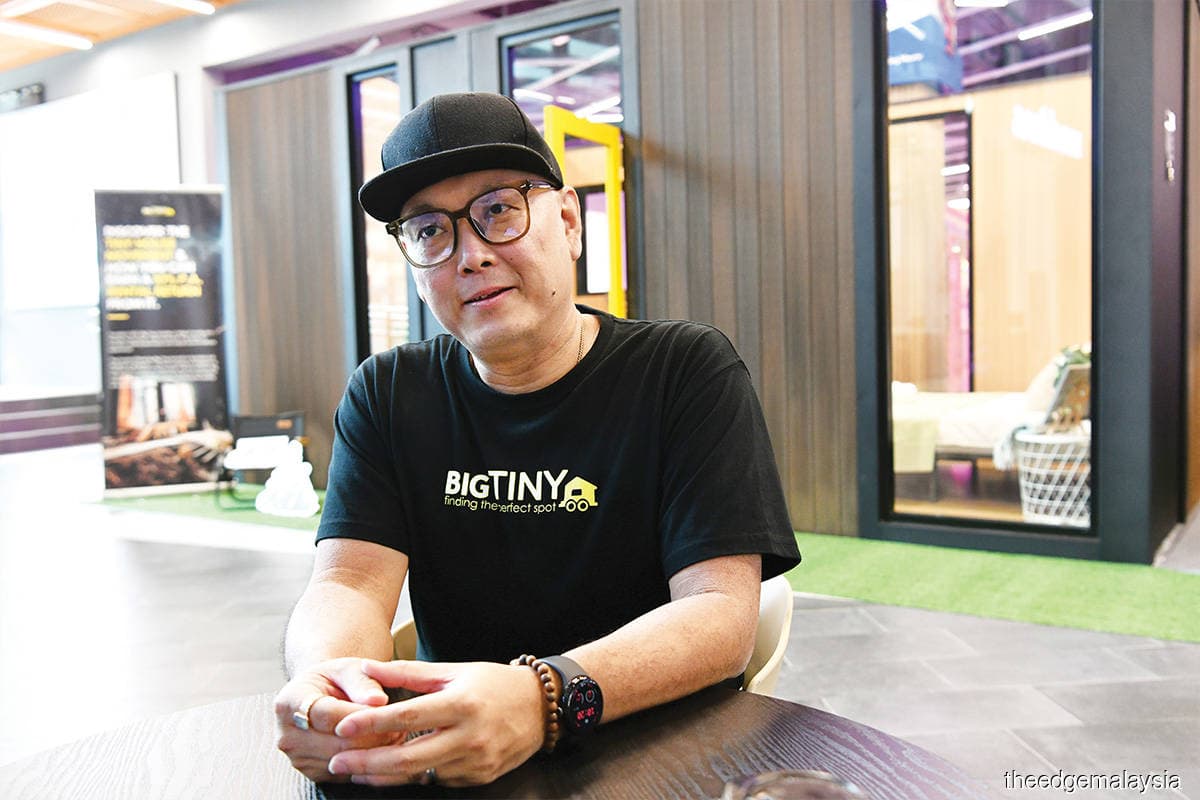
How does it work? Big Tiny co-founder Jeff Yeo says consumers would purchase tiny houses from the firm and lease them back to the company, which then places the tiny houses at tourist spots around the world for rent. The rental income generates revenue for the firm, and investors are paid a fixed rate of return in a given period, stipulated in the sale and management contract signed by the two parties.
There are two packages available, he adds. The first is a two-year agreement where Big Tiny aims to provide the tiny house owners with an 8% return per annum. The other is a five-year agreement that aims to generate a 10% return per annum for owners.

At the end of the lease period, the tiny house owners can opt to sell the houses back to the company at the original price. From an investment perspective, it means they would receive their investment principal.
The buyback clause, however, is only effective until the 10th year. Those who are interested in participating in the programme for a longer period are advised to enter into a new programme by buying a new tiny house.
The minimum investment amount is RM30,000, where a purchaser would co-own a tiny house with nine other people, says Yeo. The full price for a tiny house by Big Tiny is RM300,000.
Is an 8% to 10% return per annum too good to be true? Yeo says it is achievable.
“Let’s say you buy a tiny house for S$90,000. A return of 10% per annum is S$9,000. If you divide the figure by 12, it is S$750 per month. Our tiny houses are rented out for, conservatively speaking, S$200 per night on average, which means they only need to be rented four nights a month for us to pay the tiny house owners [the returns],” he explains.
Yeo says the details of the programme are all listed in the legal documents, which also state that the maintenance and repair work on the tiny houses, if any, are borne by the company. There is no hidden fee. “The 8% and 10% return is the net rate. It is transparent,” he adds.
A successful example is a tiny house that the firm placed in the Snowy Mountains in New South Wales, Australia. Yeo says the rent of this particular tiny house has gone up to S$650 per night and is fully booked over most weekends. Another successful project are the tiny houses located in Grampians National Park in Australia, with the mountain range behind them and the Halls Gap Zoo beside them.
“The sites on which we place our tiny houses are curated by our team. There are places with nice scenery and activities that our guests can participate in, such as picking fruit, harvesting eggs, squeezing milk and more,” he adds.

Scouting for scenic spots, working with landowners
In fact, Big Tiny has a land sourcing team tasked to identify interesting spots globally to place its tiny houses for rent. “Their expertise lies in finding very interesting pieces of land with amazing scenery,” says Yeo.
As for the land on which the firm places its tiny houses, it tends to enter into a profit-sharing agreement with the private land owner, he says. A legal document is drawn up and signed by both parties and submitted to the local council for approval.
Yeo says other similar companies tend to lease land by paying a fixed amount for placement of the tiny houses. But the benefit of profit-sharing is that it mitigates certain risks, such as when the tiny houses are not generating sufficient income to cover the cost.
Furthermore, there are a few tiers to the profit-sharing mechanism, he says. Landowners who provide more value-added services for the tiny houses’ guests are entitled to a higher profit-sharing rate.
For instance, a landowner who only provides the space without other services is entitled to the lowest rate. The rate is higher if the landowner helps connect the tiny houses to electricity and water supply.
If more services are provided, such as meals that come with several options, such as including a cheese platter, wine and picnic baskets, the landowner will get an even higher profit-sharing rate.
“So, it is a business model where everybody has skin in the game. As the land partner, you want to host well. If you get good reviews online, which translates into more bookings and profits, it is better for [you] and for us. We want to make sure it works for everybody,” says Yeo.
Another advantage of tiny houses is flexibility. As they have wheels underneath, these houses can be moved easily from one spot to another nearby with better earning potential.
Yeo says Big Tiny owns the patent for the design methodology used for its tiny houses, which enables the houses to be assembled in under three hours. “It is very much like Ikea furniture,” he points out.
Asked how the firm rents out the tiny houses? He says they are placed on 10 major booking platforms, including Airbnb, Booking.com, Trivago and Traveloka. The firm also has its own website for online booking.
“We leverage the existing database of travellers [provided by these major platforms]. But it takes some time to build up the popularity [of the tiny houses]. Those placed in a bad location, if any, are weeded out. We track them and have monthly meetings with our hospitality team. They monitor the occupancy rates very closely,” he adds.
What is the overall occupancy rate for the tiny houses managed by Big Tiny? “Conservatively speaking, it is about 55% to 60%. Of course, we have popular ones at 90% and above,” says Yeo.
As at September, the company was managing more than 400 tiny houses globally through its sale and management programme. It is aiming to have 5,000 in the next few years. To achieve this goal, it is launching larger-scale projects, such as the one in Grampians National Park, where 30 tiny houses have been placed.
“The larger-scale project has a more communal setting, equipped with a swimming pool, recreation room and playground for kids. Our latest project has an aviary for birds as well. It intends to provide various activities for everyone, both the adults and kids,” he says.
The tiny houses used in the larger-scale projects are owned by the firm itself. These are tiny houses that it buys back from its clients after the sale and management contract expires.
“We buy them back because we own the factories. It is cheaper for us to refurbish the interior as opposed to a customer doing it themselves or through a third-party service provider. The tiny houses are built with relatively high-quality materials with a lifespan of 25 to 30 years,” says Yeo.
The firm plans to enter the Japanese market by placing tiny houses in the country for rent later this year, he adds.

Governed under caravan laws in Australia
As the adage goes, there is no such thing as a free lunch. Just like any investment, the tiny house sale and management programme comes with its own set of risks. For instance, those who participate in the programme receive their payouts from Big Tiny’s cash holdings, which means the programme is as good as the financial health of the firm itself.
Asked about its ability to make the necessary payments, Yeo says the firm has been Ebitda (earnings before interest, tax, depreciation and amortisation) positive since 2018 and has a healthy cash flow. He adds that the business started in 2017 and it has not missed any payments to those who participate in its sale and management programme.
Yeo notes that the firm did not make payments for seven months starting from the first half of 2020, during the height of the pandemic, but payments resumed in early 2021 and the lease period of the programme was extended for seven months. “So, it was like a delayed payment, not a non-payment.”
It was a challenging period. He recalls that the firm had to stop renting out tiny houses to guests and he had to call clients to evoke the force majeure clause of the contract, which means unforeseeable circumstances that prevent a party from fulfilling a contract.
“We thought we would be blasted and scolded. But most of them told us not to worry. Some weren’t happy, but we tried our best to explain to them the sustainability of the company. And that it was not a non-payment,” he says.
It is also important for those interested in Big Tiny’s sale and management programme to understand that the tiny houses are regulated under caravan laws in Australia and some other countries.
Can the tiny houses be sold quickly at a fair price in the event of liquidation? Yeo says they are tangible assets with market value, especially in certain countries such as Australia, which is where its tiny houses will be sold in the event of liquidation.
“The secondary market for tiny houses from Big Tiny is generally quite positive and likely to remain receptive [by the consumers], driven by the ongoing interest in eco-tourism, alternative housing solutions and sustainable living practices. As tiny houses are no longer new in the Australian market, it will not be hard to find platforms to list them for sale,” he explains.
Do its clients hire a lawyer to review the contract for the sale and management programme? Yeo says some of them do. “In fact, we have some lawyers as clients. We have quite an interesting variety of client profiles, including bankers.”
The sale and management programme is for the firm to expand faster, he points out. “If we do it ourselves, we wouldn’t be growing at such a rate.”
In total, the firm has done about 1,400 tiny houses since 2017, including those it directly owns, those owned by others and those co-owned by its clients. In Malaysia, the firm has placed some co-owned tiny houses at a glamping site in Bentong, Pahang.
“It is a collaboration with the glamping site owner. They co-own the tiny houses and place them on their site. We share the profit. The glamping site operator is both the landowner and a partner,” says Yeo.
He says a notable investor of Big Tiny is Koh Boon Hwee, chairman and independent, non-executive director of the Singapore Exchange (SGX) Group. According to SGX’s official website, he is also chairman of venture capital firm Altara Ventures Pte Ltd and sits on the board of GIC Pte Ltd, one of the three investment entities in Singapore that manage the city state’s financial reserves, alongside the Monetary Authority of Singapore and Temasek.
Big Tiny is an investee company of Treuenburg Group, an institutional real estate and venture capital investor headquartered in Erfurt, Germany, through GPPC Capital Ltd, according to Yeo.
Save by subscribing to us for your print and/or digital copy.
P/S: The Edge is also available on Apple's App Store and Android's Google Play.