

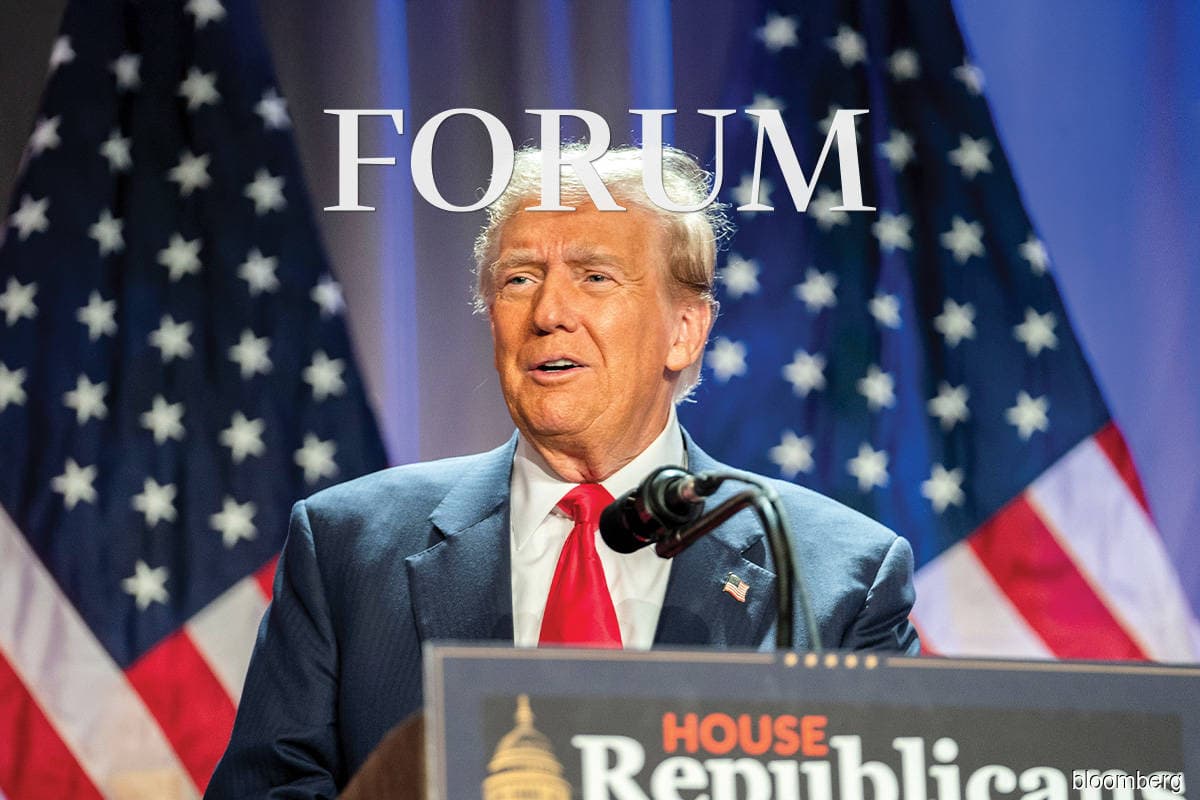
This article first appeared in Forum, The Edge Malaysia Weekly on November 25, 2024 - December 1, 2024
Recently, Malaysians and Americans shared a striking political moment. In Malaysia, former Prime Minister Datuk Seri Najib Razak issued a rare apology for his role in the multibillion-dollar 1Malaysia Development Bhd (1MDB) scandal. Responses from Malaysians to Najib’s apology have been sharply divided. As discussed in the 129th episode of the popular Malaysian political podcast Keluar Sekejap, two social media polls were conducted with a combined total of approximately 20,000 participants. The responses were nearly evenly split between those accepting his apology and those rejecting it. Meanwhile, across the globe, Americans witnessed the re-election of Donald Trump as the 47th president of the United States.
We have two leaders with contentious legacies — one addressing a scandal that shook his nation but is still supported by many, the other returning to power despite being convicted of multiple felonies. What is going on? What do these political incidents reveal about the state of the political landscape in today’s world?
At first glance, these may look like two isolated cases of politicians who share a dismissive stance towards truth. On the one hand, Najib wilfully lied about the misappropriation of billions in funds, maintaining a narrative of innocence despite overwhelming evidence to the contrary. On the other hand, it is reported that Trump has made 30,573 false claims during the past four years of his presidency — by far the highest number recorded for any US president.
However, at a more profound level, the puzzle is not so much about why these politicians lie but more about why they remain influential despite their controversies and blatant disregard for facts. A closer examination reveals that this paradox reflects a broader shift in the criteria by which leaders are judged and in the role that truth plays within society.
This phenomenon aligns with what British-Pakistani scholar Ziauddin Sardar describes as “postnormal times” — a period of epistemological rupture in history where “old orthodoxies are dying, new ones have yet to be born and very few things seem to make sense”. It is marked by rapid, complex and often chaotic changes; traditional boundaries of truth and authority become destabilised, and whatever we understood as normal is being redefined — as seen in the global pandemic, climate change, ongoing wars and the resurgence of far-right ideologies in Europe and the US. This transition can be attributed to uncertainties in the sociopolitical and economic landscapes, the rapid pace of technological advancements such as artificial intelligence (AI), deep fakes, and intense surveillance, and a digital culture where echo chambers proliferate and campaigns against established knowledge can be led by anyone, anywhere.
Trump’s victory and Najib’s support can be seen as additions to the broader series of developments marking the chaos of postnormal times. Postnormal times, to a certain extent, facilitate Trump’s rise to power. Despite the staggering volume of misinformation Trump propagates, his base of supporters remains largely steadfast and even grew with the recent electoral win which also earned him the popular vote. This is because society exhibits a desire for nostalgia and yearns for clarity and control in times of distrust, chaos and uncertainty. Trump’s nationalist populism capitalises on these human instincts, leveraging people’s frustrations with the status quo, their fear of an uncertain future, and their desire to restore a perceived past greatness. By offering simple solutions and, as International Islamic University Malaysia political scientist Syaza Shukri describes, “a sense of continuity with tradition”, Trump channels these frustrations and anxieties into a compelling political narrative.
In the case of Najib, the continual support and the possibility of mercy may become more pronounced as the traditional markers of truth and accountability lose their power over alternative narratives and public perception. While an apology does not fully absolve one from one’s actions, we are more likely to soften our judgement, and especially in post-truth times, if a narrative feels more genuine or compelling compared to other competing and conflicting narratives, we may even overlook past transgressions entirely. As Khairy Jamaluddin discussed in the Keluar Sekejap podcast, there is always a possibility that the apology can lead to a pardon by the Yang di-Pertuan Agong, especially considering that the “Yang di-Pertuan Agong is also human himself”.
The consequence of the erosion of truth could be the loss of reality, the death of democracy and the rise of polarisation. As historian Timothy Snyder contends, “Post-truth wears away the rule of law and invites a regime of myth.” While Najib’s apology may seem harmless when viewed in isolation, on a grand scale of things, it can bend perceptions and deepen divides in an already polarised political landscape. With each camp clinging to competing truths, the path to shared understanding becomes ever more elusive.
An extreme version of post-truth can even signal a fascist state. For example, John Kelly, the Trump White House’s longest-serving chief of staff, recently described Trump as having “met the definition of a fascist” and suggested that he “would govern like a dictator if allowed”. In certain ways, Trumpism evokes the chilling parallels of George Orwell’s 1984, where truth is twisted and reality is controlled by the powerful. In Orwell’s dystopia, the government rewrites history and controls information to maintain authority. Similarly, Trumpism often involves distorting the truth to shape a version of reality that aligns with its political narrative, blurring the line between facts and fiction.
Although Malaysia’s political landscape diverges considerably from that of the US, this does not mean that we should let our guard down. The rise of divisive rhetoric in the decades of partisan political polarisation, if left unchecked, can further erode the foundations of democracy and even lead to authoritarian tendencies and religious fanaticism as people cling onto the few remaining perceived pillars of truth in today’s climate of post-truth, such as religion and tradition.
Having long recognised the profound shift towards postnormal times, Prime Minister Datuk Seri Anwar Ibrahim has initiated the Madani policy framework as a strategic guide to steer Malaysia towards a future defined by sustainability, prosperity, innovation, respect, trust and compassion. While we are still a long way from fully realising this vision, with divisions and discrimination persisting across various layers of society and corruption remaining entrenched, progress is being made through initiatives such as The Postnormal Times Madani Exhibition, Kembara Perpaduan, Kawasan Rukun Tetangga and rigorous corruption-busting campaigns.
To amplify these efforts and move towards a more unified, just and trustworthy nation, we should shift from promoting dialogues to fostering polylogues, where diverse voices converge to encourage new understandings and greater responsibility towards each other. We must also strengthen efforts to promote critical thinking and intellectual openness in education, where sources of information are evaluated and beliefs challenged. Grassroots events like the “International Think Big Summit 2024: Crossroads” by the Malaysian Philosophy Society, which focus on promoting polylogues, critical thinking and awareness of postnormal times, can serve as catalysts for bridging divides and narratives in our increasingly polarised society.
To end, incidents such as Najib’s apology and Trump’s victory in the US’ presidential election are more than just passing news stories; they serve as a wake-up call to all Malaysians to look beyond the narratives presented in the media and public discourse, and seek the truth and reality that are gradually slipping through our fingers in an era of postnormal uncertainty.
Chew Zhun Yee is co-founder and managing director of the Malaysian Philosophy Society (MPS). Sahilah Ain Sathakathulla is a content curator at MPS.
Save by subscribing to us for your print and/or digital copy.
P/S: The Edge is also available on Apple's App Store and Android's Google Play.