

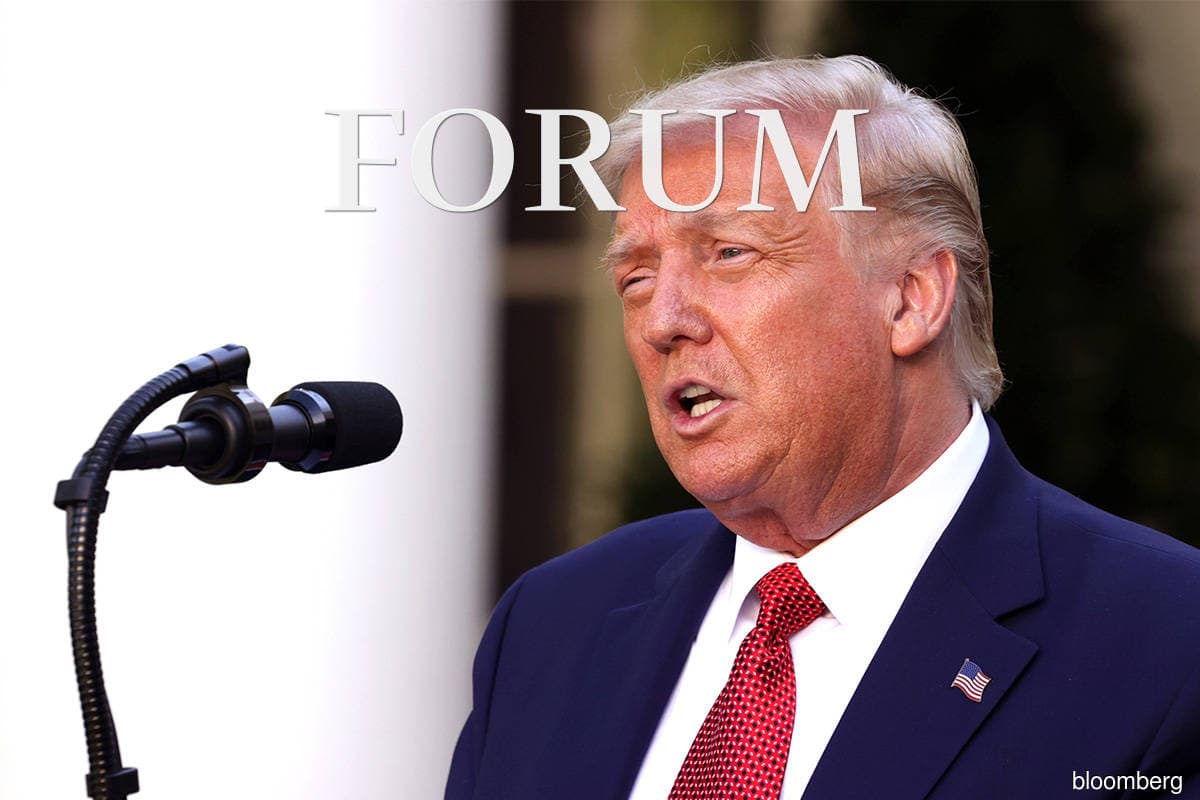
This article first appeared in Forum, The Edge Malaysia Weekly on November 25, 2024 - December 1, 2024
Donald Trump won. He will be the next president of the US despite one conviction and several outstanding court cases against him. So much speculation has emerged as to what it would mean for the world. His previous term as president made many countries around the world grimace at this prospect.
So many words have been written about why the Democrats lost to the Republican candidate. One that rather appeals to me is that “the foreign policy of Biden” was a yoke on candidate Kamala Harris that she could not surmount. Stripping away the political-diplomatic correctness surrounding the phrase, it literally means that Americans could not support an administration that itself supported a regime committing genocide. Having lived in the poorest state in the US at that time for five years, I learnt that Americans will never stand for someone weaker being oppressed, never mind genocide, and that they will always have a cheer for the underdog. This genocide was racial eradication — decades of opposition against simple racism in the US should have screamed “red flag” to any politician. Harris wanted to continue Biden’s foreign policy. Trump seized on that huge blunder by vowing to end wars. Alea jacta est (the die is cast).
Worse yet, the Republicans already control the Senate and the House of Representatives. This means Trump will not have any effective checks, balances and controls on what he wants to do.
Now that the date for the US presidential handover is coming nearer, what has Malaysia to fear from Trump?
It was declared that the Trump presidency will raise tariffs on all Chinese goods by 60%. What was also said but seems to have been missed out is that all other imports from all other countries will be hit by 10% in tariffs. The latter means Malaysia. A qualification pops up: Most of Malaysia’s exports are not final goods but intermediate goods. Much of that is “owned” by US firms. Would they also be subject to tariffs? If they are, would US foreign direct investments (FDIs) in Malaysia stay or sail away? We may obtain some quantification to that by asking whether a 10% tariff (and hence, cost hikes) would cause the savings by offshoring to disappear, thus making sense to reshore back to the US. That, however, to quote a famous economic phrase is “micro-motives for macro behaviour”, that is, too detailed to grasp easily. Clearly, the US is driving itself into isolationism economically and “Fortress America” is likely.
The US appears to be set on autarky, meaning it will do everything by and for itself. History has shown that countries that embrace autarky typically collapse as Imperial China, Imperial Japan and, more recently, the Soviet Union have demonstrated.
Trump will forever be remembered as the person who reversed globalisation. His method was simply to start bringing back US manufacturing industries back to the US, called “homeshoring”. Variations of it have emerged, like “near-shoring”, which means back to countries near to the US, or “friend-shoring”, which, as the name makes clear, means only investments for countries friendly to the US. Already, homeshoring has made the US the only country with all five of the world’s leading edge semiconductor manufacturers. The US is targeted to produce 30% of leading-edge chips in the world by 2032, up from 0% in 2022 (re: President Biden). Malaysia wants a stake in global semiconductor chip manufacturing. How? Only obsolete chips, perhaps, by the time US homeshoring is complete.
Homeshoring has massive implications for developed countries as well. In Germany, the government recently collapsed. At the heart of that is an investment outflow of €650 billion (RM3 trillion) from Germany instead of investing domestically. That meant a stagnant economy. The outflow is expected to increase as German companies rush to be in the US before Fortress America goes up.
What all this means is that countries that have hinged their grand economic strategy on FDIs, such as Malaysia, are going to find that imperilled as the goose that lays the golden egg will no longer do so.
Trump has cracked globalisation and now one wonders if the US will be pulled out of all sorts of associations and trade agreements. He has already started making noises to that end. Remember that in 2017, he pulled the US out of the Trans-Pacific Partnership (TPP). One long-reaching consequence of the US pulling out of trade agreements would be that of logistics. During the global pandemic lockdowns, international movements of goods were severely affected as countries simply did not trade with each other. That not only brought much higher prices for transporting goods, but products that used to fill shelves domestically were simply no longer there. I stopped buying from Amazon because the delivery costs were often twice or thrice that of the item’s value. Should the US pull out of trade agreements, it is likely that shipping costs will skyrocket, and American goods will be much less available on shelves everywhere. Global trade can be expected to slump.
Why would they pull out of trade agreements? Simple: Countries would be unlikely to take Trump’s tariff hikes lying down. Retaliatory tariffs are almost certain. Things will simply escalate, and push will come to shove, and trade agreements will fall by the wayside. This simply means global markets will constrict, to everyone’s detriment, but arguably more so for the US.
This raises another question: What then happens to the US dollar? Will it continue to dominate the world currency markets as it does today? Will it continue to give seigniorage, the ability to the US to simply issue debt beyond what restricts other countries? If the US dollar is not being used for trade with the US, why then use it for trade between two different countries? Is there another currency readily available to take the US dollar’s place? Not easily. What all this will lead to are higher prices, brought about by greater difficulty to secure a trading and/or settlement currency. In fact, the euro itself was conceived to bring down costs within the euro area, which was trading in multiple currencies, generating costs that retailers had to pay for. Are the costs high? The European Commission had estimated that the savings from eliminating manifold transactions of currencies by establishing the euro was 0.4% of the European Union GDP per annum.
In short, Trump’s ascendency is one fraught with peril for the world. Will he repeat his first presidency’s misadventures? Likely, as a leopard cannot change its spots.
Huzaime Hamid is chairman and CEO of Ingenium Advisors and the author of two macroeconomic books
Save by subscribing to us for your print and/or digital copy.
P/S: The Edge is also available on Apple's App Store and Android's Google Play.