

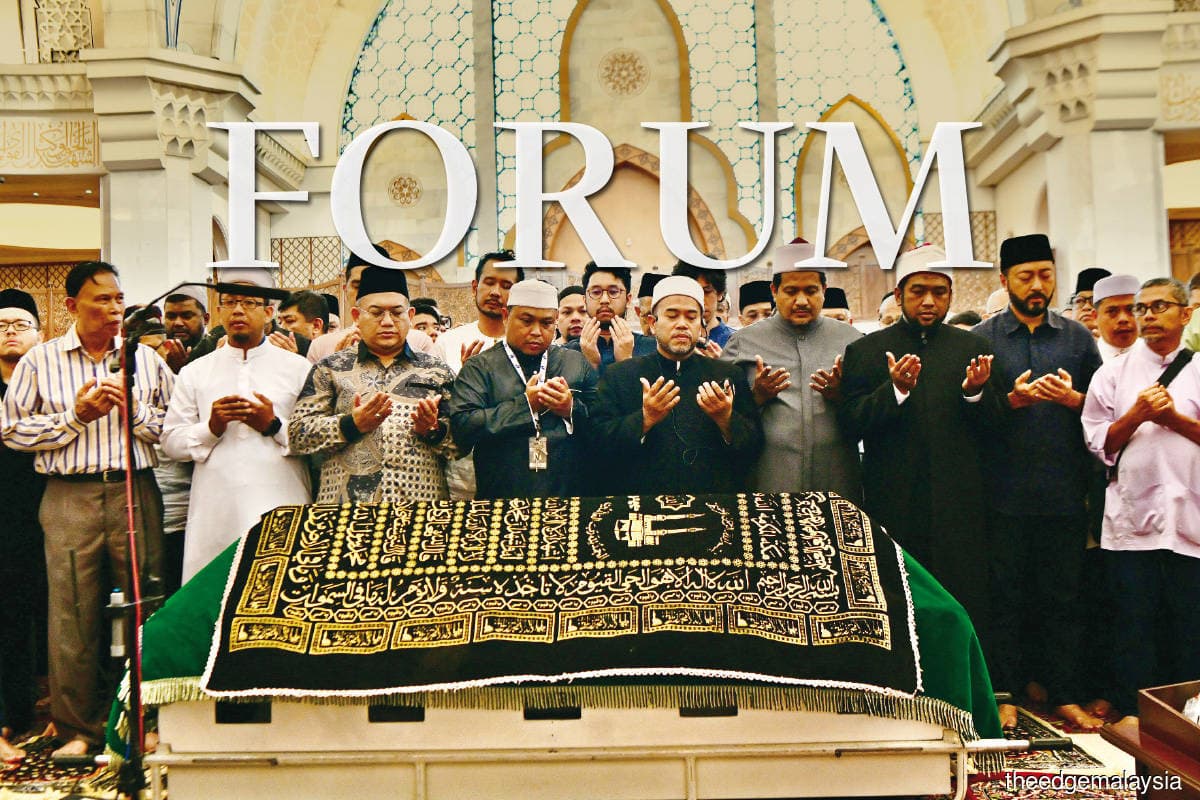
This article first appeared in Forum, The Edge Malaysia Weekly on November 18, 2024 - November 24, 2024
The Umno leader who first introduced Umno to the corporate world after the New Economic Policy was launched in 1971 was Tengku Razaleigh Hamzah. Razaleigh did this by taking control of Fleet Group in 1972 via Umno proxies/nominees. Fleet Group then controlled the New Straits Times group in Malaysia and over time expanded into banking, insurance and other areas of the economy.
However, it was Tun Daim Zainuddin, who passed away on Nov 13 at age 86, who perfected the art of maximising the nexus between business and politics when he was Umno treasurer and Malaysia’s finance minister.
Tun Dr Mahathir Mohamad appointed Daim as finance minister and Umno treasurer in 1984, replacing Razaleigh after the latter was defeated by Tun Musa Hitam for the post of Umno deputy president for the second time.
Mahathir backed Musa on both occasions because he saw Razaleigh, with his financial prowess, as a threat.
Mahathir also preferred fellow Kedahan Daim to be his economic czar.
The strong bond between Mahathir and Daim eventually led to a split with Musa who then teamed up with his erstwhile rival Razaleigh to take on Mahathir in the 1987 party polls. They failed, albeit narrowly, and the way was then clear for Mahathir and Daim to govern Malaysia as they pleased, with support from rising star Datuk Seri Anwar Ibrahim.
Daim pushed the government’s privatisation agenda aggressively to create business opportunities and wealth for a coterie of young Malay businessmen. He also helped Mahathir dole out lucrative contracts to Umno leaders across the country.
“There was not one Umno division leader that did not get favours from Daim. He controlled the entire web of divisions through his position in the government and connections to the corporate world as Umno became more ‘corporatised’,” says a former Umno division head.
Daim voluntarily relinquished his post as finance minister to Anwar in 1991. However, Mahathir retained Daim as party treasurer.
Razaleigh’s model was for Umno to own businesses directly through Fleet Group. Fleet Group’s major asset was New Straits Times Press (M) Bhd (NSTP), which was then a very profitable and influential media group.
The point man for Razaleigh at Fleet Group was Datuk Junus Sudin but when Daim took over, he appointed Tan Sri Mohd Desa Pachi, an accountant by profession, to run Fleet/NSTP.
Daim’s strategy was different. His idea was to create a crop of bumiputera professionals who would lead the charge into the corporate world.
In line with his strategy, Daim picked out a slew of young bumiputera professionals and put them in charge of companies that benefited from lucrative government contracts and concessions. These individuals were then expected to support the party’s cause.
The biggest of the contracts went to companies owned by Tan Sri Halim Saad, such as Renong/UEM, which was handed the privatisation project to build the North-South Expressway in 1988. The other Daim boys included Tan Sri Razali Abdul Rahman, Datuk Hassan Abas, Tan Sri Amin Shah, Tan Sri Wan Azmi Wan Hamzah and Tan Sri Tajudin Ramli.
Daim’s idea was for UEM to distribute contracts to build the highway amongst smaller bumiputera companies. But what happened eventually is that the contracts went to companies that were majority-owned by non-bumiputeras who had the capability and financial strength to complete the contracts.
Nevertheless, Renong and UEM went on to own a multitude of companies with a finger in almost every pie of the economy except for the sin sectors such as gaming and alcohol.
Meanwhile, Tajudin landed TRI Industries Bhd, which used to control mobile cellular provider, Celcom. In 1994, he went on to take a controlling stake in Malaysian Airline System (MAS). Many observers blame Tajudin for the subsequent problems faced by MAS to this day. In 2000, with the help of Daim, who had returned as finance minister after Anwar was sacked, Tajudin sold his MAS stake to Khazanah Nasional at a price that was well above the market value at the time.
The going was good for Daim and his clique of bumiputera champions from the late 1980s.
Daim’s model was followed by Anwar who himself had a few favoured bumiputera businessmen in the corporate world through Realmild Sdn Bhd and Malaysian Resources Corporation Bhd (MRCB).
The corporate rivalry between companies aligned to either Anwar or Daim continued until 1998. The Asian financial crisis (AFC) struck and most of them were exposed to huge debts. The brunt was felt by Renong and MAS, two companies closely aligned to the Daim boys.
The AFC was also the turning point in the battle for political supremacy between Anwar and Mahathir. As history has well documented, Anwar was arrested and thrown into jail, paving the way for Daim’s return in 1998.
Daim’s comeback was viewed as a revival of fortunes for companies such as Renong, TRI and a host of others. These companies were still reeling from huge debts and needed to be restructured.
However, Daim’s second stint did not last long.
He led the forced merger of the banking sector in June 1999, an exercise that did not earn him any brownie points from Mahathir. Daim wanted to form six banking groups, a move that did not go down well with some of the long-time businessmen close to Mahathir.
Mahathir overturned Daim’s decision and expanded the banking consolidation to 10 groups. The irony was that Mahathir made the announcement in October 1999 in London, catching members of his cabinet, including Daim, by surprise.
In early 2001, speculation was widespread that all was not well in the Mahathir-Daim partnership. Daim left the government service and resigned as Umno treasurer in June.
Khazanah Nasional took over Renong and its debts.
Daim’s ambitious experiment to build a select group of bumiputera businessmen to lead the community’s charge into the corporate was not a big success.
From 2001, Daim was actively involved in the banking world, particularly in Africa, where he saw tremendous potential with the growing presence of China in that continent. Locally, he had a stake of just below 15% in Alliance Bank, which he disposed of in April 2016.
The Mahathir-Daim partnership resumed in 2018 after the Barisan Nasional government was toppled.
Daim returned to the government as head of the Council of Eminent Persons (CEP). The highlight of the CEP was the dismantling of a successful team in Khazanah under Tan Sri Azman Mokhtar that had by then picked and built regional companies such as IHH Healthcare Bhd (KL:IHH) and CIMB Group Holdings Bhd (KL:CIMB).
Many saw it as vengeance against Azman and his team for taking over the interests of companies that were previously owned by the Daim boys.
The CEP was disbanded after the Sheraton Move in March 2020, which toppled the Mahathir-led Pakatan Harapan government.
Daim was not seen in public again until January this year when he turned up in court to face multiple charges for failing to declare assets to the MACC. What the public saw was a frail, wheelchair-bound and partially blind Daim.
His experiment to create a coterie of bumiputera businessmen by deluging them with government projects, land and concessions failed. It proved that businesses built with government support do not have the foundation to withstand economic upheavals.
But what is very visible is Menara Ilham, a 58-storey tower in the heart of the Kuala Lumpur city centre that is owned by Daim’s family and valued at between RM1.5 billion and RM2 billion.But it is just a small piece of Daim’s wealth that was accumulated as a savvy businessman and the most powerful Umno warlord of the past 40 years.
M Shanmugam ([email protected]) is a contributing editor at The Edge
Save by subscribing to us for your print and/or digital copy.
P/S: The Edge is also available on Apple's App Store and Android's Google Play.