

This article first appeared in Digital Edge, The Edge Malaysia Weekly on November 11, 2024 - November 17, 2024
The long, anxious wait for harvest is a feeling that farmers know all too well. However, biocompatible carbon quantum dots could tip the scales by giving Malaysian farmers the plant boost they need to bolster crop yields and potentially combat food insecurity in the country.
Quantum dots are nanoscale semiconductor particles that can emit light when stimulated by an energy source. The frequent applications of quantum dots range across display technology and biomedical imaging to solar cells and sensing devices.
In contrast to its typical applications, Qarbotech Sdn Bhd has patented a photosynthesis enhancement nanotechnology, which consists of biocompatible carbon quantum dots that help crop yields capture more light for enhanced photosynthesis.
Qarbotech is a Malaysia-based agritech start-up that recently announced its expansion across Southeast Asia, driven by US$1.5 million (RM6.2 million) in a seed extension round from investors including 500 Global, Better Bite Ventures, ID Capital, EQT Foundation and Epic Angels Ltd.
Earlier in February, Qarbotech raised US$700,000 (RM3 million) in seed funding and grants. The seed round was led by 500 Global and includes grants from the Singapore government-linked Temasek Foundation and Malaysia’s Khazanah Nasional.
500 Global is a venture capital firm that invests in founders building fast-growing technology companies.
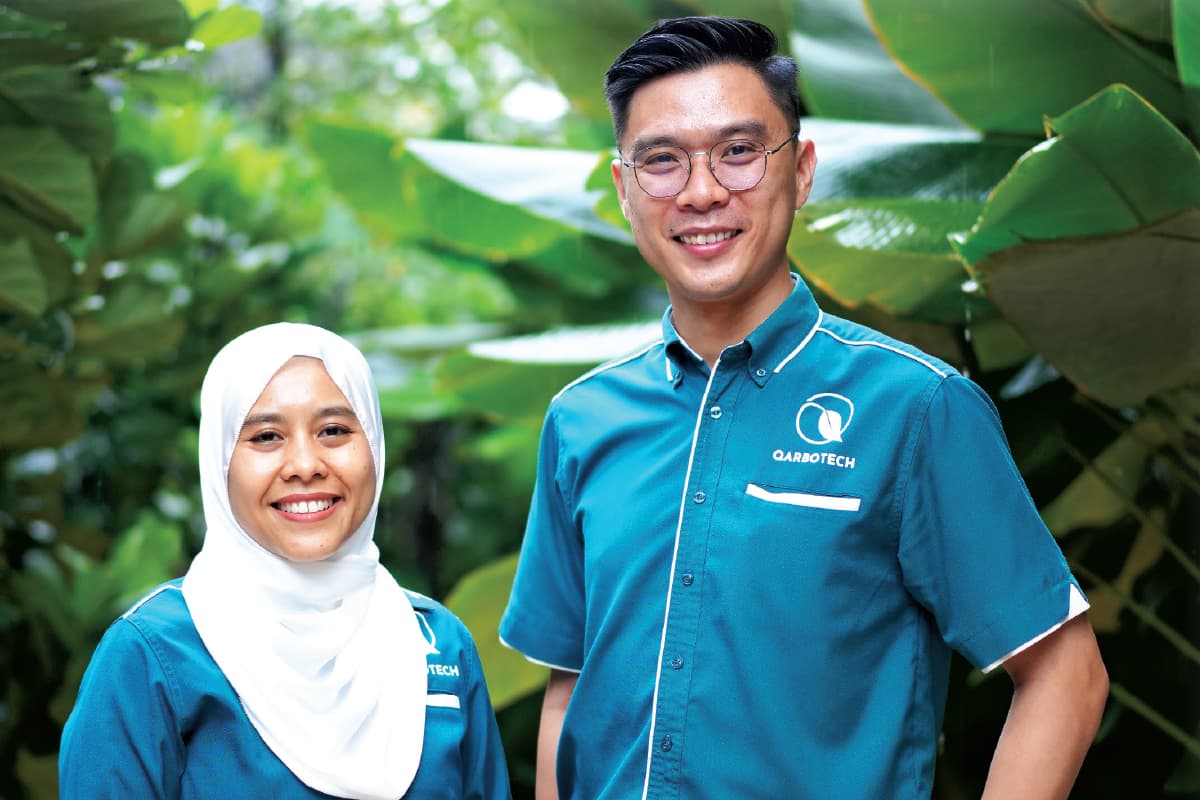
“Normal quantum dots are metal-based, which is not suggested for consumption as it will bioaccumulate in the body. However, the carbon-based [compound within the enhancer] is inert and safe for handling and consumption,” says Qarbotech founder Dr Suraya Abdul Rashid.
The enhancer boosts crop yields by up to 60%, based on a validation study focusing on paddy cultivation done in Sungai Besar, Selangor.
“With 60% more rice yield, that will make Malaysia self-sufficient, provided all paddy farms in the country use our product. We can be self-sufficient and not rely on imports anymore,” says Qarbotech co-founder and CEO Chor Chee Hoe.
The carbon quantum dots are produced from agrowaste biochar — a charcoal-like product made from biomass waste. The biochar is processed into a powdery material using a hydrothermal process, with the result being tiny carbon quantum dots suspended in water.
“For application, it can be either through a foliar spray onto the plant’s leaves or through absorption into the soil and roots. Our farmers usually mix it with either agricultural inputs, for example, pesticides or fertilisers, so they can spray everything in one go,” says Chor.
With drastic climate changes affecting crop cycles, Chor found that production dropped to around 40%, especially during the overcast weather or rainy season. However, the enhancer solution has helped them maintain the consistent yield through the monsoon season and even the dry season.
“We are also able to help in removing more carbon dioxide, ranging from 20% to 80%, as photosynthesis absorbs carbon dioxide and releases more oxygen. So, we also see that in the future, if a lot more farms or even more organisations are using our product, we can help them with carbon offsetting,” says Chor.

Down to the nanospeck
Handling quantum dots can be challenging due to their nanoscale size. Moreover, quantum dots are often synthesised using complex chemical processes that require precise control over reaction conditions and parameters.
“From the early part of my career, I’ve been working on producing nanomaterials. So, one challenge that I’ve encountered is that when you produce nanomaterials, most of the time, the process is not scaleable,” says Suraya.
A professor with the Department of Chemical and Environmental Engineering in the Faculty of Engineering at Universiti Putra Malaysia (UPM), Suraya currently serves as deputy director of the Institute of Nanoscience and Nanotechnology (ION2).
Producing nanomaterials in a lab is a small feat for Suraya but commercialising them has been a challenge.
“The normal method of making it wasn’t really safe, as my students had experienced mini explosions through the experiment. It is a headache if you want to scale it up,” says Suraya.
Initially, she did not think that her research into nanomaterials would be utilised for producing the photosynthesis enhancer. However, she realised that researching and commercialising nanomaterials for devices required more studies and grants compared to agriculture solutions.
“I went into agriculture thinking that coming up with the solution is more practical, easier to apply and a lot faster to commercialise. So, the lowest hanging fruit, as far as commercialisation is concerned, is through agriculture,” says Suraya.
But the challenge doesn’t stop there as securing government grants for the fundamental research on quantum dots is highly competitive as well.
“And that’s why we still have a lot more to explore in terms of other applications or even more fundamentals about the material,” says Chor.
During the early days of the start-up in 2018, the plantations and farms they pitched to expected more validation data in the commercial field, for which Qarbotech had limited resources in collecting at that point in time.
“We pitched to a number of Malaysian investors too but [they weren’t interested]. However, we were very fortunate to participate in a competition organised by Japanese firm Leave a Nest,” says Chor.
Leave a Nest is a science venture company founded in 2001. Qarbotech was announced as the grand prize winner in the Tech Planter Asia Finals 2021 organised by Leave a Nest. With the win, an early-stage venture capital within Leave a Nest’s network invested in its pre-seed stage.
“That investment gave us the resources to kick-start more trials to collect more data,” says Chor.
Chor’s family network and friends who were in the biotech space had supported their ventures as well in early 2023. Eventually, they connected with 500 Global, which had invested in Qarbotech in August 2023.
“500 Global has a very close network with other government agencies and individuals that are related in the agriculture space, a few of whom we have collaborated with. We also get access to the founder hub that consists of coaches and mentors from overseas who are in the nanotech, agritech and even biotech space,” says Chor.
Suraya also mentions the support they get from 500 Social House, a co-working space for founders under 500 Global, in conducting meetings. The space has benefitted them as Qarbotech is often based in UPM.
“So the funding from 500 Global will be utilised to establish our pilot plant to upskill our production capacity. For now, our production capacity is just 2,000 litres a month. But by the end of June, we will have a production capacity of 100,000 litres a month. That will fulfil the demand from Malaysia and also interested parties in Indonesia,” says Chor.
Qarbotech was invited by the Northern Corridor Economic Region to conduct trial runs focusing on Perak, Penang, Kedah and Perlis. It has offered Qarbotech a free test plot to run trials on rice cultivation.
Additionally, Perbadanan Putrajaya has approached Qarbotech to address the issues concerning insufficient sunlight in the shaded areas of the botanical gardens. Qarbotech is to run a proof of concept with its solution to help improve the growth of the landscaping plants.
Qarbotech was also recently shortlisted for UOBFinLab’s GreenTech Accelerator 2024 in the food and agriculture category, which was announced on June 27 and will conclude this month (November).
The programme offers up to S$100,000 (RM329,000) for green techs to pilot relevant, impactful and deployable solutions with businesses. During the six months, the selected green techs are tasked with tackling real-world sustainability pain points from more than 50 challenge statements contributed by 27 challenge partners.
Save by subscribing to us for your print and/or digital copy.
P/S: The Edge is also available on Apple's App Store and Android's Google Play.