

This article first appeared in Digital Edge, The Edge Malaysia Weekly on November 11, 2024 - November 17, 2024
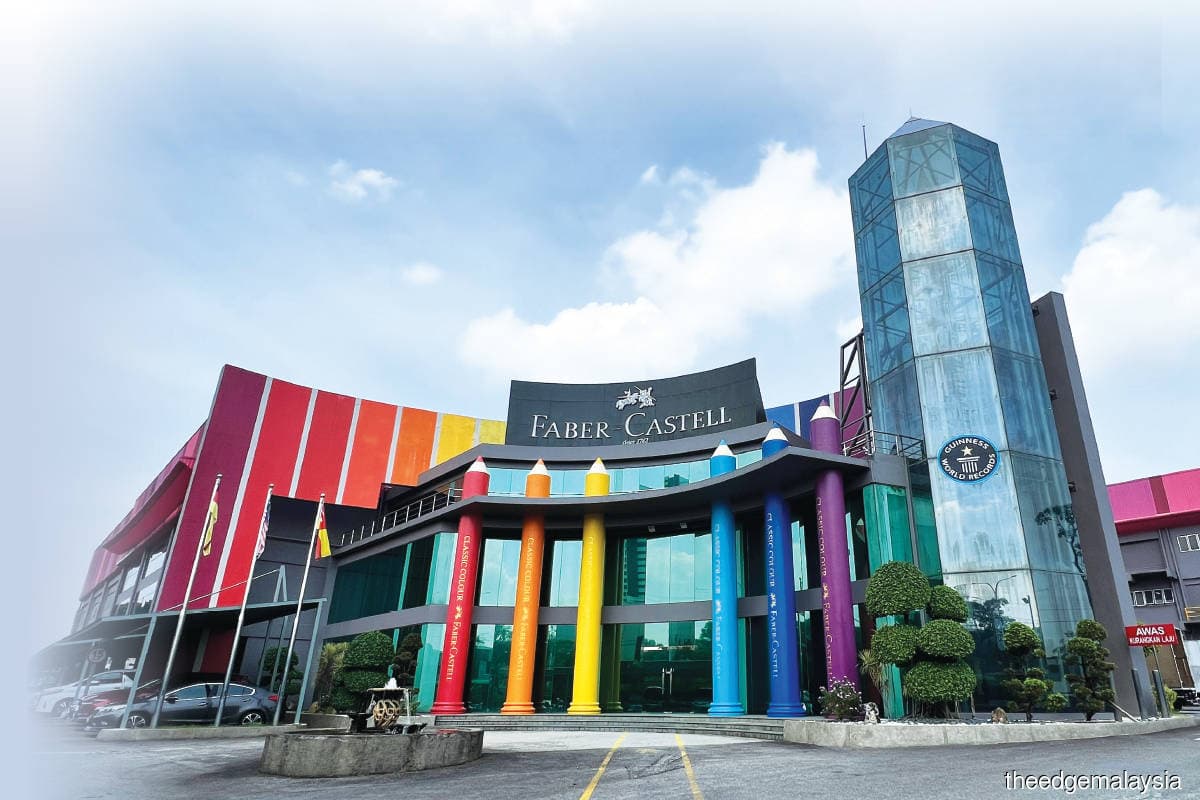
Imagine stepping into the Faber-Castell factory, tucked away in the industrial sprawl of Subang Jaya. You would expect rows of assembly line workers, busy chopping wood, applying glue and assembling pencils — a scene straight out of a traditional manufacturing playbook.
But inside this colourful, bustling facility, nostalgia has given way to innovation. Robotic arms swoop and pivot, automated systems hum. Here, the factory churns out pens, pencils and other stationery items, powered by a sophisticated blend of smart automation and streamlined logistics.
It offers a window into how a legacy brand can reinvent itself, trading in old tools for cutting-edge technology in the manufacturing process. Andrew Woon, managing director of A W Faber-Castell (M) Sdn Bhd, notes that while machinery and automation aren’t new to the stationery industry, technologies like artificial intelligence (AI), robotic process automation (RPA) and the Internet of Things (IoT) have become essential for streamlining operations and boosting efficiency.
The Malaysian arm of the 263-year-old German brand Faber-Castell began in 1978, with the late Dr Toh Yan Peng at the helm as both managing director and CEO. With just eight employees, the subsidiary initially focused on producing natural rubber and PVC erasers, rolling out the first products in 1980. It has since grown into one of the world’s largest eraser manufacturers, exporting 90% of its 150 million erasers produced annually — alongside a wide array of writing instruments — to markets across the globe.
“Even since the late Dr Toh’s time, machinery existed and they were heavy-duty production machines. What I did was accelerate that progress and introduce machines that operate with technologies like AI to run more efficiently. This increased output as well as reduces our labour costs,” Woon tells DigitalEdge.

At Faber Castell’s Malaysian factory, for example, AI vision cameras handle quality control, scanning for seven to 15 types of defects at the end of the assembly line.
“Normally, we have a person who checks the quality of the products, whether they are assembled properly, printing is clear, preventing misalignments and if you have noticed, there is a little wax at the end of new ballpoint pens; these were all physically checked by a designated person,” says Woon.
“Now, we have installed these AI vision systems, which not only detect defects and ensure better quality control but also collect data and improve machine throughput.”
The company plans to invest US$7 million (RM30.5 million) in capital expenditure for new machinery, with an additional US$40 million earmarked for warehousing and manufacturing facilities to align with the standards of Industry 4.0.
This is in line with Malaysia’s ambitious New Industrial Master Plan (NIMP) 2030, which aims to establish 3,000 smart factories by the decade’s end. NIMP 2030 builds on the foundation of Industry4WRD, the country’s first national policy on Industry 4.0 introduced in 2018, designed to drive digital transformation and technological adoption in the manufacturing sector to keep it competitive on a global scale.
“[At the moment] we have a road map for the next three years, where we will probably spend close to a US$50 million investment in capital expenditure on machinery and expansion. We also have a strong double-digit growth projection, which we are [hoping] to increase through these machines to support our growth. This is not just to cater for the local demand, we also export a lot of products,” Woon adds.
Globally, Faber-Castell operates seven other manufacturing facilities, in Indonesia, China, Peru, Brazil, India, Germany and Austria.
When Woon assumed the role of managing director in 2019, he set his sights on digitalising operations to boost efficiency, as sales management and order processing were still handled manually. The company’s first step was to streamline these back-end processes by implementing RPA for sales and order management.
“We used to manually take orders and it took a lot of labour and time to do it. We have now shifted towards mobile sales apps and RPA for our invoicing. Processing orders now is seamless,” he says.
Integrating data from various sources into a single dashboard presents challenges, as raw data formats often lack compatibility. However, Woon notes that RPA bots can reformat and standardise this data, enabling smooth visualisation. RPA facilitates data cleaning, filtering and conversions — such as adjusting date formats or unit types — and consolidates information from different sources like retail and stationery stores.
It can also automate the regular updating of dashboards, ensuring stakeholders have real-time access to critical information. Additionally, it can be programmed to trigger alerts based on specific metrics; for example, if inventory levels dip below a set threshold, an alert initiates the restocking process.
“Processing, which used to take hours per order, now takes just minutes. It saves time and reduces manual work for our sales and customer service teams, freeing them from repetitive tasks. Now, they can spend that time engaging with more stores and focusing on higher-value tasks,” he adds.
The company also utilises machine learning for sales forecasting through a custom-built application tailored for seasonal, promotion-driven activities. This approach helps prevent both overstocking, which could take years to clear, and understocking of products.
“When dealing with vast amounts of data points — thousands upon thousands of entries — it can take weeks, even months, to identify patterns manually. It’s not impossible, but it’s challenging. We use AI to run these forecasts and it significantly improves our accuracy, which has proven to be quite good.”
Crafting stationery in an automated age
Before automation, production volumes were modest, but now the company can turn out 2,000 to 4,000 ballpoint pens per hour, Woon says.
“Human workers would probably produce much lower in terms of units. Those were the early days, but now we have automation and use machines to run the production and assembly lines.”
Woon clarifies that when he talks about robotics, he is referring not to humanoid robots that perform manual tasks. “It means that some machines are smarter, more intuitive with AI built in, while others handle repetitive tasks like assembly, work that no longer requires human involvement.”
He recalls that on the assembly line, each station once required a team of at least 10 people. One person would assemble a part, another would handle the next component, someone else would take care of packing and another would perform quality checks. The list went on. Now, automation has streamlined these roles, transforming the production process.
“As you automate, humans do not need to do anything much except operate and control the machine, rather than doing the actual work of assembling products,” says Woon.
AI-powered machines and robotics now work seamlessly alongside humans in both factory and warehouse environments, executing repetitive tasks with precision and speed, enhancing productivity and reducing errors. While this integration has undoubtedly boosted efficiency, Woon acknowledges it has replaced certain areas of human expertise.
Within Faber Castell’s operations, he says, the shift towards automation has meant letting some of the manual labour workers go or redeploying workers to other departments to adapt to the rise of technology.
“We have around 177 local workers and the rest, approximately 83, are foreign workers,” says Woon.
“Today, most of our foreign workforce comes from Indonesia, Nepal and Myanmar, often on two-year contracts. After that period, some choose not to renew and, with the introduction of machines, we simply don’t need as many people as before.”
Existing workers undergo extensive training to understand programming and operate advanced tech machinery. With the growing reliance on technology, the company has also started hiring specialists in machine learning to support these innovations.
Woon also highlights the challenge of a rising minimum wage, which requires a careful balance between managing labour costs and keeping product prices competitive.
To address this, Faber-Castell has focused on automation and technological advancements to increase production efficiency and reduce the workforce in the long run.
“In Malaysia, the minimum wage has increased; it was RM1,000, then RM1,500, and now in the latest national budget it is RM1,700. As labour costs rise, so do product prices, so we needed to find ways to offset these increases. Automation, particularly AI, enables us to achieve that,” he adds.
Can stationery survive the digital age?
In a world dominated by screens, the relevance of stationery is perpetually in question, especially as technology becomes essential for even the simplest tasks. The global pandemic, which underscored the role of digital tools, has only intensified debates over whether the digital age will spell the end of traditional stationery.
Yet, Woon believes that stationery is here to stay, driven by the innate human desire to write rather than constantly tap on glass screens.
“The country is still unprepared for technology to take over entirely, especially in the education system,” he explains.
“In Malaysia, demand for stationery will remain steady. In wealthier countries, classrooms have adopted iPads, but here, the cost is prohibitive for many families. For that reason, the stationery industry is likely to endure.”
Globally, the stationery market remains substantial, with a value of about US$80 billion in 2022. Despite the ubiquity of digital tools, the industry has proven resilient — growth is projected to be at a rate of 4% annually starting in 2023, according to Ken Research. This steady growth can be attributed to factors like the rising demand for personalised, eco-friendly stationery, the flourishing creative industry and the lasting appeal of handwritten notes and journaling.
Recognising this potential, Faber-Castell has adapted to the digital age by blending tradition with innovation. Each year, the company partners with Malaysia’s Ministry of Education on the Score-A programme, a collaboration designed to integrate creative learning into the curriculum.
This initiative encourages students and educators to explore mind mapping, journalling and other visual tools that incorporate stationery, fostering skills that digital-only methods can overlook.
“Our vision is to empower educators and students by actively contributing to the education sector, sparking meaningful discussions, nurturing creative thinking and enhancing problem-solving skills,” says Woon.
In a world that often pushes paper aside, stationery is finding ways to write its own future, he observes.
Save by subscribing to us for your print and/or digital copy.
P/S: The Edge is also available on Apple's App Store and Android's Google Play.