

This article first appeared in The Edge Malaysia Weekly on October 28, 2024 - November 3, 2024
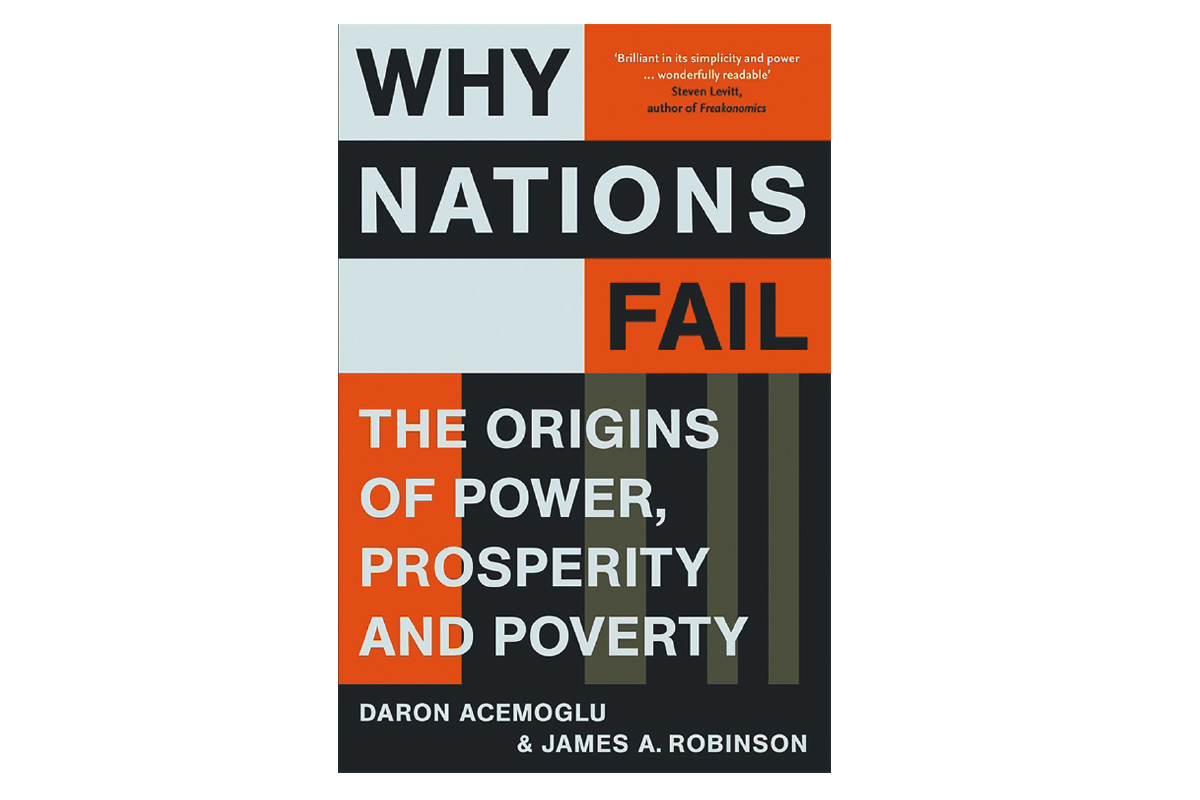
Why Nations Fail draws widely from across the globe and vividly from history to answer some big questions on why some societies prosper while others persist in poverty
Economics not long ago was at risk of becoming obscure and irrelevant. The perfectly informed and rational human agents of mainstream theory were nowhere to be found in the bubbles, financial crises and economic upheavals of recent times. All too often, Western policymakers and market practitioners have been stunned when sensible economic prescriptions were blindsided by politics.
Emerging from the consequent angst in academic circles is an approach that broadens the forces and influences seen to shape economic outcomes. Nobel Prize winner Daniel Kahneman’s Thinking, Fast and Slow marries insights from social psychology and neuroscience to economic behaviour.
Blending prehistory, geography and anthropology, The Origins of Political Order by Francis Fukuyama’s distils three ingredients for a successful and enduring nation: the rule of law, a strong state and accountability.
Older, but in keeping, is Albert O Hirschman’s classic text Exit, Voice, and Loyalty, which makes a comparison between the choices citizens make when trapped in failing organisations and states. “Exit” is voting with your feet, taking your business elsewhere. “Voice” is staying put and fighting for reform from within.
Daron Acemoglu and James A Robinson, professors at MIT and Harvard University respectively, make a compelling addition to this trend in contemporary economics. Why Nations Fail draws widely from across the globe and vividly from history to answer some big questions. Why do some societies prosper while others persist in poverty? Why does the global map of the richest and poorest countries look remarkably the same today as 50, 100 or 200 years ago with sub-Saharan Africa and Central America much poorer than Western Europe, North America, Australia and New Zealand? Without oil, the Middle Eastern countries are also all poor.
Traditional development economics (the “dual economy” thesis, modernisation theory, “market failures”) ignore politics. Therein lies their failure for it is politics, argue the authors, that drive everything. Get the politics right and all else will follow.

And what is right are “inclusive” institutions that incentivise citizens and create virtuous circles of innovation, expansion and widely held wealth. Elements vital to keeping the virtuous circle going are pluralism, where many varied groups exist to check each other’s power, laws applied equally, universal education, a free media to inform and empower, secure property and patent rights that encourage investment and open markets free of monopolies and progressive taxes.
However, where “extractive” institutions prevail, allowing the small elite to monopolise economic gains, technological advances are blocked, productivity deteriorates and a vicious circle of enduring backwardness sets in. There is great and easy profit to be made merely by controlling power, expropriating the assets of others and setting up monopolies. Hence the hostility to new technologies, the impact of which is both creative and destructive. Favouring new skills and economic groupings, innovation invariably undermines the power and privileges of the old, vested elite.
However, inclusive institutions that adapt to allow ever-broader sections of society to generate and share the new wealth trigger a path of rising prosperity. Extractive societies are ultimately unsustainable. Blocking newer, more efficient ways, old sources of wealth are rendered obsolete by more vibrant competition elsewhere. As the pie shrinks, infighting among the elite for control intensifies.
Acemoglu and Robinson’s central thesis is that these institutional differences become crucially important at critical junctures, major events that disrupt the existing balance of power in a nation. The Black Death of 1346, expansion of world trade after 1600, the Industrial Revolution in the late 18th century and European colonisation were among such defining moments.
Why did the Industrial Revolution take off first in England followed by its settler colonies (the US, Canada, Australia), France and Spain, but fail elsewhere? The authors trace the roots of the bubonic plague in 1346, which transformed and split Europe. Halved in number, the peasantry in Western Europe gained bargaining power. Not so in Eastern Europe. Serfdom hardened to leave the medieval feudal order intact and the masses destitute.
In England, however, the masses were further empowered by the Glorious Revolution of 1688. Power shifted from the monarchy to Parliament, which acted to open economic access to a broad cross-section of society. England rationalised property rights, enacted patents for ideas, protected law and order and abolished monopolies and arbitrary taxation.
Thus, by the 18th century, England had developed the world’s first set of inclusive political and economic institutions. This plurality of interests and freedom under a growing market economy allowed entrepreneurs and innovators to emerge and commercialise the scientific knowledge that had accumulated in Europe over several centuries. The impact was dramatic. The Industrial Revolution improved every aspect of the English economy: transport, metallurgy, steam power and mechanisation of textile production. The French Revolution in 1789 then led the institutions of Western Europe to converge with those of England.
In contrast, absolutist rule continued in the 19th century in Eastern Europe, the Ottoman empire, Africa and most of Asia, blocking the spread of industrialisation. China was a major naval power centuries before the Europeans. But by the 15th century, the Ming emperors had abandoned global voyages fearing that trade and new ideas would threaten their rule. Subsequently, independent cities, merchants and industrialisation were non-existent in China for two centuries. Though never formally colonised, a weakened China was defeated in the Opium wars and forced into humiliating trade concessions by the European powers.
Conditions were no less hospitable in India with society constrained under a rigid caste system, absolutist Moghul rule and the arrival of English colonial rule. In Southeast Asia, initial progress from a thriving spice trade reversed under the extractive plantations of the Dutch companies and English East India Company. Only Japan played out differently in Asia. Like China, Tokugawa rule since 1600 was feudal, absolutist and banned international trade. However, the arrival of the Americans in 1853 cemented opposition and led to a political revolution. The Meiji Restoration enabled more inclusive institutions and modernised Japan, laying the foundations for subsequent rapid growth.
In the Americas, European colonisation set the stage for divergence. In contrast to the inclusive institutions modelled after England that developed in the US and Canada, highly extractive ones emerged under the Spanish conquistadors on lands occupied by the once majestic Aztec, Inca and Maya civilisations, forcing their living standards down to subsistence level. These institutions endure till today, condemning the region to poverty.
Africa was the part of the world least able to capitalise on the Industrial Revolution. Already lacking centralised states, resulting in lawlessness and unstable borders (a continuing handicap shared with Afghanistan, Nepal and Haiti), the Atlantic slave trade decimated human and property rights and compounded Africa’s backwardness. Ironically, while the discovery of the Americas helped England develop inclusive institutions by emboldening the merchants opposed to the Crown, it made Africa more extractive. Independence, rather than creating a critical juncture to improve their institutions, has opened a cycle of revolutions and radical movements that merely replace one tyranny with another (dubbed the “iron law of oligarchy”).
With these vivid trajectories from the past 500 years, the authors show how critical junctures served as a double-edged sword in that how political institutions in various nations responded determined if they set off on a path of rising prosperity or poverty. Fascinatingly, small initial differences became more significant over time.
Seeing institutions and incentives as the cause, Acemoglu and Robinson are dismissive of views that poor countries are poor because of their geography or culture or because their leaders are ignorant.
Witness the yawning gap between North and South Korea, identical twins in geography and culture, but divided at the 38th parallel six decades ago to evolve under very contrasting political regimes. Or East and West Germany before the fall of the Berlin Wall in 1989. Perhaps the most controlled experiment is in the little-known town of Nogales. Divided by a mere fence, residents on the north, belonging to the US, face lower crime, live longer and earn three times the south side, which is part of Mexico.
Hence, it is not Islam that keeps the Middle East poor, but the extractive nature of Ottoman and European colonial rule bequeathed upon today’s authoritarian regimes. Could European descent be at the root of success? Yet Argentina, more “European” than the immigrant populations of the US and Australia, has fallen mightily from the richest ranks at the turn of the 20th century. Meanwhile, Japan and Singapore, with miniscule European heritage, are now as prosperous as Western Europe.
Western policy circles (the IMF, World Bank, aid agencies) also come in for criticism with their approach that assumes that merely enlightening political rulers about sound economics will “engineer” prosperity. The politically powerful make economic choices that enrich them at the expense of the majority because they can get away with it, not because they are ignorant.
But history is not destiny. Crossing into the 20th century, there are striking examples of countries “breaking the mould”. In the US’ South, the empowerment of black Americans through the civil rights movement, coupled with the intervention of federal institutions, finally ended the domination of the southern white elite. In 1940, southern states were at half the average US national income. By 1990, the gap had vanished and in 2008, the nation elected its first black president.
The rebirth of China is no less remarkable. Impoverished for three decades under Mao’s disastrous policies of the Great Leap Forward and Cultural Revolution, China reversed course to embark on the most rapid growth in the world. It was Deng Xiaoping’s brilliant political coup that freed the way to introduce more inclusive market incentives in agriculture and industry, and allow foreign investment into selected cities.
The common ingredient: political reform that seized the day to shape more inclusive economic institutions and incentives. While admittedly few, it is in these examples that the lessons of the book have their most appeal, offering a way forward to douse the fires burning in Egypt, Turkey and Brazil.
Tong Kooi Ong is executive chairman of The Edge Media Group. This piece first appeared on his blog www.tongkooiong.com.
Save by subscribing to us for your print and/or digital copy.
P/S: The Edge is also available on Apple's App Store and Android's Google Play.