

This article first appeared in The Edge Malaysia Weekly on October 21, 2024 - October 27, 2024
TOWARDS the end of the European trading day on Oct 15, Dutch chip equipment giant ASML Holding NV, which has a monopoly on making machines and tools for manufacturing the most advanced chips, like those used to train large language artificial intelligence (AI) models, inadvertently revealed its third-quarter earnings as well as guidance for the fourth quarter on its website. Although US tech giants don’t start reporting their quarterly earnings until the end of this month, two foreign bellwethers — ASML and its biggest client, Taiwan Semiconductor Manufacturing Co, or TSMC, traditionally report a week earlier, giving tech investors an idea of what to expect as the earnings season gathers pace.
ASML revealed bookings of just €2.6 billion (RM12.2 billion) in the September quarter, well short of the €5.39 billion that most analysts were expecting. For companies in the semiconductor chips ecosystem, bookings are seen as a good predictor of earnings over the next several quarters. ASML now expects net sales for 2025 to come in between €30 billion and €35 billion, at the lower half of the range it had previously guided.
Understandably, ASML shares plunged 21% over the next two days, triggering a broader tech sector sell-off led by AI-related stocks. It wasn’t just ASML’s chip gear peers like KLA Corp, Lam Research Corp and Applied Materials Inc that were hit hard. Shares of chip design firm Nvidia Corp, whose top-of-the-line Blackwell AI chips are sold out until the end of next year, chip manufacturers like TSMC and South Korea’s Samsung Electronics, and AI chip users such as software giant Microsoft Corp, search behemoth Google’s owner Alphabet Inc, cloud computing and e-commerce pioneer Amazon.com Inc and social media supremo Meta Platforms Inc, were hammered as well in the aftermath of ASML’s earnings.
Leading edge technology
ASML is probably the most important tech company in the world that most people have not heard about. The chip gear maker dominates leading edge lithography, a printing process that uses a flat stone or metal plate on which the image areas are worked using a greasy substance so that the ink will adhere to them, while the non-image areas are made ink-repellent. Its humongous machines burn patterns in layers of material deposited on disks of silicon, completing one stage in the multi-step process of making semiconductor chips.
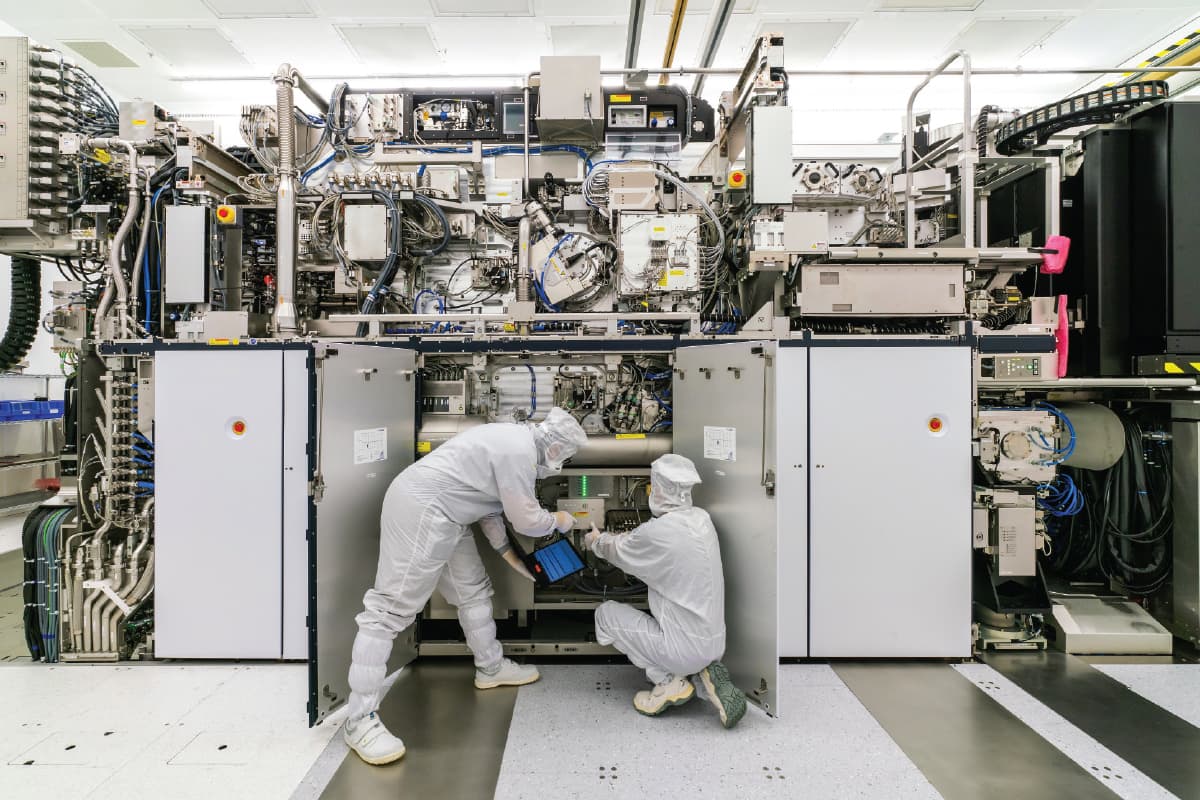
Its top-of-the-line machines like the high-numerical-aperture (high NA) extreme ultraviolet (EUV) lithography machines can cost up to US$380 million (RM1.6 billion) and weigh as much as two Airbus A320s. ASML is the only company on earth that has the ability to make these machines. Let me try to explain what EUV technology is, why it is so important, so expensive and why companies like TSMC and its peers are willing to spend tens of billions to buy more and more expensive EUV machines.
Chips made with EUV lithography are behind driverless cars and robotaxis, AI-powered smartphones like Apple’s new iPhone 16 Pro that are now hitting stores, smart homes, augmented reality and, of course, AI. EUV gear helps companies like TSMC, which accounts for nearly 40% of ASML’s revenues, fit in more transistors on a chip, which in turn facilitates higher processing speeds and memory. Nvidia Corp and other chip design firms are seeking higher-intensity processing for their AI chips.
Each new generation of chips, known as a node, involves cramming billions of tiny transistors together. Smaller nodes indicate more advanced technology. Making ever smaller nodes leads to more powerful, faster and more energy-efficient chips. Photolithography, first used in chip manufacturing in the mid-1960s, made it possible to pack chips with increasingly more components. The process involves crafting small circuits by guiding beams of light through a series of mirrors and lenses, and then shining that light on a mask, which contains a pattern. Light conveys the chip design, layer by layer, eventually building circuits that form the computational building blocks of everything from smartphones to AI.
In the 1960s, photolithography machines used beams of visible light. But the smallest features their light could draw on the chip were fairly large. In the 1970s, chip tool makers started using smaller wavelengths of light, and by the early 1980s, they could make chips with UV light. Japanese chip equipment makers Nikon Corp and Canon Inc dominated the industry. Founded in 1984, as a subsidiary of Philips in Eindhoven, the Netherlands, ASML started as a bit player. Though Japan’s NTT first demonstrated EUV in 1986, it was ASML that mastered the process for mass production two decades later, leading to 7 nanometer (nm) chips in 2019, 4nm by 2022 and 3nm currently. TSMC plans to start mass production of 2nm chips with ASML equipment late next year. The next iteration of Apple’s smartphone, the iPhone 17, will most likely have a 2nm processor chip.
EUV lithography enhances the scalability of chip production, making it much more cost effective. That has been critical to sustaining Moore’s Law, which predicts that the number of transistors on an integrated circuit doubles every two years or so. Chipmakers are always trying to shrink the transistors on a microchip in order to pack more of them in. That is increasingly becoming harder now that transistor dimensions measure in a few nanometers.
The key to ASML’s dominance is the use of EUV light, which is like a precision scalpel in chip design that helps reduce the likelihood of defects. EUV light’s special wavelengths enable finer chip imprinting than traditional deep ultra violet (DUV) light.
Here’s how the EUV process works: Tiny tin droplets are vapourised by laser to create plasma, emitting EUV light. Smooth precision mirrors focus the light with incredible accuracy. The process repeats 50,000 times per second, ensuring steady and efficient EUV light production for chip manufacturing. Its scanner creates distorted circuitry patterns, counteracting physical and chemical process distortions. The machine then checks and adjusts the wafer position 20,000 times a second to maintain a perfect alignment. Each silicon wafer undergoes numerous etching and coating cycles, requiring exact lithographic exposures. The whole process is complex and requires precision engineering. It is very difficult to master, which is why ASML is the only maker of EUV machines and only one chip maker, TSMC, has been able to optimise the use of those machines. China is seven years behind ASML in chip equipment manufacturing and probably up to five years behind TSMC in making 2nm chips using ASML’s EUV machines.
The plunge in ASML stock follows its massive rally over the past eight years. The stock surged over 1,300% from January 2016 through to July this year when its market capitalisation topped US$400 billion. Although the stock has fallen 38% from its peak three months ago, it is still up over 800% since early 2016. The stock now trades at 24 times next year’s estimated earnings despite analysts rushing to slash their earnings estimates for the chip equipment giant. The irony is that ASML’s bookings and revenues related to AI chip equipment are still growing at a fast clip. Revenues grew 30% last year but are likely to slow to single-digit growth this year before accelerating again in the second half of 2025.
Hit by bans, customers’ problems
The Dutch maker of chip manufacturing tools is being hit by US export controls on advanced chips as well as equipment to China and an ongoing slump in the auto sector, particularly electric vehicle (EV) sales outside China. China sales accounted for 29% of ASML’s revenues last year. Because ASML’s EUV machines contain US-made components, like its critical light source manufactured in San Diego, California, the US has effective power to limit ASML’s exports and put pressure on the Dutch government to do the same. Without the US components, ASML can’t make the much coveted EUV gear so it has to comply with Washington’s rules.
With further US restrictions, ASML expects China sales will likely make up around 20% of its total revenues in 2025. Despite the US and Dutch ban on EUV machines, ASML can still export immersion deep ultraviolet (DUV) machines, or more mature machines used to manufacture lower-end chips that cannot be used to train complex large language AI models.
The sales surge in China late last year and in the first nine months of this year was triggered by reports of the impending US and Dutch ban of higher-end chip equipment to China. Chipmakers in China bought up as much equipment as ASML could deliver as they built up inventory ahead of the ban. Nearly 50% of ASML’s total sales so far this year has been to China, compared with 30% in recent years. Another issue for ASML: problems at the beleaguered Intel Corp, its third largest customer, which has scaled down and further pushed out its audacious US$100 billion-plus chip foundry rollout. Last month, Intel slashed its capex by 20%, mostly by putting off the purchase of expensive chip equipment.
Samsung, ASML’s second largest customer, is also grappling with problems as it tries to expand its foundry or contract manufacturing for chip design customers like Nvidia, Advanced Micro Devices Inc, Broadcom Inc and Qualcomm Inc. “Intel and Samsung’s integrated business model is more inherently difficult than, and disadvantaged to, the manufacturing-only business model of TSMC, as the complexity of designing and manufacturing chips at the same time is enormous,” notes Morningstar’s chip equipment analyst Javier Correonero in a recent report. “Some of Intel and Samsung’s foundry customers might be sceptical to share their chip designs with these firms, as they might fear their designs could be copied if there is no proper separation between design and manufacturing operations,” he says. “As TSMC is only a manufacturer, it does not have to deal with the complexities of chip design and can focus on maintaining its position as the world’s best fab operator.”
The ban on exports of EUV equipment to China and problems at Intel and Samsung notwithstanding, ASML will grow revenue at a low double-digit rate in the next decade with demand from more fabs, more systems per fab, higher selling prices and growth in service revenue. ASML’s problems are “from specific issues at Samsung and Intel and potential restrictions on China, rather than structural headwinds”, says Janardan Menon, semiconductor analyst at Jefferies & Co in London. “Despite the slowing of Moore’s Law, ASML is still managing to shrink chip resolutions that, together with new transistor architectures like gate-all-around, or GAA, and complementary field-effect transistor or CFET, used in smaller technology nodes, will require more lithography intensity,” Correonero argues. As ASML improves not only the technology, but the productivity of its machines, it can justify charging its customers higher prices. Even if it charges 20% more for its equipment but users like TSMC see productivity increases of 40%, the cost per wafer for the foundry is still going down.
Analysts estimate as EUV machines account for more than 70% of ASML’s total revenues by the end of 2026, its sales to China will likely shrink to 15% or less. That will make TSMC by far its biggest customer, perhaps accounting for as much as 60% of total revenues. Increasing over-reliance on a single customer could be ASML’s Achilles heel. As TSMC becomes a larger customer, it could try to put more pressure on ASML to lower the price of its equipment, Jefferies’ Janardan argues. Until now, both companies have refrained from exerting leverage on the other. ASML’s best strategy to offset this risk is to continue delivering productivity improvements, which it has successfully done so far.
The latest revenue and guidance miss that led to the record plunge in ASML stock this past week is likely to be in the rear-view mirror over the next few quarters. ASML is a key cog in the fast growing AI ecosystem. With its monopoly in EUV lithography, the Dutch giant which has gross margins of over 60% is well poised to bounce back soon. Its EUV and DUV lithography work with sophisticated embedded software without which the machines are just a giant heap of metal. ASML also bundles in an array of services for the users of its machines and software. The world needs more AI chips for everything from robotaxis to smartphones, and to make more AI chips, foundries like TSMC, Samsung and Intel will need more, and far better, EUV lithography machines to etch out their future.
Assif Shameen is a technology and business writer based in North America
Save by subscribing to us for your print and/or digital copy.
P/S: The Edge is also available on Apple's App Store and Android's Google Play.