

This article first appeared in The Edge Malaysia Weekly on October 14, 2024 - October 20, 2024
COMING to two years since completing its merger that gave it the No 1 spot among Malaysian listed telecommunications companies and a wide market share lead versus rivals, CelcomDigi Bhd (KL:CDB) CEO Datuk Idham Nawawi says the group is reaping merger synergies and economies of scale, but admits much still needs to be done to fortify its pole position.
“To be honest, being number one is a bit scary. It’s a lot easier to be a challenger than to be number one. The biggest challenge that we have as the number one, especially when you come from two different challengers, [is] how you change your mindset as the market leader … It is something we have to learn very fast, because our competitor may learn to be a challenger faster than [us] learning to be a leader. That is a challenge, because it’s easier to be a challenger — just attack, attack, attack, right? But [now] we not only have to defend against this attack, but we have to portray ourselves differently to society, to our customers, to all stakeholders. It is harder to be number one and to stay number one,” Idham tells The Edge in an interview.
Its closest competitor is a force to be reckoned with. Maxis Bhd (KL:MAXIS), which CelcomDigi overtook with the merger that was completed at end-November 2022, has been growing service revenue and gaining market share as well as subscribers faster than CelcomDigi, going by its numbers in the past six quarters.
With 20.2 million subscribers as at 2Q2024, CelcomDigi’s lead against Maxis has narrowed from 8.2 million subscribers at the point of merger to 7.5 million, according to data appended with the respective companies’ quarterly earnings releases between 4Q2022 and 2Q2024. Similarly, CelcomDigi’s lead on quarterly service revenue has reduced from RM0.61 billion in 4Q2022 to RM0.48 billion in 2Q2024 (see Charts 1 and 2).
Both CelcomDigi and Maxis — the so-called “Big 2” telecoms operators — have guided “low single-digit” service revenue growth for FY2024.
Maxis has also continued to guide “marginal to low single-digit growth” on earnings before interest, tax, depreciation and amortisation (Ebitda).

Following the release of its 2Q2024 results, where service revenue was 0.4% lower year on year, CelcomDigi, however, revised its guidance on earnings before interest and tax (Ebit) to a “single-digit decrease”. Idham attributes the downward revision to its voluntary separation scheme (VSS) that cost around RM140 million in 1Q2024. He is also “cautiously optimistic that the second half of 2024 will be better than the first half”.
The near-term hit notwithstanding, Idham says acceleration of the productivity enhancement programme puts CelcomDigi in a stronger position to move forward. “If you normalise against that, we should be stronger, because we are a lot more productive.
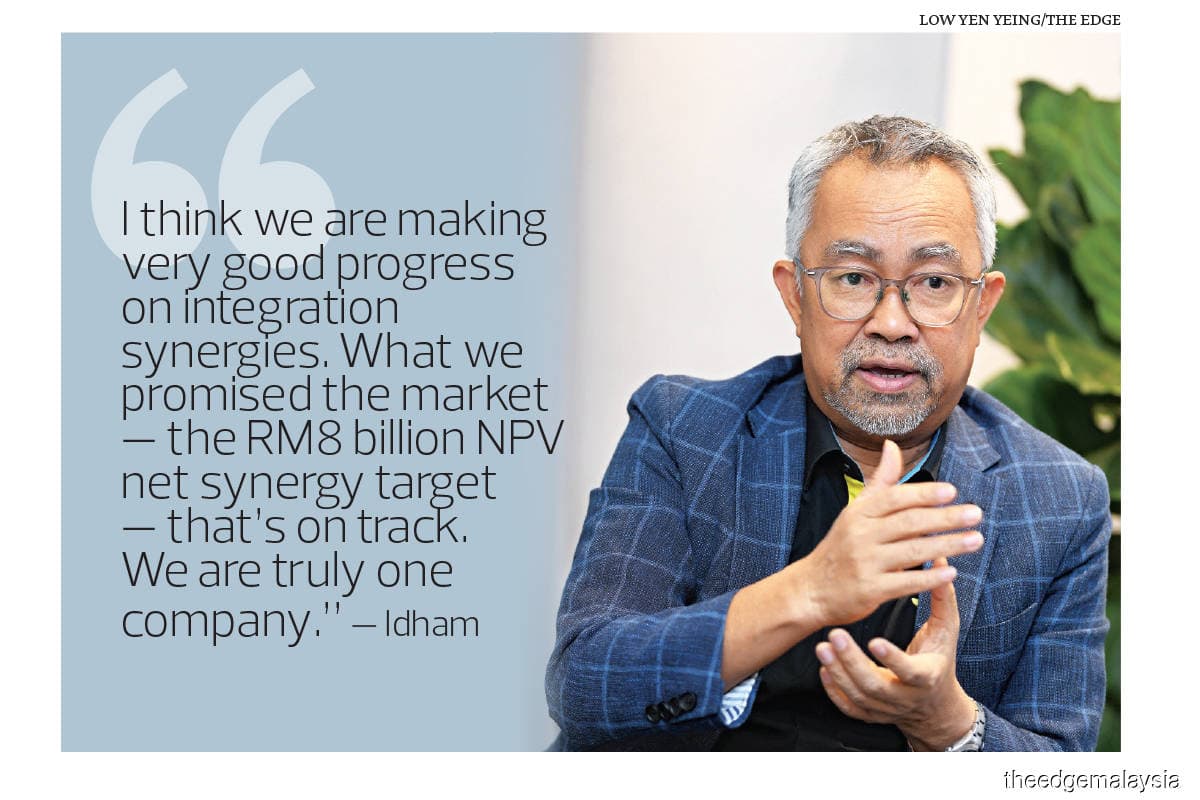
“I think we are making very good progress on integration synergies. What we promised the market — the RM8 billion NPV (net present value) net synergy target — that’s on track. We are truly one company. There’s no Digi. There is no Celcom. We are all one team, one management team, one sales team, one network team,” Idham says, relating how the corporate and commercial teams are in the CelcomDigi tower while the former Digi headquarters has been turned into an innovation and technology hub that houses its newly launched RM55 million Artificial Intelligence Experience Centre (AiX) where “more than 40” AI and 5G solutions and live pilots are being conducted with enterprise customers for adoption.
“It is all very AI-centric, solution-centric, not an exhibition but a showcase of what we have. Some of them are actually being implemented in the country,” he adds.
With over 3,500 redundant sites phased out and some 10,000 sites modernised, Idham says network integration works is set to surpass 75% by year end (from over 60% currently) and be completed next year, putting CelcomDigi in the best position to lead the second 5G network.
“We are now building the widest, most modern 5G-ready network, 18,000 sites. We can just add the 5G equipment for the 3.5GHz spectrum upgrade and we’re done,” he says, noting that CelcomDigi has a “multi-partner strategy” when it comes to vendors on infrastructure, application and managed services. “We have a good financial position, healthy cash flow … without giving too much detail [on the 5G second network proposal], I think we are holistically ready to build a digital nation.” (See accompanying story.)
Already, some RM1.1 billion gross synergies and over RM700 million net synergies (after deducting about RM400 million of integration costs, including for VSS, IT and retail store transformation costs) have been achieved in FY2023 and the first half of FY2024. The RM701 million comprises RM566 million savings in capital expenditure (capex) and RM135 million in operating expenditure (opex), Idham explains. By year end, total gross synergies for FY2023 and FY2024 are projected to exceed RM1.6 billion, with net synergies of close to RM1 billion.
Furthermore, there are potential sales coming from enhanced CelcomDigi retail stores nationwide, where frontline personnel have been retrained to deliver a “digital everything” experience to better attract and retain customers, who the group hopes will spend more every month and stay on longer, Idham reveals.
“If you buy a phone, you probably want a Bluetooth speaker, you may want something for your home that can connect to your phone … previously, we focused more on just phone devices and accessories,” he says, noting that these enhanced retail stores will grow from 17 currently to 44 by year end.
Idham also lets on that CelcomDigi is mulling making inroads into the data centre space, but emphasises that it has no plans to enter the real estate space. “We are looking at many options. There are many concepts on data centres that are being explored in Europe, one of it being sovereign data centre … If we were to play, or once we play, we will not be just a real estate player.”
Asked about Digi’s telecoms towers that can be sold to tower companies, Idham says CelcomDigi’s immediate priority is to complete merger integration works to derive the promised synergies and deliver better services to its consumer and enterprise customers.
Like everyone watching the telecoms space, Idham says CelcomDigi is also looking forward to the impending resolution of Malaysia’s decision to transition from a single wholesale network (SWN) on 5G to a dual network model. A decision on who will lead the second 5G network was supposed to be announced by end-September but was still pending at the time of writing. Will this be resolved by year end? “Hopefully [but] I won’t be able to say that. It is for the government [to say].”
Save by subscribing to us for your print and/or digital copy.
P/S: The Edge is also available on Apple's App Store and Android's Google Play.