

This article first appeared in The Edge Malaysia Weekly on October 14, 2024 - October 20, 2024
Go here for all about Budget 2025
MALAYSIA’s Budget 2025, themed “Madani Economy: Negara Makmur, Rakyat Sejahtera” to be tabled on Oct 18, was originally slated for a week earlier on Oct 11, the day Prime Minister Datuk Seri Anwar Ibrahim officially accepted the symbolic transfer of the Asean chairmanship to Malaysia from Laos in Vientiane.
The fact that Anwar is tabling his third straight federal government budget as the nation’s 10th prime minister is no small feat, beating the tenures of three of his immediate predecessors: Tun Dr Mahathir Mohamad (PM7 — 22 months), Tan Sri Muhyiddin Yassin (PM8 — 17 months) and Datuk Seri Ismail Sabri Yaakob (PM9 — 15 months).
Not only is the ringgit hovering near its strongest in at least two years against the US dollar, Anwar may even narrow the projection range or revise higher the country’s 2024 official gross domestic product forecast of 4% to 5%. Malaysia’s GDP grew 4.2% in 1Q2024 and 5.9% in 2Q2024, bringing the average in the first half to just over 5%. The Malaysian Institute of Economic Research (MIER), for one, sees GDP growing between 5% and 5.5% in 2024.
Against this backdrop of strength, expectations are still for Anwar to announce measures that would help lift wages and put more money into the pockets of the low- and middle-income groups to counter grouses of the higher cost of living. He has already announced a civil service wage increase in December 2024 and January 2025.
“We are committed to ensuring that Malaysia thrives in this global environment. We are determined to create a pathway to raise incomes, eradicate poverty and ensure that growth is sustainable, inclusive and just,” Anwar said at the Khazanah Megatrends Forum 2024 (KMF2024) on Oct 7.
As such, Budget 2025 — the final budget under the 12th Malaysia Plan (2021-2025) — is expected to remain expansionary, while continuing to show a reduction in budget deficit to the 3.5% to 3.9% range as a percentage of GDP, at least at the point of tabling, say economists. This is already above earlier projections of the fiscal deficit falling to as low as 3.2% of GDP by 2025.

“On balance, an expansionary budget will give the government a strong justification for a robust GDP growth outlook of 4.5% to 5.5% in 2025 (versus a revised estimate of 5% to 5.5% for 2024 from 4% to 5% previously). The announcement of most budget measures or policies including tax-related proposals are foreseen to further solidify the country’s economic and financial fundamentals as well as keep the current positive investor and market sentiment afloat through 2025,” Julia Goh, senior economist at UOB Bank Malaysia, wrote in a recent pre-budget note.
She expects the fiscal deficit for Budget 2025 to come in at 3.8% of GDP versus an estimated 4.3% for 2024. “To achieve this, the government has to undertake deeper reforms, enhance revenue, spur investments and expand the economic base,” she added, noting that reforms would set the tone to introduce the next five-year economic blueprint [13th Malaysia Plan (2026-2030)] that is scheduled to be tabled in parliament in July 2025.
Those who expect the fiscal deficit for Budget 2025 to be closer to 4% note the fact that year-to-date numbers show Malaysia’s fiscal deficit being closer to 5% versus the 4.3% targeted when Budget 2024 was tabled last year. This comes even as operating expenditure continues to grow faster than revenue, which official figures show to have come in below projections so far this year. This is despite development expenditure in 1H2024 coming in just below RM40 billion or 38% of the RM90 billion pencilled in Budget 2024.
By The Edge’s back-of-the-envelope calculations, Budget 2025 could exceed RM400 billion to be the biggest at the point of tabling for the country so far, beating Budget 2023’s RM386.1 billion and Budget 2024’s RM393.8 billion, on the back of growing operating expenditure. UOB’s Goh expects Budget 2025 to be RM404.8 billion, with operating expenditure rising to RM324.8 billion on the back of enhanced targeted cash aid, pre-announced civil service pay adjustments as well as higher special grants to Sabah and Sarawak.
The actual Budget 2023 spending — which included sizeable subsidy spending as well as US$3 billion allocation for the repayment of 1Malaysia Development Bhd (1MDB) bonds under development expenditure — was RM406.4 billion, exceeding the pandemic-time high of RM395.2 billion in 2022, official figures show (see chart).
The key question ahead of the tabling of Budget 2025 is just how far Anwar is willing to go with fiscal reforms, particularly the retargeting of the subsidy for RON95 fuel and the reintroduction of a broad-based consumption tax that would bring in far more revenue as the economy grows compared to other forms of direct taxes being bandied about in recent weeks. These include the reintroduction of an inheritance tax, as well as the introduction of a high value goods tax (HVGT) and tax on unhealthy or junk food.
Economists say both subsidy rationalisation and the reintroduction of the goods and services tax (GST) or value added tax (VAT) needs to happen for Malaysia to make meaningful progress towards fiscal reform.
Knowing all too well expectations of him by learned economists and the like at KMF2024, Anwar reminded the audience that his administration began rationalising the subsidy for diesel in the peninsula in May this year, having also cut back on the subsidies for electricity and chicken.
“Rather than playing to the gallery of populist demand, responsible governance warrants that we must sometimes take the bull by the horns. So, we had this subsidy rationalisation. Unpopular. It’s sweet, palatable to economists, but a disaster for politicians. But since we are committed to institutional and economic reforms, we have to pursue [it]. Can you imagine, we subsidise everything. We are the most democratic. We subsidise the rich, the poor, foreigners, everybody. That has to stop.
“Rather than taking the safe course of merely paying lip service while being frozen in action, as previous governments had done, we had to summon firm political courage to take this course of action at the risk of being unpopular. Not too unpopular because we have to survive the next election. Otherwise, we will be like, you know, Churchillian [referring to Winston Churchill]. We all want to be great statesmen and only plan for the next generation. A good politician is rotten because they only think of the next election, but [if] you really want to be a great statesman, you lose the next election. So, you have to balance: be both a statesman and partly a good politician. So, you have to bear with me on that,” Anwar said, noting how billions saved were being channelled back to the people in the form of targeted subsidies and cash transfers.
Observers wonder if the plea for patience is an affirmation that he would not be reintroducing GST or the like when tabling Budget 2025. Some even think the rationalisation of the RON95 subsidy would not be mentioned during the tabling of Budget 2025 since the diesel subsidy has not been rationalised for Sabah and Sarawak and given that the burden of subsidies has already fallen from over US$100 a barrel to below US$80 a barrel currently.
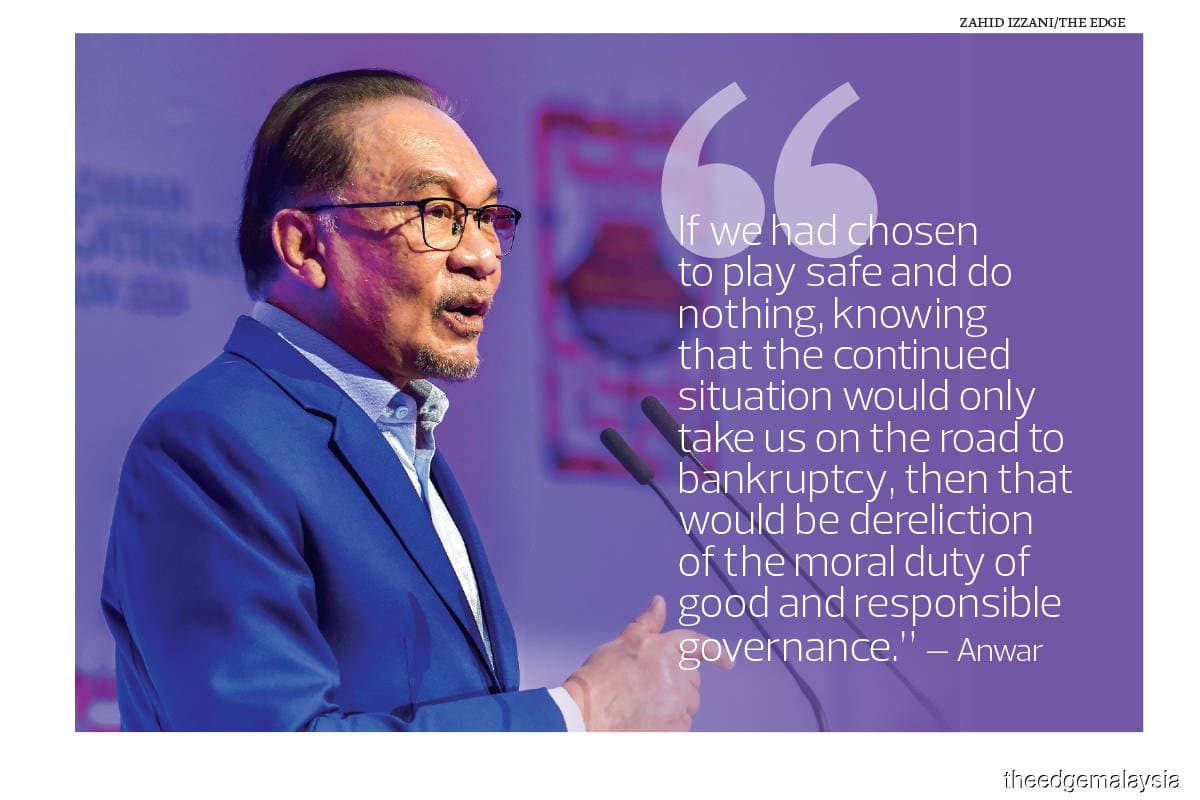
There are those who remain hopeful, pointing to the fact that Anwar had gone on to say that “if we had chosen to play safe and do nothing, knowing that the continued situation would only take us on the road to bankruptcy, then that would be dereliction of the moral duty of good and responsible governance” and that his administration will “continue to proceed boldly on the course of structural reform”.
“The right message on the RON95 fuel subsidy rationalisation also ties in to the green transition. Otherwise, by introducing carbon taxes, Malaysia would be joining countries like Indonesia and India with conflicting policy signals when it comes to fossil fuel subsidies while also having carbon taxes,” says an observer, noting that fuel subsidies “more likely than not” exceed nascent collection from carbon taxes.
CGS International Research economist Nazmi Idrus, in his recent pre-budget note, reckons that Budget 2025 “could perhaps be the toughest budget thus far for the Madani government”, given the need to reduce debt towards a more sustainable level while pressured by increase spending commitments with limited low hanging choices for revenue enhancements.
Also projecting a fiscal deficit of 3.8% of GDP for 2025, higher operating expenditure and lower development expenditure in 2025, Nazmi says, “The options are clear but not necessarily easy — either raise revenue or find ways to cut spending. Either option could negatively affect the consumer base. As such, we think the main element for this budget is how the government addresses its fiscal constraints but also formulates a mitigating measure to minimise the impact on the lower-income group, regardless of what is announced.”
He proposes three scenarios for Budget 2025. “Either reintroduce GST, cut the RON95 fuel subsidy, or enhance other taxes (such as SST). The first and second choices will allow for improved fiscal sustainability but it is unlikely both will come at the same time, in our view. Also, we believe the second option is less palatable politically. Meanwhile, we see the third option as akin to ‘kicking the can down the road’, allowing the government to survive another year but not necessarily solving its problems. As such, we believe chances are high for a GST reintroduction helped by the drive for e-invoicing while there is still sufficient time to prepare for the tax before the general election needs to be called by November 2027.”
It remains to be seen just how much Anwar is willing to push the envelope as his administration strives to balance between being good statesmen and surviving the next election. Announcements that would sit well with the people as well as economists would be measures that would help transform Malaysia’s workforce to be more resilient and encourage investments in innovation.
Save by subscribing to us for your print and/or digital copy.
P/S: The Edge is also available on Apple's App Store and Android's Google Play.