

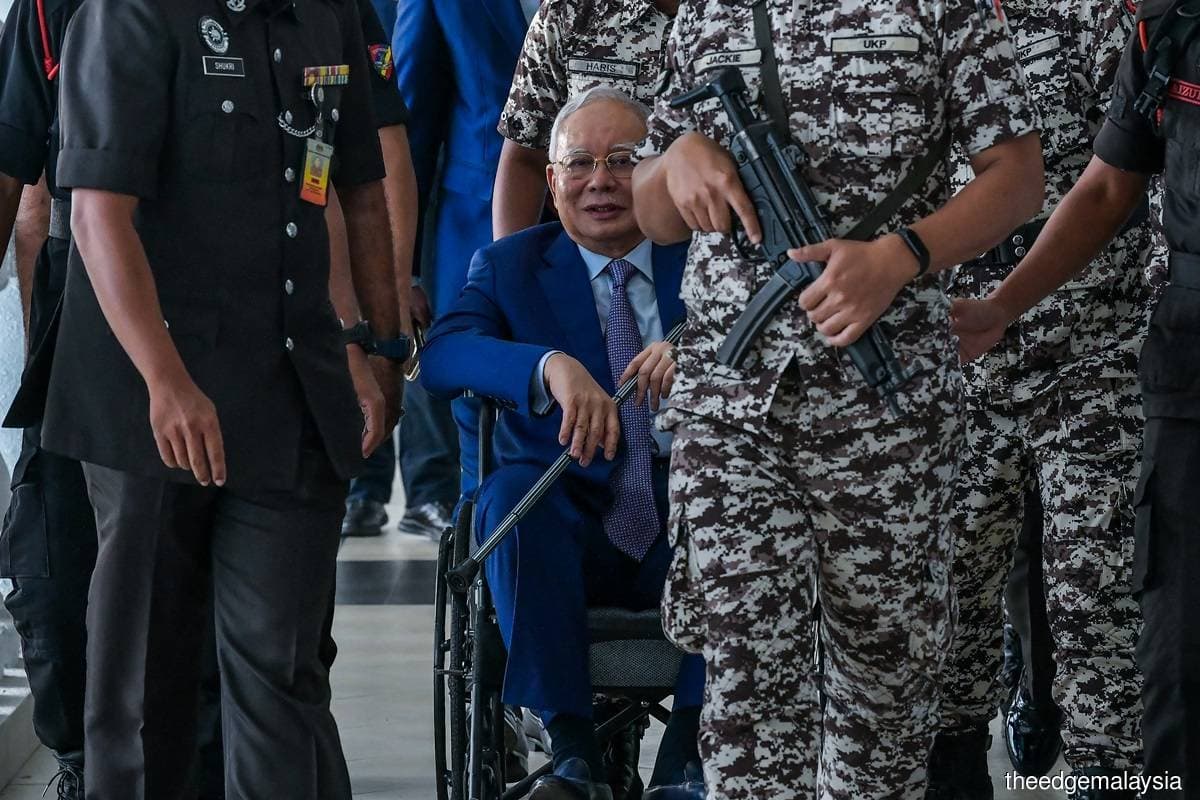
KUALA LUMPUR (Sept 18): The High Court on Wednesday fixed Nov 11 to deliver its decision on whether to grant leave (permission) to the Malaysian Bar to challenge the Federal Territory Pardons Board’s decision to halve the prison sentence of former prime minister Datuk Seri Najib Razak from 12 years to six years, and reduce the RM210 million fine by three-quarters to RM50 million.
Judge Datuk Ahmad Kamal Md Shahid fixed the date after hearing submissions from the Attorney General’s Chambers representing the board and Najib’s lead counsel Tan Sri Muhammad Shafee Abdullah, as well as replies from the Malaysian Bar’s representatives Datuk Zainur Zakaria and Datuk Yeo Yang Poh.
In judicial review proceedings, leave (permission) has to be obtained before the merits are fully heard to ensure that an application is not frivolous or vexatious.
Earlier, Yeo submitted that at the leave stage, the disputed facts in the case could not be determined just yet, as the threshold was very low, and that the Bar was submitting on the single issue of justiciability of the board’s decision and not challenging the power of the Yang di-Pertuan Agong (YDPA).
Yeo said that the Bar was basing its arguments on the amendment to the Federal Constitution after 1994, in particular Article 40(1A) that stipulates:
“In the exercise of his functions under this Constitution or federal law, where the Yang di-Pertuan Agong is to act in accordance with advice, on advice, or after considering advice, the Yang di-Pertuan Agong shall accept and act in accordance with such advice.”
Yeo further referred to the board’s statement issued on Feb 2, 2024, that the Pardons Board had decided to halve the sentence, which means the board made the decision and the YDPA had acted on the advice.
“This is a novel issue and has not been decided before by any court, and for this reason alone, leave (permission) should be granted by the court,” he said, adding that this discretion for the Yang di-Pertuan Agong to grant a pardon had been removed post-1994, following amendments to the constitution to insert Article 40(1A).
Senior Federal Counsel Ahmad Hanir Hambaly @ Arwi, and Shafee, told Ahmad Kamal that there was nothing novel in the application and argued that the Bar was actually challenging the YDPA’s decision to grant the pardon, which had already been considered by various cases in the past which were non-justiciable.
They argued that the court should adopt or look at Article 40(2) of the Federal Constitution, which stipulates the YDPA’s discretion.
Shafee said the YDPA’s discretion meant power, and on this, he agreed with Ahmad Hanir that it was non-justiciable.
Ahmad Hanir told the court that it was the prerogative power of the YDPA to grant pardons, and hence, there was no issue for determination of facts, as it was not a complex issue as the matter had been supported by case laws in the past.
“It is trite that there is no novel issue for the court to decide, and this is not something the court has to decide for the first time,” the SFC said.
Shafee questions Malaysian Bar’s locus
Shafee, while agreeing with Ahmad Hanir, also raised the issue of whether the Bar had locus standi (legal standing) to file the application as he questioned the Bar’s annual general meeting (AGM) where the motion to challenge Najib’s pardon was passed.
The senior counsel raised Section 64(4) of the Legal Profession Act 1976 (LPA) on the issue of quorum and said that the March 16, 2024, the AGM was held without the necessary quorum of at least 500 members in attendance.
Shafee said there were fewer than 400 members in attendance at the AGM, and hence, questioned the validity of the motion and the tabling of the application.
“The AGM had to be adjourned for 15 minutes, and they actually resumed it by 12pm, whereas the LPA stipulates that should the quorum not be met, then the AGM is to be held the next day, which they failed to do,” he said.
“This makes the decision for the Bar to pass the motion to challenge the Pardons Board null and void. It is like the fruit of the poison tree — it is nullified as the AGM was done without a proper forum – and hence the action should be considered as not having the locus,” he said. Shafee also questioned the legality of the Bar’s office bearers following the AGM’s lack of quorum.
Shafee further said that the Constitution has been consistent on the powers of pardon being the royal prerogative of the YDPA, as it is with the other Malay rulers and governors.
“One cannot question the decision-making or justiciability of the decision-making process,” he added.
Zainur: Court cannot rely on Shafee’s argument, which is based on an affidavit
Zainur, in replying to Shafee, said the court could not make a decision at the leave stage based on the affidavit filed by Shafee’s son in questioning the quorum.
The court, he added, should not decide on refusing leave just because Shafee considered the AGM to be invalid, as this was not the proper forum to challenge illegality.
Yeo further said the statutory function of the Malaysian Bar under Section 42 of the LPA was “to uphold the cause of justice without regard to its own interests or that of its members, uninfluenced by fear or favour", and that the question of legality of the office bearers to bring the action should not be questioned as they were not elected during the AGM.
The executive members are elected among the 12 committee members and the votes from each states’ two representatives.
Yeo again highlighted that the issue was still over the determination on Article 40 (1A) on the decision made by the Pardons Board to give the advice to the YDPA, and reiterated that the Bar was not challenging the justiciability of the YDPA’s discretion, but merely the board’s decision to give the advice, which, under Article 40(1A), the YDPA is bound to accept.