

This article first appeared in The Edge Malaysia Weekly on September 16, 2024 - September 22, 2024
OVER the years, Malaysian flag carrier Malaysia Airlines Bhd has found itself losing pilots and flight attendants to its Singaporean and Middle Eastern counterparts, which offer some of the best pay packages to attract international talent. Now it is losing experienced aircraft technicians and engineers too.
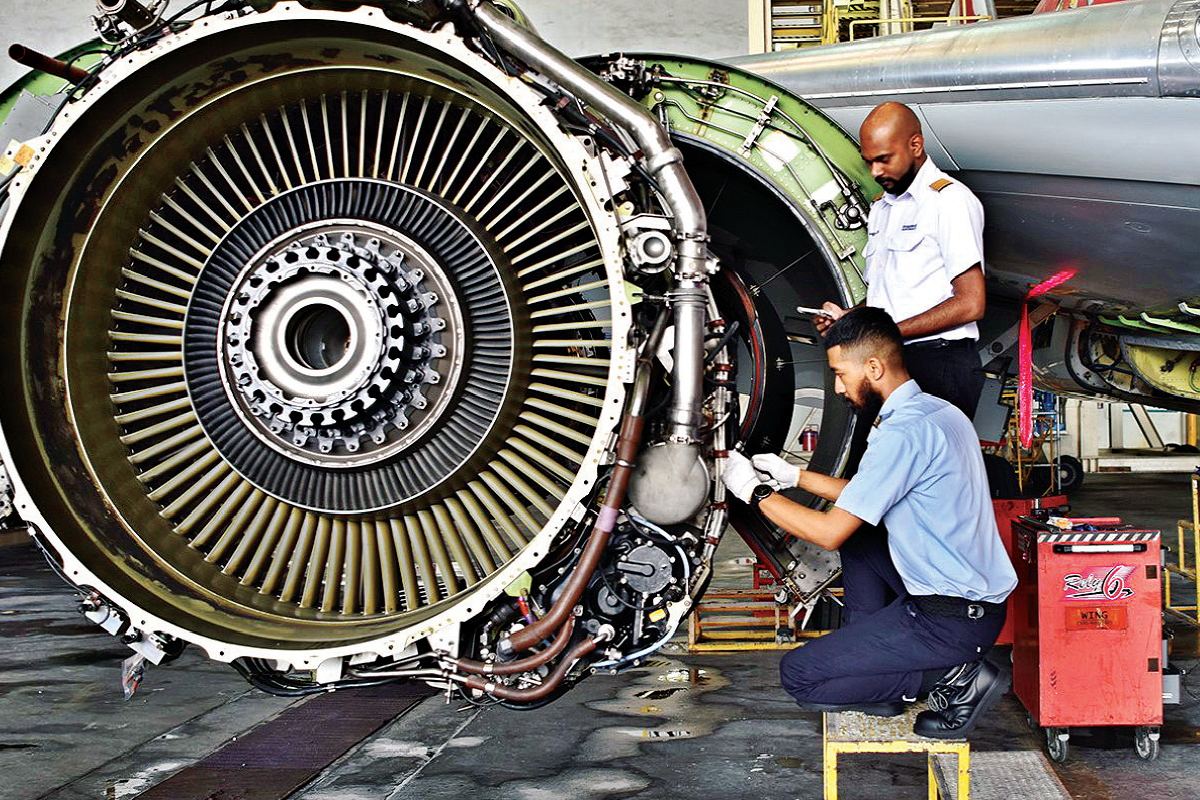
A recent audit that revealed an outflow of personnel from Malaysia Airlines’ maintenance, repair and overhaul (MRO) arm is now shining a spotlight on its maintenance workers. They are being trained but are quickly lured away by high-salaried positions at rival airlines that are looking to ramp up their fleets.
And as the ringgit has remained weak against major currencies, there is no silver lining for the national airline.
According to Transport Minister Anthony Loke, the departure of 63 of 411 engineers from MAB Engineering is partly to blame for the national carrier’s recent surge in flight disruptions. Since August, Malaysia Airlines has suffered numerous technical problems with its fleet, which prompted the Civil Aviation Authority of Malaysia to launch an audit into its quality control.
Opposition politicians had criticised the government for allowing SIA Engineering Co Ltd (SIAEC) to set up a local MRO operation at Sultan Abdul Aziz Shah Airport in Subang, Selangor, which had been recruiting Malaysia Airlines engineers.

While there has understandably been some concerns about staffing shortages at Malaysia Airlines, its group CEO Datuk Captain Izham Ismail points out that it is only a small part of the equation.
He has attributed its recent spate of delays and cancellations to an ongoing struggle to obtain spare parts for its ageing fleet of aircraft and delays in new aircraft deliveries, which is a global issue.
“For heaven’s sake, it’s only about 70 [or 15%] of our total engineers. As a CEO who is entrusted to induce economic movement in the country, I welcome foreign companies to come here because that is foreign direct investment (FDI) to the country. So, are Malaysia Airlines engineers being poached by SIAEC? The answer is yes. Is it a big number? The answer is no,” he said in an interview on Sept 6, most of which was published in The Edge on Sept 9.
Still, investors should train local talent instead of poaching from competitors, laments Izham.
On its part, the airline isn’t resting on its laurels and has launched programmes for training engineers. Last year, it churned out about 100 engineers and technicians, and more are in the pipeline.
However, according to Izham, people are leaving faster than the airline can train them and when the ecosystem becomes unstable with regard to compensation, it will become unsustainable eventually.
Izham concedes that the battle for skilled workers is not new in the aviation industry. “Staff attrition is continuous. Thus, it is important for Malaysia Airlines to continue training people. Malaysia’s labour cost is low and English is widely spoken in the country, which make our workforce attractive. And the aviation industry is not alone in facing a skilled workforce shortage. The oil and gas industry faces [a] similar challenge. Rather than lose sleep over the shortage of resources, we just have to churn out more. If they want to leave, we can’t stop them.”
Shukor Yusof, founder and analyst of aviation research firm Endau Analytics, agrees that the issue of poaching and compensation is not unique to Malaysia Airlines’ parent Malaysia Aviation Group Bhd (MAG).
“Other Malaysian companies face a similar predicament. If we take a step back, it’s really about the value of the ringgit. Malaysia still holds a current account surplus but its ratio to gross domestic product is down to the lowest level in two decades. The airline industry is denominated in US dollars, so pilots, engineers and other professionals are pegged as close as possible to others in the business, be it Singapore or the Gulf region.
“Even if an employee receives a remuneration close to his/her compatriot, say, at a foreign rival airline, the ringgit is more volatile when there’s global instability, therefore susceptible to fluctuations. Employees’ pay by and large has not kept pace with inflation and the rising cost of living,” he tells The Edge.
“According to agencies that track human resources across the economy, the airline industry has a 17% deficit of skilled workers, which is only set to widen to 25% over the course of this year,” Shukor adds.
‘You have to roll with the punches’
According to a source, senior captains with at least 30 years of experience at Malaysia Airlines saw the most substantial salary cut of as much as 40% during the Covid-19 pandemic, and their pay has yet to be restored to 2019 levels.
In August 2022, MAG had introduced a Total Rewards Transformation Programme, under which its permanent employees were paid based on their performance on the job. The rewards structure was to make variable the costs of the organisation, optimising them so that it would not be laden with fixed costs.
“The remuneration philosophy at Malaysia Airlines is productivity-driven. Henceforth, you need to look at gross pay, [which takes into account] productivity, efficiency and incentives. At the end of the day, how much you take home. We don’t have a fixed salary,” Izham said during the Sept 6 interview.
The pay gap between Malaysia Airlines and its rival airlines is narrowing, but it isn’t always easy. Izham said MAG has provided a salary increment to all its employees twice — once last year and another last month.
“We have made adjustments to our engineers’ salaries four times over the last 1½ years. We have 12,000 [personnel in total]. I have to say that our salaries are now on a par with the market. However, there are pockets in the organisation whose average salary is still below market. We are addressing that in stages,” he added.
However, the airline does not “simply raise salaries” but applies a cost-of-living adjustment or COLA as a measurement in staff remuneration. “For example, how much is the cost of a McDonald’s Big Mac? A Big Mac in Malaysia costs RM20, while in Dubai it costs AED31 (RM36.60). You can’t compare apples to apples. You cannot compare the salaries from airlines [in two different countries]. The cost of living is different,” Izham explained.
“With an employer like the national carrier, we have to compare total employment proposition value and total employment experience, not just the financial remuneration. When setting Malaysia Airlines against other locally-based carriers, the corporate image of the national airline should not be underestimated or set aside. That’s because there is still a good, solid base of positive national sentiment regarding the flag carrier,” says Shahryn Azmi, co-founder of technology start-up Kard Asia and former CEO of Corporate Reskilling Centre, a Khazanah Nasional Bhd unit, which was intended to provide reskilling, job creation and redeployment opportunities for employees not migrating to the new company, Malaysia Airlines Bhd, under the MAS Recovery Plan.
“For the majority of the staff, being able to say to friends and family that they work for Malaysia Airlines still has considerable cachet. The ‘internationalness’ of the airline — meaning that it flies [regularly] to Europe, North Asia and the US, counts for a lot. It puts Malaysia on the world map, literally, and that has value for anyone associated with that. Cabin crew get to regularly travel to global destinations that many Malaysians only dream of going to and only for a short holiday, and just once in their lives. Another airline just flying around Asean is on a secondary level of corporate standing as compared to being a truly long-haul global airline,” he tells The Edge.
Shahryn notes that the individuals who choose Malaysia Airlines to be their employer do so deliberately, having taken many employment factors into account. “All this means that the Malaysia Airlines cachet is sufficient to compensate for any slippage in remuneration relative to another locally-based carrier.
“In the past seven to 10 years, stories of Malaysian workers jumping ship for better pay have been rife. Have the anecdotes been more than usual? Possibly. So, ‘leaving for better pay’ became quite Malaysian-normal. Under all this though, was something more insidious and that was the quantum involved: How much money would cause an individual to leave their current job for another employer?
“Also, how much offered salary difference would cause a potential recruit to choose Company B over Company A? I have heard of these decisions being made for RM50 a month. Jumping ship for an extra RM50 a month sounds completely ridiculous, but we need to consider not the cash but what it stands for and the circumstances around that RM50. RM50 may be petrol costs, Grab or MRT fares for X period of commuting. RM50 may also be X days’ lunch cost. Again, it still sounds minimal but an employee’s current employer will rarely, if ever, give a staff member an extra RM50 pay just because that person has been offered that amount by another company. That employee knows this and so they won’t even ask for the RM50. Instead, they will just resign,” he explains.
According to Shahryn, as the individual rises in rank and up the pay scale, the amount that has to be offered to them to join another company has to be much more. Often, that lure comes with additional benefits as well.
“A ‘signing bonus’ isn’t unusual and back in 2015, when Middle Eastern airlines were trying to recruit exiting Malaysia Airlines personnel to join them, one to two months’ salary as a signing bonus wasn’t at all unusual. Note that the pay package was between 300% and 1,000% the Malaysia Airlines amount, so one or two months of immediate signing bonus was very tempting.
“Senior personnel are often also offered more responsibility, wider authority, so much so that they are not just getting more money but going on to a bigger job as well. Non-cash perks are now the thing with senior personnel being offered executive coaching and overseas training programmes at prestigious graduate schools,” he adds.
Staff departures will continue. Subhas Menon, director-general of the Association of Asia Pacific Airlines, says: “This is the way of the world. There is competition everywhere, even competition for workers. When it happens, you have to roll with the punches. You have no choice. You cannot stop people from moving to competitors. And you can’t blame anyone.
“This happens from time to time. Probably some airlines can afford to pay more. At one point, airlines in Asia were losing pilots to the Middle East. When airlines are starting up or ramping up and they have the capacity to pay more, there are always moments like this,” he adds.
Save by subscribing to us for your print and/or digital copy.
P/S: The Edge is also available on Apple's App Store and Android's Google Play.