

This article first appeared in Wealth, The Edge Malaysia Weekly on August 26, 2024 - September 1, 2024
GXS Bank Pte Ltd group CEO Muthukrishnan Ramaswami has set a target for the firm — to break even by 2026. With a committed capital injection of S$1.9 billion (RM5.7 billion) into its Malaysia and Singapore entities, it will need a balance sheet of about S$1.5 billion in deposits and S$2 billion in loans to hit the target, which it is on track to achieving.
Ramaswami says the firm rolled out its personal financing product in Singapore in last April and the next in line will be its business financing and fixed income products embedded with insurance protection.
“We are building our business banking capabilities and are looking forward to serving Singapore’s and Malaysia’s micro and small businesses in 2025. As a start, we will offer deposit accounts and unsecured business loans for this segment,” he adds.
GXS Bank is a joint venture between Grab Holdings Inc and Singapore Telecommunications Ltd. It operates GXS Bank in Singapore and GXBank in Malaysia, the latter of which is owned with a consortium of partners, including Kuok Brothers Sdn Bhd.
Grab launched its Indonesian business two months ago by integrating the digital banking services of PT Super Bank Indonesia (Superbank) directly into the Grab app. The group holds 28.35% equity interest in Superbank, according to its 2023 annual report.
In an interview with Wealth, Ramaswami says GXBank is growing its customer base rapidly. It has about 750,000 customers in Malaysia (as at end-July) who have conducted more than 13 million transactions via the digital bank’s debit card and QR Code.

GXBank racked up 131,000 users in Malaysia within a month after its launch in November 2023. The figure doubled to 262,000 as at March 31, 2024, according to Grab’s financial report for its first quarter of this year (1Q2024), then almost tripled in the next four months.
Grab gained even more traction in Indonesia. The Superbank digital banking service garnered 650,000 users about two months after it was launched, says Ramaswami.
A factor that partly contributed to its success in Malaysia is speed, which he attributes to the group’s regional presence. Its peers Aeon Bank and Boost Bank were launched on May 30 and June 6 respectively, half a year later than GXBank. Two other digital banks, one by a consortium of Sea Ltd and YTL Digital Capital Sdn Bhd and another by a consortium led by KAF Investment Bank Sdn Bhd, are experiencing a delay in their launch.
Ramaswami says GXBank took only about a year to be launched locally as it leveraged the digital banking system in Singapore, which took about two years to be built. It is moving even faster in Indonesia.
“We are fast in Malaysia because we are leveraging everything we are doing in Singapore. Of course, there is some difference. Onboarding in Malaysia requires users to take a snapshot of their physical IC (identity card). Singapore has an electronic IC. Other parts are the same,” he says.
While Ramaswami cannot disclose the latest figures on the deposits the digital bank has garnered, the group’s progress is reflected in its recent capital injection into its Singapore and Malaysia entities. Grab injected S$229.5 million into GXS Bank in June. Its co-founder and CEO Anthony Tan met with Prime Minister Datuk Seri Anwar Ibrahim in February to brief him on GXBank’s RM1.5 billion investment plan.
Asked how the group will utilise the capital injection, Ramaswami says it is mostly to meet the central bank’s capital ratio requirement as the deposits of GXS Bank and GXBank continue to grow.
“As we are growing, we keep injecting. Banks hold customers’ deposits, and you need capital [reserved] for it, based on a ratio specified by the central bank. So, we draw down capital from our shareholders in line with our growth. You will read such news periodically as we continue to grow,” he says.
Asked if GXBank has a comfortable lead in the Malaysian market, Ramaswami says there is no such thing as a comfortable lead when running a business. It is more like being chased by a lion.
“I don’t know if you have heard this analogy. If you’re in the wild and a lion is chasing you, you can’t just avoid being the last [in the line of people fleeing]. So, there is no such thing as a comfortable lead [in doing business]. You don’t look at it like that,” he says.
Customer-centric approach to launching products
Ramaswami says the group will continue to stick to its customer-centric approach that has led it to introduce innovative products that distinguish the digital bank from its peers.
For instance, it understands that the man in the street is not able to earn more meaningful returns from parking money in savings accounts at traditional banks. Fixed deposits provide better returns — the longer the period, the higher the returns. A premature withdrawal means you forfeit the interest earned.
Hence, GXS Bank and GXBank provide users with savings accounts that give them better rates than traditional banks. As of July 26, GXBank users can earn an interest of 3% per annum, which is significantly better than that offered by traditional banks.
A quick check online shows that one of the largest banks in Malaysia offers only 0.2% interest per annum on its savings accounts for the RM1,000 to RM10,000 savings band. The highest rate is 0.6% for balances above RM250,000.
Meanwhile, GXBank pays interest on a daily basis. For most people, the sum credited into their bank accounts is tiny, but many find it mentally rewarding. And they can withdraw their money easily at any time for expenses with no penalty.
“Every day, our users see interest [coming into their bank accounts]. That itself promotes a saving habit,” says Ramaswami.
Similarly, GXBank debit card holders, who receive unlimited 1% cashback on their expenditure, are paid the cashback daily.
Another example of its customer-centric approach is the GXS FlexiLoan, its personal financing product that was launched in Singapore in April last year.
“The research process for the product starts with the customers. We want to find out their pain points. Among them, the onboarding and approval process take too long and require a lot of documents,” says Ramaswami.
So, GXS Bank has shortened its onboarding process significantly for borrowers, which can be done in as fast as five minutes. Loan approvals can be completed in three minutes, which means borrowers will know the details of the loan, such as the amount they are able to borrow and the rate they have to pay.
“If you’re in Singapore and borrow from a big bank, and you repay [your loan] quicker than you expected, you pay an early payment penalty, right? With us, you have the flexibility to repay at any time [without penalty]. And we charge you daily interest. You don’t need to pay interest at the end of the month, but only until the day you use it [the financing product]. It is more customer-centric,” he says.
This efficiency stems from GXS Bank’s ability to estimate its borrowers’ income by capturing data from various sources, including their pension savings and tax payments, says Ramaswami.
“Our model can tell how likely you are to earn X amount of money. Based on our strength to estimate income, we can make you a loan. We are also more conservative in lending money, instead of giving them as much as we can lend.
New products in the pipeline
Ramaswami says a product similar to GXS FlexiLoan is expected to be rolled out in Malaysia in the first half of next year. But it doesn’t stop here.
GXS Bank and GXBank are looking to launch the first investment product to come with insurance protection. The group is likely to work with a local asset management firm to roll out the product, which would provide it with fee-based income.
“It would be a fixed income fund that invests in very safe securities. But what we also plan to do is to have a wrapper around it, which means insurance protection [for the investors] provided by an insurance player,” he explains.
For instance, say Bank Negara Malaysia’s overnight policy rate is 3%. The fund may aim to offer investors a slightly lower return than that, let’s say 2.8% per annum, but provide them with protection against, let’s say, loss of job for three months.
“You don’t get such a product easily from traditional players by paying a small amount of money. But for us, even if you’re saving RM5,000, we want to give you the wrapper. The insured sum could be equivalent to how much you’re saving [with the investment products]. As long as you have the product, you have the coverage,” says Ramaswami, adding that such a product could benefit Grab users, including Grab drivers and delivery people or merchants selling products on its app.
Would GXS Bank and GXBank consider micro-investing? Recall that Grab launched a suite of financial products and services in 2020, including its first micro-investment solution called AutoInvest. But the solution was shuttered in September last year as it wasn’t “commercially viable in the long run”, according to news reports.
Ramaswami acknowledges that micro-investing is a tough business to run. The amount of money collected from users for investments can be too small to make an impact for the investors and business operator.
“Can we work together with them [Grab and its partners GXS Bank and GXBank] and make it a better product [to be launched in the future]? We will look at it. We need to see if we can do it better,” he says.
Micro-investing means investing one’s spare change in the markets, be it bonds or equities. It is not an easy market, as Raiz Malaysia Sdn Bhd has shown. It ceased operations in July after running the business for four years.
Raiz was a micro-investing start-up and a joint venture between Raiz Invest Ltd, an Australian financial technology company, and Jewel Digital Ventures, a subsidiary of Permodalan Nasional Bhd.
In Malaysia, GXBank inked a 10-year partnership with Zurich General Insurance Malaysia Bhd and Zurich Life Insurance Malaysia Bhd, on May 10, to launch micro-insurance products that are specifically intended for those in the lower income bracket.
On top of that, the group aims to launch a business financing product in Singapore and Malaysia by leveraging the strength of its partners, including Singtel and Kuok Brothers (Kuok Group), which have extensive business networks in both countries. For instance, GXBank can tap into the data of the companies under Kuok Group and provide its distributors in the fast-moving consumer goods (FMCG) industry in Singapore and Malaysia with loans.
“Data-wise, if you’re a distributor for companies under Kuok Group, the latter has many years of data on how you make payments, right? We can use that data to assess if we can make loans to the distributors. They could be buying, say dairy products or coffee, to redistribute. We could end up financing their inventories,” says Ramaswami.
“In Singapore, we are planning to get this [product] out before year end. And Malaysia will not be far behind. The timelines are different in each country as we have to work with the regulators before rolling it out.”
Not yet competing with traditional banks
According to Grab’s financial report for 2Q2024 ended June 30, its digital bank business had garnered US$730 million (RM3.22 billion) in deposits. In Malaysia, GXBank was the first digital bank launched in the market, which means the deposits it received locally would have come from traditional banks.
Nevertheless, Ramaswami says digital banks are not competing directly with conventional banks as the regulator imposes a cap on the size of their balance sheet. This means there is a limit to how much money the bank can take in and the amount of loans it can give out.
Bank Negara’s licensing framework caps the digital banks’ assets at RM3 billion during the foundational phase that lasts until at least mid-2026. That means the aggregate digital bank balance sheets will be less than 1% of the banking system in the medium term, even under the most bullish assumptions, according to Fitch Ratings.
An important objective of the digital banks is to serve the underserved, which is generally understood as people from the lower income group, thus avoiding direct competition with conventional banks.
Ramaswami points out that the “underserved” does not mean only people from the B40 (bottom 40% income group), but also includes those who are less wealthy and not well served by the big banks.
“Underserved doesn’t mean poor, but those who are deemed not ‘attractive’ to the big banks. They may not have a net worth of, let’s say RM100,000. And the big banks are not serving them well as the cost of service for the branch network is high,” he explains.
GXS Bank and GXBank are sticking to their core strategy of offering simple, easy-to-use and customer-centric products for the underserved in the next few years.
“Right now, our products are simple. Saving accounts with daily interest and loan accounts that charge daily interest. The underserved are looking for basic things, not complex products. That’s where we do well and where our strength is. The key is simplicity. It will take us three to five years to serve our customers properly and be a profitable business,” says Ramaswami.
Moving forward, GXS Bank will continue to tap into the ecosystem of its partners to acquire more customers efficiently.
Ramaswami says digital banks like GXS Bank and GXBank enjoy the advantage of being nimbler and moving faster than the incumbents. But such an edge won’t last if they continue to grow in size and roll out more complex products.
It will be a different ball game when digital banks decide to grow more aggressively after getting the full banking licence from the regulator.
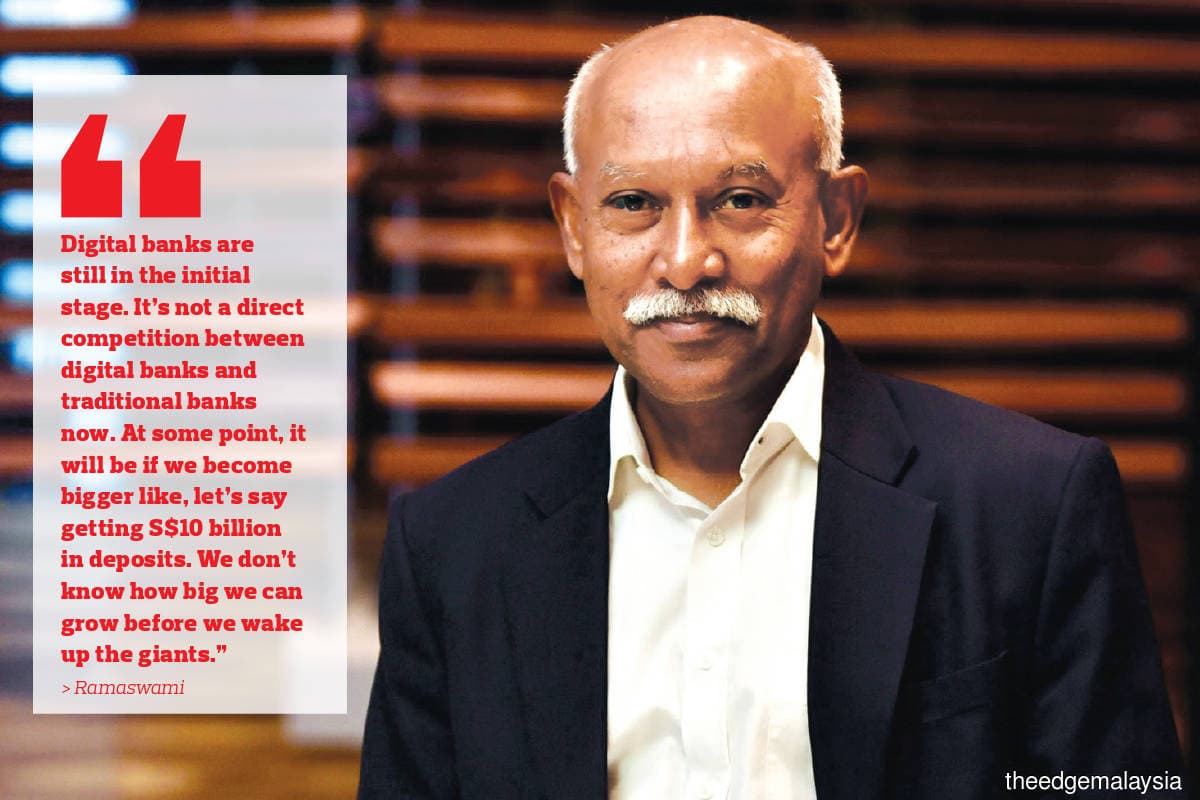
“Digital banks are still in the initial stage. It’s not a [direct] competition [between digital banks and traditional banks now]. At some point, [it will] be if we become bigger like, let’s say getting S$10 billion [in deposits]. We don’t know how big we can grow before we wake up the giants,” he says.
Save by subscribing to us for your print and/or digital copy.
P/S: The Edge is also available on Apple's App Store and Android's Google Play.