

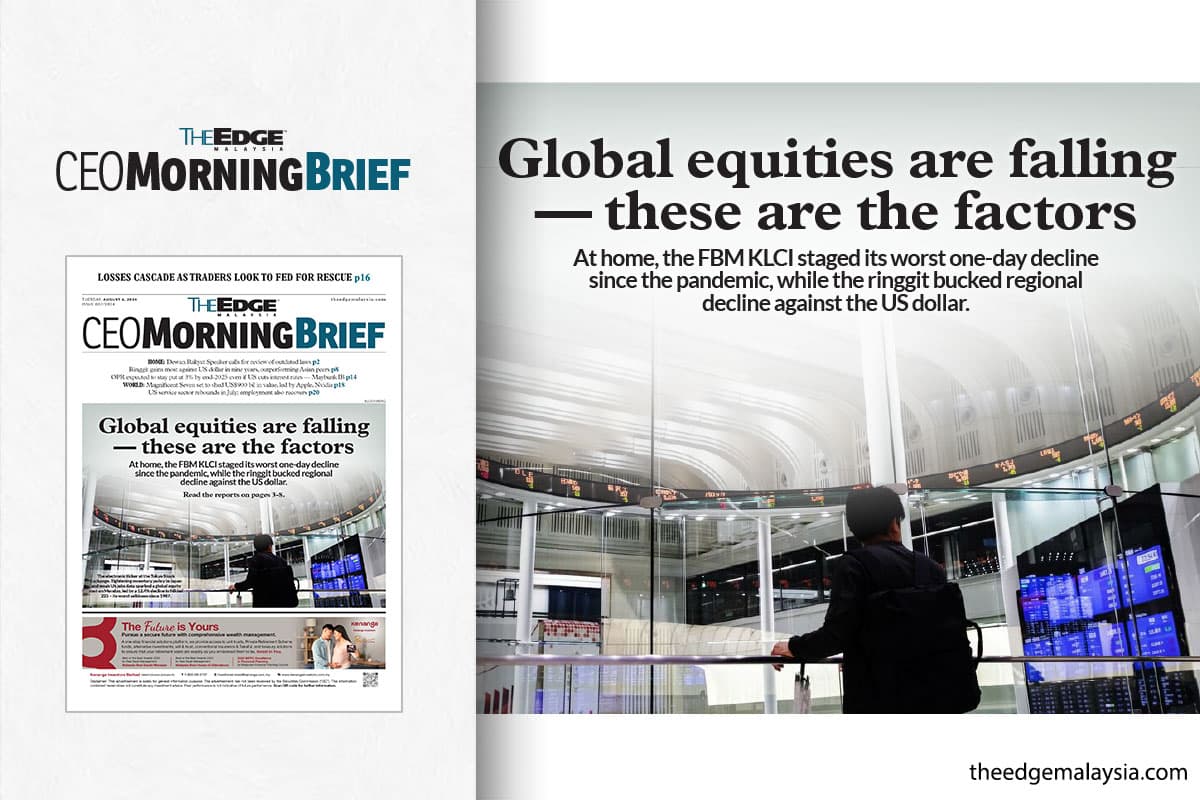
KUALA LUMPUR (Aug 5): The global stock-market rout accelerated on Monday, with losses cascading across major markets in all continents with the Asian markets dropping the most.
The Japanese equities crashed most in over a decade, its benchmark Nikkei 225 plunging 12.4% or 4,451.28 points to 31,458.42. Nikkei 225 tumbled 18.2% over a five-day period followed by South Korea’s Kospi down 11.7% and Taiwan Taiex down 10.5% over a five-day period.
Back home, the FBM KLCI opened sharply lower against last Friday’s closing, indicating jittery market sentiment that has kept buyers at bay. The KLCI sagged 74.57 points, or 4.63%, to 1,536.48 points, wiping out all the gains made over the past three months.
The KLCI had fallen 5.4% over the past five trading days (see table).
At press time, equity markets in Europe and the US started the week with fierce selldown as well.
So what has triggered the global stock rout?
1. Bank of Japan surprise tightening
The Bank of Japan (BOJ) surprised the world last Wednesday calling for a rate hike of 0.25% against a market consensus of 0.1% rise. The move to take the rate to its highest since 2008, from a policy rate of 0-0.1%.
Later the same day, the US released several negative economic data: Institute for Supply Management (ISM) manufacturing PMI dropping to an eight-month low in July at 46.8, against consensus of 48.8. Worse still, the higher than expected US unemployment claims of 249,000 against a forecast of 236,000 sparked worries of impending slowdown in the world’s largest economy.
The concerns of a slowing US economy coupled with the BOJ tightening led to an unwinding of Japanese yen carry trades and contributed to rampant selling of Japanese equities that started last Thursday (Aug 1).

Since Wednesday, the Japanese currency has surged more than 7.4% versus the US dollar, making huge implications towards global carry trades strategy.
The Nikkei, meanwhile, had fallen 20.5% since Wednesday, and had wiped out its year-to-date (YTD) gains. It is now down 7.1% YTD and back to June 2023 levels.
2. Weak US jobs report sparked another wave of selldown
Recession fears were mounting after the US payroll report showed growth of merely 114,000, which came short of consensus’s 175,000 forecast while June figures were revised lower. The jobless rate also hit a three-year peak of 4.3%, above the 4.1% expected and triggered the Sahm’s Rule.
According to Sahm’s Rule, if the unemployment rate, based on a three-month average, is a half percentage point above its lowest point over the previous 12 months, the economy has tipped into a recession.
For context, Sahm Rule's accuracy rate is 100% going back to every recession since the early 1970s.
However, Claudia Sahm, the inventor of the rule, is not convinced that the US is slipping into recession at the current moment.
“We are not in a recession now — contrary to the historical signal from the Sahm Rule — but the momentum is in that direction,” Sahm told CNBC by email on Friday. “A recession is not inevitable and there is substantial scope to reduce interest rates.”
“We are in a place where things have slowed. So, we’re not in contraction territory. That frankly is not good enough, we can do better than avoiding a recession,” Sahm was quoted by CNBC as saying.
“What is very worrisome and today’s employment report underscored, is the direction of travel, the momentum is not good. We are pointed towards what would be recessionary dynamics and that should be a real wake-up call,” said Sahm.
Fund managers contacted remain upbeat about the US economic prospect and unanimously pointed out that the US recession hard-landing worries are overblown at this stage.
“One month of bad jobs data doesn’t necessarily mean a recession, at 5.5% US interest rate now, the Federal Reserve has a lot of room to manoeuvre,” Peter Lim Tze Cheng, founder and chief research officer of Trident Analytics Sdn Bhd commented.
Areca Capital Sdn Bhd CEO Danny Wong views that the soft jobs report is meeting exactly what the Federal Reserve wants, which could help hold off the inflation. He also pointed out that a September rate cut is largely expected by the market.
3. Poor US tech earnings weighed on sentiments
The poorly-received results of large names in the US tech sector did not help at all. Last Friday, Intel suffered its largest single day decline of 26% — the worst in more than 40 years after the company gave a grim growth forecast and laid out plans to slash 15,000 jobs.
Amazon shares tumbled 9% last Friday, a day after the company reported a revenue miss and gave a forecast for the third quarter that fell short of Wall Street’s expectations.
Over the weekend, reports about Nvidia’s upcoming artificial intelligence chips will be delayed due to design flaws, adding gloom to the US semiconductor sector. Given Nvidia has led US equity gains in 2024 and now places more weightage on US flagship indices, any southward movements in Nvidia shares could drag major US indices lower.
4. Warren Buffet’s cash pile at record high
Another drag to equity prices is filing reports about Warren Buffet’s Berkshire Hathaway Inc that it had almost halved its stake in its largest holding, Apple Inc. The renowned investors had also cut its second largest holding — Bank of America Corp — raising its cash pile to a record US$276.9 billion (RM1.24 trillion). This had sparked speculation of concerns of an imminent market top.
It is also worth noting that Berkshire Hathaway was bullish about Japanese equities. It bought into Japan’s largest trading houses since 2020.
5. Flare-ups in geopolitics
Geopolitical anxiety and the expected retaliation from Iran and Hezbollah towards Israel after the killing of Hamas leader was another risk-off factor. On Sunday, the US Secretary of State Antony Blinken warned foreign ministers from the G7 countries that attacks by Iran and Hezbollah on Israel could come "as early as Monday".
When asked about the global stock rout particularly the Nikkei, Areca Capital’s Wong attributed the adverse price actions to global investors’ timing of locking in their profits as well as the Japan rate hike structural impact towards carry trades.
“Since Japanese equities had enjoyed a pretty good run this year, it is normal for them to take profits on the handsome gains they had, whilst some overleveraged traders may have been caught off-guard” Wong highlighted.
Trident Analytics’ Lim concurs with Wong that market profit taking is the primary factor as he pointed out that global stock indices had made decent runs this year.
“When you look at the largest decliners these few days, they are mostly the biggest gainers this year, the market is finding reason to lock in profits, in my opinion,” he said.
Meanwhile, one fund manager who wants to remain anonymous commented that the severe selldown in Japanese stocks was mainly concerns over earnings prospects after rate hike.
“Most of the large Japanese are global exporters, an appreciating currency may not be favourable to their earnings; also, most Japanese listed firms make modest profit margin, a rate hike from historical low levels, may impact their operating landscape especially from cost of funding point of view,” he added.