

This article first appeared in The Edge Malaysia Weekly on August 5, 2024 - August 11, 2024
HUMAN Resource Development Corp Bhd (HRD Corp) has come under fire lately from the Public Accounts Committee (PAC) and the National Audit Department for the alleged lack of good governance practices, and the purported absence of checks and balances on its investments.
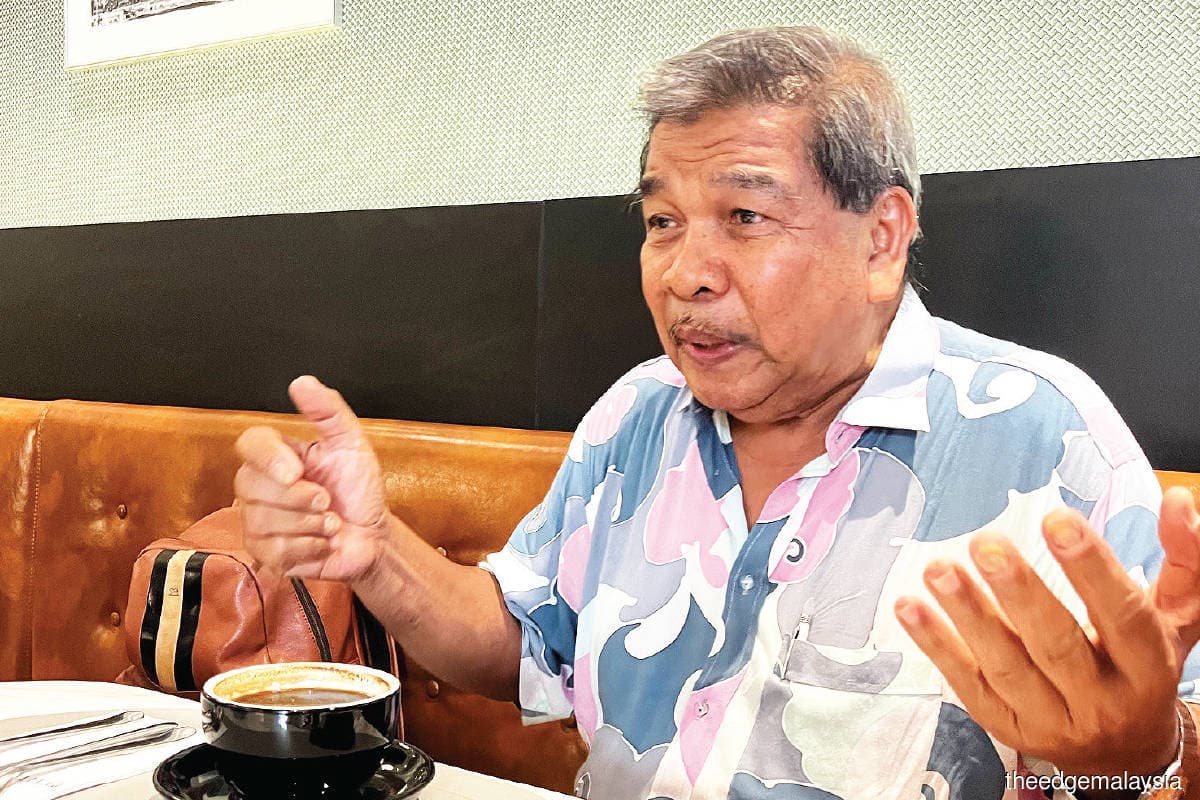
While HRD Corp has sought to defend itself against all allegations — including its investments such as the acquisition of buildings and stakes in privately held companies, high renovation costs and ballooning operating expenses — former chairman Datuk Abdul Razak Abdul, who was with the agency from 2013 to 2017, sheds light on HRD Corp and its inner workings.
From the 1990s to early 2000s, Abdul Razak was a well-known corporate figure, helming insurance outfit Idaman Unggul Bhd, formerly Idris Hydraulic (Malaysia) Bhd, which had a lucrative timber concession in Sabah. He was also on the boards of companies such as Mutiara Goodyear Development Bhd, FACB Industries Inc (KL:FACBIND), TAP Resources Bhd, Wonderful Wire & Cable Bhd and Atlan Holdings Bhd (KL:ATLAN), in which he is still a director.
His area of expertise includes reviving ailing companies, and he was also involved in the late 1990s corporate fight for KFC Holdings (M) Bhd, which eventually saw the fast-food chain operator come under the control of Kulim (M) Bhd, a Johor Corp Bhd company.
On HRD Corp’s investments in buildings, he says: “In one way, you can say it’s a good investment — to have your own building — and, on the other hand, how do you [justify the need to] buy the building?”

He says there were plans to redevelop the land that the HRD Corp building occupies, on Jalan Beringin in Damansara Heights, into a 30-storey building — in partnership with Tan Sri Desmond Lim Siew Choon, whose Pavilion Real Estate Investment Trust owns Pavilion Damansara Heights nearby.
“Now, [HRD Corp] buys [buildings and assets] from other people … Why?” he asks. “When times are good, everyone is quiet; but when times are bad, all these things [questions] will emerge.”
The two-hour chat that The Edge had with Abdul Razak was an eye-opener, and many aspects of the allegations were discussed, including Section 50 of the Pembangunan Sumber Manusia Bhd Act 2001 (Human Resources Development Fund Act 2001), which reads: “The Corporation shall be responsible to the Minister, and the Minister may give directions which are consistent with the provisions of this Act to the Corporation and the Corporation shall, as soon as possible, give effect to all such directions.”
With Section 50, it would seem that the buck stops with the minister of human resources.
Abdul Razak left the agency before its CEO Datuk C M Vignaesvaran was investigated by the Malaysian Anti-Corruption Commission (MACC) in 2018. HRD Corp was known as the Human Resource Development Fund at the time.
Vignaesvaran came under fire in 2018 after Pakatan Harapan won the 14th General Election, and allegations of misappropriation of RM300 million in funds emerged. The funds were purportedly diverted to purchase properties and pay out hefty bonuses, as well as dished out for dubious training contracts — in some cases, without the knowledge of the fund’s board of directors. Vignaesvaran was cleared of any wrongdoing.
More recently, the current CEO of HRD Corp, Datuk Shahul Hameed Dawood, is taking a leave of absence while MACC investigates the government agency.
The following are excerpts from the interview.
The Edge: Why did you leave HRD Corp?
Datuk Abdul Razak Abdul: I couldn’t get along with some people there.
You left before things got ugly?
Yes, I left. I knew things were going to be very embarrassing, very embarrassing. If there’s no board resolution, it’s wrong [you cannot buy assets]. You cannot [buy assets] if you don’t get the board resolution.
[The] board must endorse [the acquisition] ... It’s not your [the CEO’s or management’s] money.
Look, [how things work in reality is] in the first place, we [the board] make decisions first and, then, before implementing, get the minister to endorse … It’s easy. There’s one letter; the minister says, based on this [whatever facts], ‘I agree.’ He signs, that’s it.
Once you have that — easy, complete — the thing [plan] is complete.
Then, there is also the alternative, where the management approaches the minister and asks him to buy some asset. So, the minister agrees and signs, but he signs after [the management] tells the minister the board [has already] agreed; and, so, the minister signs.
Once he [the minister] has signed, he cannot run away [turn his back on the deal]. Usually, he has to wait until the board makes the decision; [only then does he sign]. [In the alternative situation,] he signs first, because he [the minister] was, in a way, hoodwinked.
So, he [the minister] cannot run away from it. It’s either he opens up to say, ‘I was hoodwinked,’ [or he goes with the deal], but [in the former,] the publicity is bad.
HRD Corp is a cash cow, right?
Of course, it’s a cash cow … When I came in 2013, the collection was only RM650 million to RM700 million per year. After I left, it was RM1.1 billion. During my time, I did increase the number of people who contributed.
Sometimes, one wonders: What is the role of HRD Corp? If you ask me, it’s not [being] the training provider. We are a fund management [outfit]. Just like EPF (the Employees Provident Fund), we collect money and, after that, we pass it to whoever is an expert to run [the training courses].
These are basic questions, what’s the role, what’s the real role [of HRD Corp]? Is it the minister or the management that calls the shots?
Who is accountable, actually?
Always the CEO [during Abdul Razak’s time]. The CEO saw the minister every week, after the post-cabinet meeting.
HRD Corp says they have the right to invest the money.
They do ... [But, for] any investment committee, it has to be asked: What is the purpose of the committee? Is the investment worthwhile? Does it meet the objectives?
But, then, they [HRD Corp] don’t have a chief investment officer or fund managers, right? Even the [investment] objective is not clear.
The CEO could think he’s good enough for all these [roles]. But the CEO also has his advisers ... But if you ask me, their [HRD Corp’s] role is just like EPF, like KWAP (Kumpulan Wang Persaraan [Diperbadankan]); it’s a fund management [outfit].
Then you give to whoever [is an] expert [to do the training], get someone to do all these things.
HRD Corp says they need to make money for operations because they don’t have any money from the government … What is your perspective of this?
Okay, simple. You say [they need to invest] for them to do their own administration [operations]. You look at the interest collected. During my time, we had close to RM1.5 billion in the bank.
So, the interest on that can be used for operations.
Exactly.
So, place the funds in fixed deposit?
Yes, every month, you get money … So, you cannot say you don’t have money. And, actually, tak banyak [it’s not much]; it was about RM40 million only [for expenses] a year, during my time — now, I don’t know.
Now, the cost to maintain HRD Corp is more than RM200 million a year.
(Laughs)
Now, salaries alone are about RM73 million … 700 staff …
Why in the first place do they need so many staff?
Their argument is that after 2021, they increased the number of contributors. So, they needed to expand their manpower and their systems needed to be upgraded …
I can understand that you have to increase slightly, I understand. But to increase from RM40 million only to RM200 million, I don’t know.
Well, I can’t say, it depends … If [from] RM200 million, they can recover RM3 billion, maybe it’s worth it. It all depends, I mean, to be fair.
There was RM73 million just for salaries …
During my time, even the CEO’s bonus of RM1 million was such a big issue … during that one particular year, because we were questioning — who gave it? Then we saw [the] minister’s signature.
So, then, everyone backs off?
Yes, ada minister punya signature, sudah lah [you have the minister’s signature, it’s settled] …
It seems that what happens is that the CEO says, ‘Oh, boss has already approved’ — boss, meaning minister.
Exactly ... When you do that, nobody questions.
Even the board will not question?
Why should they? Section 50 [gives the minister the ultimate power] … Furthermore, you are there at the mercy of the minister. Minister likes you, you are there [as a board member]. Minister doesn’t like you, after one year, [you are] gone.
Is there actual use, a need for HRD Corp?
Yes, definitely, it’s good ... Our system is good. Other countries are studying to do exactly what we’re doing.

[But] checks and balances are not there?
There are, but it has not been done [run] properly.
Is the governance really bad?
Sorry, I don’t quite agree; the governance is not that bad. The governance [is okay], but the implementation is not properly done. I don’t know what constitutes the board now. But, during my time, there was always about 60% from the private sector, 40% from the government sector.
But, more importantly, the government is represented [on the HRD Corp board by] very powerful individuals.
[Also,] if you talk about governance, whose governance [are we looking at]?
During my time, it was quite clear. The structure was that the chairman was always from the private sector — I was from the private sector. The deputy chairman during my time has always been the deputy secretary general of the Ministry of Human Resources. In addition, there’s one rep from Treasury. [But that was] during my time … I don’t know now.
They keep changing [directors whenever there is a new minister, with any political upheaval]. So, that’s where the problem is … The minute you no longer have the representative from the Treasury, [things can get tricky], because you need money and approvals [from the Ministry of Finance (MoF)].
So, as chairman, if I want to make a decision, if I don’t get the concurrence from the deputy chairman as well as from the rep from MoF, the deal cannot go through.
And there are worries that there’s no Bank Negara representation on the board. Bank Negara doesn’t want to [be on HRD Corp’s board]. I went to see Bank Negara at that time; I asked questions, [but they said] they didn’t want to be involved because MoF was already there. And they should be responsible ... MoF is responsible, if anything.
You know the government structure; it’s the board’s collective decision, whoever is inside there [on the board], whether you agree or disagree.
So, now, the structure is not the same. Is it weak?
That’s one possibility … [The structure] was quite good that time. We the board don’t get involved in day to day [operations].
As far as policy [is concerned], the governance is okay provided you [go] strictly by the Act (Pembangunan Sumber Manusia Bhd Act 2001).
Do you think Section 50 is a weakness in the Act? Or should it be kept there?
In the first place, why was [HRD Corp] set up? I mean, it’s not just one, not just HRD Corp. There are many more agencies that are the same.
And they all have that same similar clause?
Yes, they all have that similar clause. So, if you ask me whether that’s a hindrance, in the first place, it was there for a certain purpose. Actually, at the end of the day, it’s the minister who calls the shots. Because you look at the appointments, this is the minister’s appointment. If the minister is not happy with you, habis lah [that’s it]; you’re out.
So, anyway, what is happening is, the question is, technically, it’s only the CEO who calls the shots in most cases, whoever it is.
Apparently, HRD Corp also invested in private companies like Singer and Berjaya Capital.
Wow … (long pause) I think you need to check the agreement signed for the put and call option. Who has been selling these shares to HRD Corp? Is it the company or the shareholders of the company? Are they [the companies] making money? If they are, we should be fair.
Save by subscribing to us for your print and/or digital copy.
P/S: The Edge is also available on Apple's App Store and Android's Google Play.