

This article first appeared in Forum, The Edge Malaysia Weekly on June 10, 2024 - June 16, 2024
“This is our petroleum,” says the Real Madrid fan as he gazes at the sweeping, metallic curves of the giant structure that now encases the historic Santiago Bernabeu Stadium. He then explains: “In order to compete with oil money, you have to be a money-making machine.”
It’s sobering news for rivals — with or without oil money — who are wondering how to compete with Real Madrid after the Spanish giants won the biggest tournament in club football and signed the game’s best player inside 72 hours last week.
Leaving aside the gleaming monolith for a moment, seldom has Real looked more dominant on the field. Without playing well, the Spanish champions were too good for Borussia Dortmund to take their European Cup/Champions League trophy tally to 15 in 69 finals. That is a gluttonous 21.74% of a fiercely contested event — with six coming in the last 11.
For a bit of perspective, the tournament’s second most successful club — it seems too flattering to call it the runners-up — are AC Milan with seven. Liverpool are joint third — with Bayern Munich — on six and their fans consider themselves “European royalty”. So where does that leave Real Madrid?
It allows their supporters to joke that if there’s ever an interplanetary event of the future, Real are a shoo-in to represent earth. By the time suitable opponents are found, they argue, Real’s co-efficient will still be good enough.
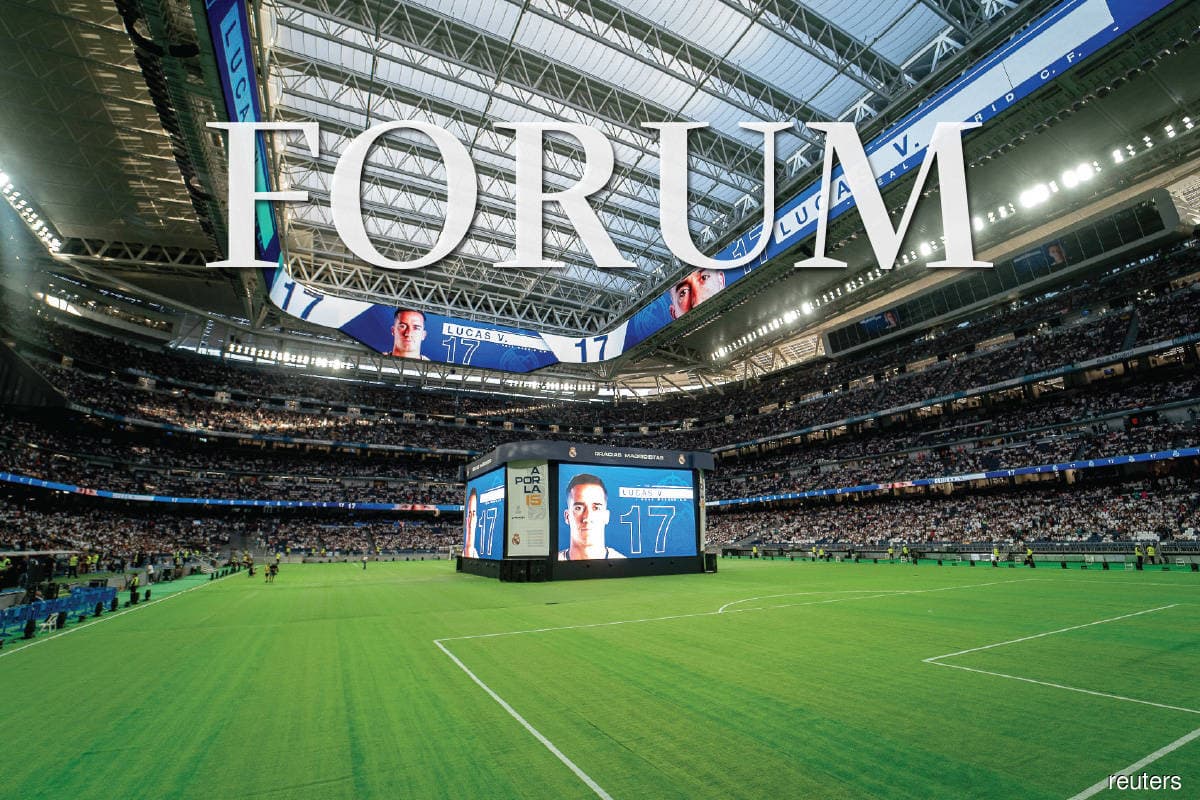
Ensuring that it remains so is what’s behind the €1.3 billion (RM6.64 billion) revamp of their home ground. Always known as one of the “cathedrals” of European football, “the Bernabeu” is now being compared to a spaceship. No longer just a place of worship, it is something that the club hopes will carry it into a future as stellar as its past.
Apart from reinforcing its 85,000-capacity fortress of a stadium, it will become a mini-city of entertainment and commerce, with a hotel, bars, restaurants and retail outlets. And when every square metre of space has been squeezed, underground walkways will funnel crowds to another Real-owned shopping centre and two high-rise apartment blocks nearby.
Nor is the club neglecting its core business: there is a retractable roof that raises the decibels of home support to intimidating levels when closed. A 360° screen ensures that fans don’t miss a kick while below the pitch is a four-storey “greenhouse” where the hallowed turf can be rolled up and stored.
This enables a multitude of events from ubiquitous Taylor Swift concerts to the local dog show to take place without a blemish on the manicured lawn. Two recent sell-out performances by the American diva generated an estimated €5 million. With ventilation, lighting, air-conditioning and irrigation, the playing surface can be maintained in pristine condition and wheeled in and out when required.
This is just one reason why data analytics company Football Benchmark (FB) puts Real’s “enterprise value” of €5.1 billion above its rivals. FB founder Andrea Sartori says: “They now have a major competitive advantage over all the European clubs. We’ll see growth on the stadium revenue side that will soon bring the Bernabeu over the €1 billion annual mark.”
It is predicted that matchday income alone will more than double once the renovation is complete. Regular NFL games will be held from 2025, along with an anticipated 50 major non-sporting events, every year.
Victory in last weekend’s final will be worth about €80 million in prize money but a lot more in terms of visibility to sponsors. Real already has a truly global reach with its jersey said to be the most valuable in the world. Last year, it became the first club to have 500 million documented social media followers, according to data analysts, Blinkfire, as well as topping Deloitte’s Money League.
Financial health has been a priority ever since club president Florentino Perez marked his first term with his famously high-risk galactico policy two decades ago. Funded by the €480 million sale of the training ground, it saw Real buy the most expensive player in the world on an annual basis and, one after another, Zinedine Zidane, Brazil’s Ronaldo, Luis Figo and David Beckham all arrived in the Spanish capital.
After initial success, opinions were mixed and eventually it was perceived as a failure as the galacticos crashed back to earth. The emphasis on attackers led to an imbalance in the side on which Zidane quipped: “Why put another layer of gold paint on the Bentley when you’re losing the entire engine?” But 20 years on, Perez’s strategy was perhaps not such a madcap idea after all.
After a perfect start in the European Cup back in the 1950s, winning the first five tournaments with superstars such as Alfredo di Stefano and Ferenc Puskas, Real lost their lustre when rivals got their act together.
They won again in 1966 but Ajax, then AC Milan, Liverpool, Bayern and finally Lionel Messi’s Barcelona ensured that Real endured an unthinkable 32-year drought. They broke it in 1998 and won again in 2000, but it was the galacticos who re-established Real as the go-to club for world superstars.
France’s Kylian Mbappé is just the latest of a long line to say it’s always been his dream to join while, with the language link, South Americans have always made it their preferred destination. Even British players such as Beckham, Gareth Bale and Jude Bellingham echo those sentiments, so in today’s climate of global fans and sponsors, Real are still finding residual benefit from both of those star-studded eras.
And Perez, very much in charge of the club that is owned by fans, who are called socios, has wised up. Combining his off-field business nous with a more adroit one on the field, he now buys players who are 25 or younger. And along with Mbappé has come the next Brazil wonder kid, Endrick, who is just 17.
The construction magnate has been the loudest voice protesting the emergence of the oil-rich clubs such as Paris Saint-Germain and Manchester City and the whole sports washing phenomenon, which is why he came up with the ill-fated European Super League. He thought it would enable traditional clubs to remain competitive with the nouveau riche.
But now he is maximising the commercial potential of the stadium while signing players whose value will rise. FB predicts he will soon have the most valuable playing squad in football as the likes of Vinicius Junior, Eduardo Camavinga, Federico Valverde, Eder Militao and Bellingham only get better.
Perez has also shown he knows when to offload players — as he did when selling Cristiano Ronaldo for €100 million and Casemiro for €70 million once they’d passed 30. But the financing of the Bernabeu did not come cheap. Perez claims the repayments will be around €60 million for the next 30 years, but the 77-year-old doesn’t miss a trick — even the underground car park is predicted to harvest almost €500 million a year.
Much like the team, he finds a way. Recent “miracle” escapes against Juventus, City and PSG, who all were convinced they had beaten them, have led to suggestions they possess “a Lazarus gene”, are “married to the tournament” or even that their dominance is down to “some higher power”.
Manager Carlo Ancelotti puts it down to “being like a family, no egos, the best organisation and our history all combining”. And now the Bernabeu’s aura of invincibility will be fuelled by its own brand of “petroleum” to see off even its oil-powered rivals.
Bob Holmes is a long-time sportswriter specialising in football
Save by subscribing to us for your print and/or digital copy.
P/S: The Edge is also available on Apple's App Store and Android's Google Play.