

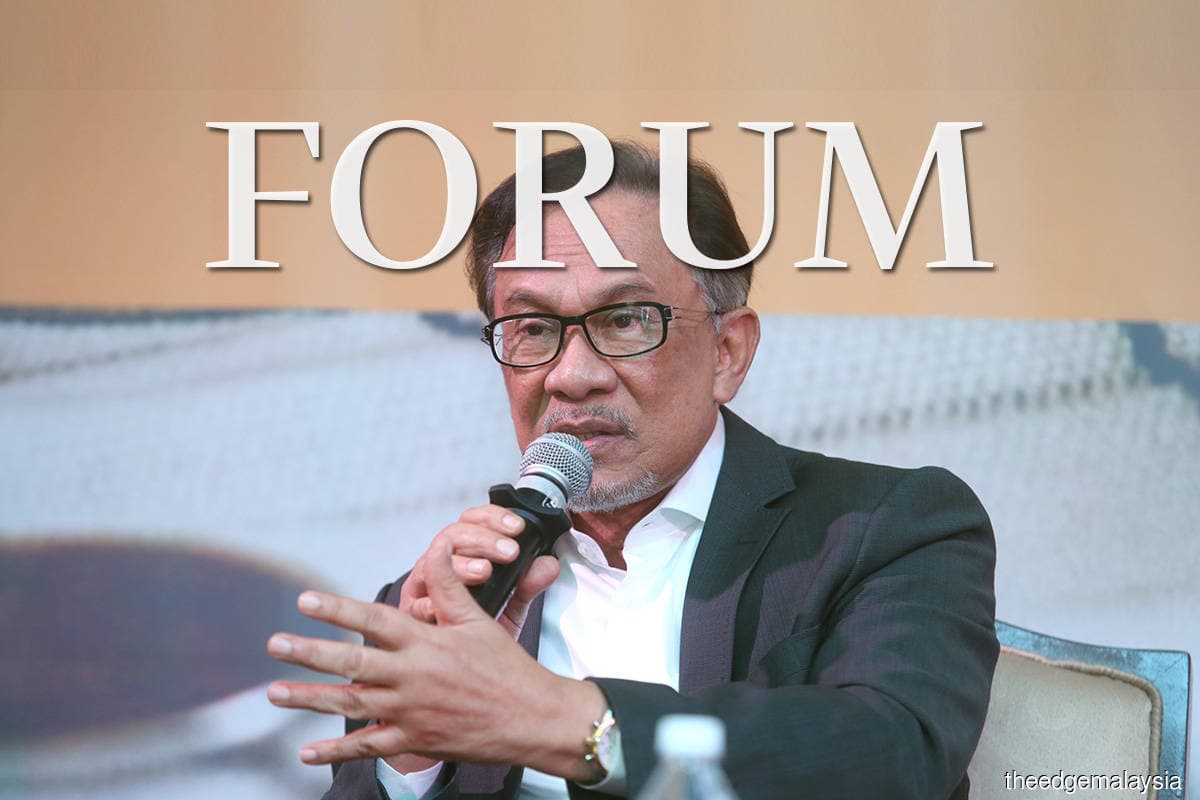
This article first appeared in Forum, The Edge Malaysia Weekly on June 10, 2024 - June 16, 2024
During the past month, two major incidents occurred that dealt with the slow progress of Prime Minister Datuk Seri Anwar Ibrahim’s reform agenda. On May 14, at the Qatar Economic Forum, during an interview with Bloomberg, Anwar was asked about the “slow rollout of reforms”. Anwar’s response was that “abrupt radical change” would prompt anger. On May 25, when Bersih, an electoral reform-based coalition of civil society movements, organised a forum to discuss this slow pace of reform, one director of this organisation stated that “nothing had happened” although it had “been 548 days since Anwar took power”. Bersih, in fact, was established in 2005, spurred by politicians then in the opposition, including those from the party Anwar leads.
Anwar’s unhurried pace to institute reforms is deeply disconcerting. After all, in 1998, when he was ousted from his position as deputy prime minister, Anwar had called for “reformasi”. This reformasi entailed major institutional and legislative changes to curb corruption and foster transparency and accountability in governance. This is an issue that Anwar has been engaging with the general public for over a quarter of a century. His reform agenda is a key factor that eventually brought his party to power. Interestingly, Anwar argued during the Bloomberg interview that “elites” claim to have “all the answers” without “even interacting with the masses” which is a “basic flaw” with “elitist democratic ideals”.
However, the “masses” have unequivocally spoken. Before the 2018 general election, as the scale and scope of corruption rose, leading even, unprecedentedly, to criticisms of kleptocracy, public calls for reforms grew. These concerns about corruption led, unexpectedly, to Umno’s fall. Instituting reforms, including holding accountable Umno leaders, such as then prime minister Datuk Seri Najib Razak and his deputy, Datuk Seri Ahmad Zahid Hamidi, were pursued with much zeal by civil society members working with the new government. Subsequently, the Pakatan Harapan government released an impressive National Anti-Corruption Plan (NACP), a five-year programme to rein in corruption.
When the Pakatan government fell in 2020, civil society continued pressing the subsequent governments to implement the reforms listed in the NACP. It was during the administration of Datuk Seri Ismail Sabri Yaakob that an important change occurred, when an All-Party Parliament Group (APPG) was created to deal with corruption.
Malaysia’s parliament structure allows for the setting up of APPGs. These APPGs comprise parliamentarians from all parties and civil society members, brought together to help deal with matters of national interest. Civil society members of an APPG, approved by the speaker of the parliament, are required to discuss and propose policy and legislative recommendations to parliamentary committees and the government. The APPG established to propose anti-corruption measures includes representatives from non-governmental organisations and the media, business professionals and academics.
Although a multitude of areas required reforms to curb corruption, by 2022, in order to get the government to act promptly, civil society members in the APPG focused on eight core issues:
1. Amendments to the Whistleblower Protection Act 2010;
2. Amendments to the Malaysian Anti-Corruption Commission Act 2009;
3. Amendments to the Judicial Appointments Commission Act 2009;
4. Enactment of a Political Funding Act;
5. Enactment of a Procurement Law;
6. Separation of powers between the attorney-general and the public prosecutor;
7. Reinstatement of the Parliamentary Services Act; and
8. Full implementation of the National Anti-Corruption Plan, 2019-2023.
After the general election in 2022, the Integrity and Anti-Corruption APPG was created. This APPG has since prepared a series of well-researched and deeply debated working papers, the basis on which to discuss these eight reforms with MPs and ministers. However, when the government proposed the Ombudsman Act, implementation of some of these reforms stalled. While an Ombudsman Act has its merits, its introduction should not delay the implementation of core reforms. In fact, some of these reforms can be undertaken immediately, such as amending two core laws: the Whistleblower Protection Act 2010, to adequately protect whistleblowers; and the Malaysian Anti-Corruption Commission Act, to ensure this institution’s independence from the executive arm of government and to check persistent criticism of selective prosecution.
Undoubtedly too, a cornerstone reform is to create the Office of the Public Prosecutor, one that is separate from the Attorney-General’s Chambers, which advises the government. Without this reform, there will be no public confidence in the rest of the reforms. This separation of powers is imperative as it provides for a check and balance on the executive arm of government, ensuring independent oversight of public governance.
These reforms, in fact, constitute part of PH’s manifesto, issued before the 2018 general election, which promised a “New Malaysia”, governed in a manner that would be a marked departure from Umno’s form of authoritarian, or semi-democratic rule, a point Anwar repeated in his interview with Bloomberg. Crucially too, these reforms will help create a business environment that inspires domestic and foreign investor confidence. Investors, after all, seek a safe and predictable environment to do business, one where they don’t have to deal with political intermediaries or corrupt practices in government.
Anwar is aware that he now oversees a deeply rigged system, and must contend as well with the dire political and economic ramifications of continuing to keep in place such a flawed governance framework. And since he has long — and correctly — proclaimed that corruption in Malaysia is endemic, he should not procrastinate in instituting reforms. If Anwar does not act immediately, he risks further diminishing the trust Malaysians have placed in him to institute accountability and transparency in public governance.
Datuk Hussamuddin Yaacub is a prominent publisher, philanthropist and reformer who has been recognised with multiple awards for his contributions to the media and education. His latest initiative is an anti-corruption crusade known as #RasuahBusters. Terence Gomez is former professor of Political Economy, Universiti Malaya. Shah Hakim Zain is a former corporate executive and the founder of Yayasan Cerdik. They are members of the All-Party Parliamentary Group-Integrity and Anti-Corruption.
Save by subscribing to us for your print and/or digital copy.
P/S: The Edge is also available on Apple's App Store and Android's Google Play.