

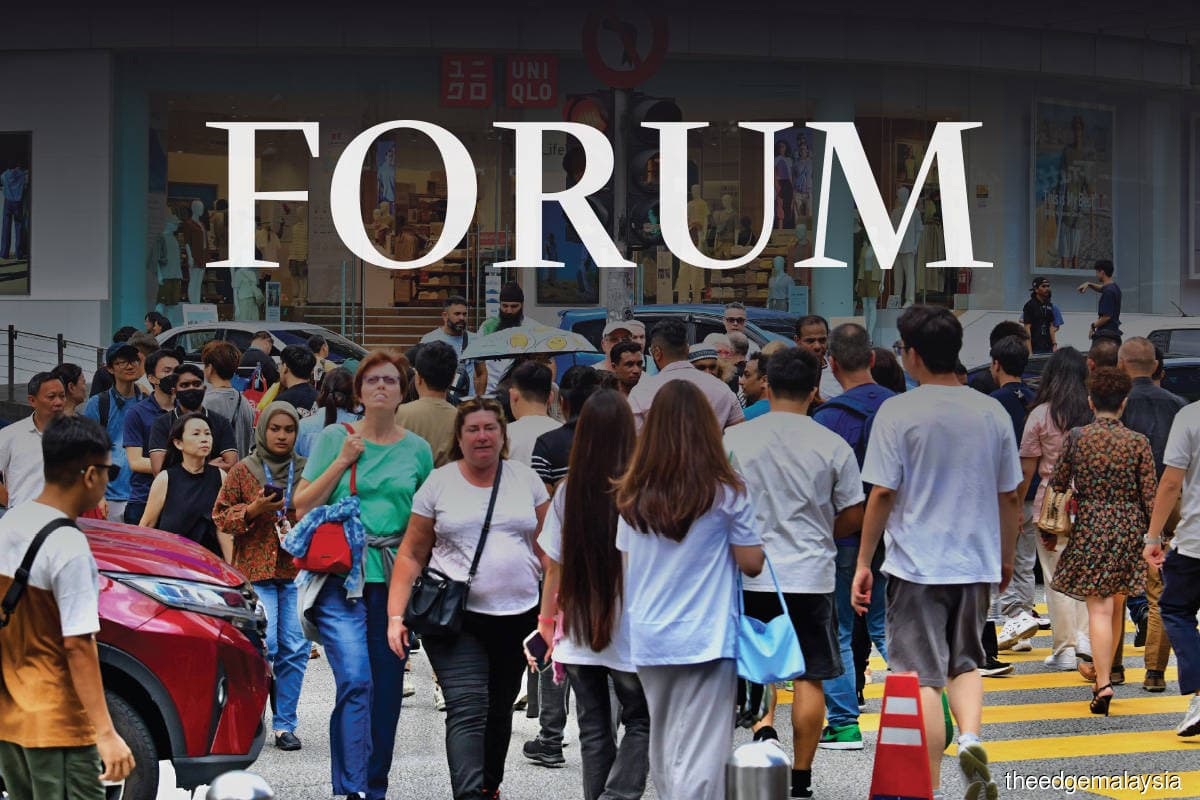
This article first appeared in Forum, The Edge Malaysia Weekly on May 27, 2024 - June 2, 2024
Throughout history, especially since the 17th century, the fall of many governments has followed after the overtaxation of its citizens. When the patience of populations breaks, their fear of going against the authorities will be trumped by anger at their financial predicament and lack of financial security for their families. Both feudal dynasties and elected governments have seen their demise by overtaxing their citizens, sometimes to death. Burdening our citizens with more taxes is our “let them eat cake” moment.
Economies do not grow through increased taxation. Governments cannot tax their way out of a fiscal crisis. National economies rise and fall by the strength of their private sector. The singular job of any government should be to ensure the continuous priming of the private sector.
The citizenry does not care about growth rates. Individuals and families, like businesses as well, live and die by cash flow, not profit and loss statements. Having more cash in hand means greater ability to spend to take care of themselves and their families. It means more money in circulation to go around. That is priming 101. And when you take some of the money away, you choke the life of the very people you need to vote for you.
There are many ways a government “taxes its people to death”. Remember that governments, both state and federal, are non-profit entities that are entrusted with the money and natural resources that belong to the people, to generate income and benefits for their citizens. Hence, irresponsible, inefficient spending by governments is effectively increasing taxation on its citizens. It means the government is taking the money — that is taxation — from its people for net negative returns for their blood, sweat and tears.
Bloated government/GLCs
The government must force itself to scrutinise wasteful spending. Think about this simple fact: the US, the largest economy in the world with a gross domestic product of US$28.8 trillion, has a federal government with only 15 cabinet departments; Malaysia, an economy of a mere US$445 billion, on the other hand, has more than 20 cabinet departments. Does that make any sense to anyone? Isn’t this akin to giving away the people’s money? When did our tax revenue become a charity for the bureaucracy and the political class? A reformist government must reform, and cutting spending should be leading the agenda as operating expenditure for 2024 is already at a high of RM303.8 billion.
The government has no right to give away the people’s money. It has no right to bloat cabinet posts and the civil service. It has no right to bestow monopolies and natural resources belonging to the rakyat to government-linked corporations (GLCs) and others with wasteful spending and without real direct returns to citizens. In fact, worse, it has no right to create such entities and then bail them out after they have burnt through the money and resources bestowed from citizens of the nation.
Government employees, including elected politicians, the civil service, GLC executives and staff are effectively non-taxpayers. The numbers in their income tax returns are paid on their behalf by the people — the makcik selling nasi lemak at the roadside, the salesmen who toil from dawn till dusk, and the workers of companies whose wages are slashed in a recessive economy. And for some reason, those in the civil service and GLCs get pay raises and bonuses while the ordinary majority of our people struggle to get or maintain jobs, lose their jobs, or suffer a fall in their income. The fact that public servants are called by that name is for one reason and one reason only — to serve the public.
Greater transparency is desired, not just of the government, but its linked companies such as Tenaga Nasional Bhd, Axiata Group Bhd, Petroliam Nasional Bhd, Ekuiti Nasional Bhd and the likes. The people have the right to know what pay packages are dished out to the “civil servants” within this category of government employment, and to whom the money goes.
Consumption taxation
Here is a fundamental question: why does the government have the right to tax consumption? What is the logic of charging its citizens, corporate or individual, for purchasing goods and services for our use or businesses after we have already paid a tax on our earnings? Why tax us some more when we use the money we have left after the government has already taken a cut from our income? The government has a fiduciary obligation to spend wisely and responsibly based on its basic revenue and not continuously tax its citizens at every turn of their life and work.
Are only the people expected to tighten their belts while the government, its linked companies and the civil service get pay rises, bonuses, and bailouts? There are
16.96 million in the workforce in this country, 1.7 million of whom belong to the civil service. Why should the government burden 90% of its working population, who are likely to be more than 50% bumiputera, while lavishing rewards time and again on the 10%?
Inflation
And now we come to the invisible taxation no one seems to talk about — inflation. Milton Friedman, the Nobel laureate in economics, once said inflation is taxation without legislation. It is effectively a hidden tax whereby the people pay for the government’s expenditure without realising it. One only needs to look at the starting pay of, let’s say, engineering graduates 20 years ago and the cost of a car then and today’s pay and costs. It is across the board staggering in its differential in Malaysia. A stagnating pay scale against a disproportionate cost of living that increases year on year. No government-devised statistical data can paint over the true reality of the rise in costs and the near stagnation of income. The drop in the value of the ringgit against the greenback is a manifestation of this inflationary fact, the one clear indicator of the fundamental strength or the lack thereof of our economy.
Net exporter and fuel subsidy
Inflation is probably the single most potent economic killer of the national economy and the citizenry. Today we hear almost incessant rumblings coming from government functionaries of the so-called fuel subsidy. Imagine the inflationary impact this will have on individuals and the economy if the ivory-tower thinking of cutting this so-called “subsidy” is to take place, supposedly to save some RM29 billion a year for the government. The Malaysian Anti-Corruption Commission chief just recently stated that Malaysia lost
RM277 billion over the last five years alone due to corruption; that is RM55 billion per year on average, and this is only a number that we know of. That, ladies and gentlemen, is the real subsidy the government has allowed to happen under its watch. RM55 billion per year is not a number any ordinary citizen can squander unless one holds a position of power over the levers of administration. Do not punish the people because the bucket that the government is holding is somehow leaking. To quote Prime Minister Datuk Seri Anwar Ibrahim, “We must begin with the governance issue to ensure no unnecessary leakage and corruption ... You can correct the excesses first then you can see if there is a necessity to tax further,” he said on Oct 18 last year.
A nation that is a net exporter of petroleum and petroleum products has no business to tax its citizens on a natural resource it makes hundreds of billions from its God-given natural wealth. The government must positively contribute towards the net purchasing power of its citizens from the one source of revenue they deserve, petroleum. A pull-out of fuel grants — yes, I call it a grant, not subsidy — is an inflationary tax on Malaysian citizens and economy. Another tax being heaped upon us, the people. Do what is right for the people and do not punish them. This needs to be carefully managed and requires an innovative solution to ensure that smuggling and other leaks of such grants to citizens (that is of “subsidised” resources) do not contribute to further burdening the people.
Minimum wage
The imposition of a minimum wage is not the gift the government thinks it is. It is another inflationary tax on businesses and consumers. Businesses will pay what the market can withstand and will earn them a sustainable business. No statutory imposition of wages will be the catalyst for the hiring of more workers or sustaining businesses when costs exceed what consumers will pay. Further, it does not help when our education system does not deliver workers of the calibre needed for the workplace. It is even worse when our immigration system is openly abused for the importation of and the opening of businesses by foreign workers.
Possible solution
I have laid out the myriad forms of taxation the people have had to endure. At this point, I would like to propose the most important fiscal stimulus that should be permanently entrenched in our governing framework, which I believe will earn immense goodwill from the people for this government. Cut our income taxes, individual and corporate, by at least 50% — as a start for this year. If countries that have practically no taxes, or very low taxes, can grow their economy from a backwater to first-world developed nations, why do we, with all the natural resources, tax our citizens again and again? Do this one simple thing and watch how it boosts our economy, and brings investment growth both from domestic and external sources. The government will earn more in revenue from a booming economy than a highly taxed one that effectively shrinks it.
Do not increase any further consumption taxation of any kind; instead look into reducing taxation, period. Along with that, the government must impose fiscal discipline on itself. The government should focus its efforts on radically reducing its operational expenditure on a grand scale, both at federal and state levels and among GLCs.
Cut operational costs by at least 50%. Eliminate monopolies for basic foodstuff. Close down unproductive universities and faculties that are producing unemployable graduates and kangkong professors. The savings we make by cutting wasteful spending can be channelled towards a “national trust fund” that is entrusted to build quality public housing for the lower-income group and raise the living wages of critical services providers in the public health/medical sector, our police and armed services personnel and science, technology, engineering and mathematics teaching force.
Tanam lalang takkan tumbuh padi. Let us make Malaysia great again.
Tengku Ngah Putra is the head of the oil and gas cluster of Majlis Tindakan Ekonomi Melayu Bersatu
Save by subscribing to us for your print and/or digital copy.
P/S: The Edge is also available on Apple's App Store and Android's Google Play.