

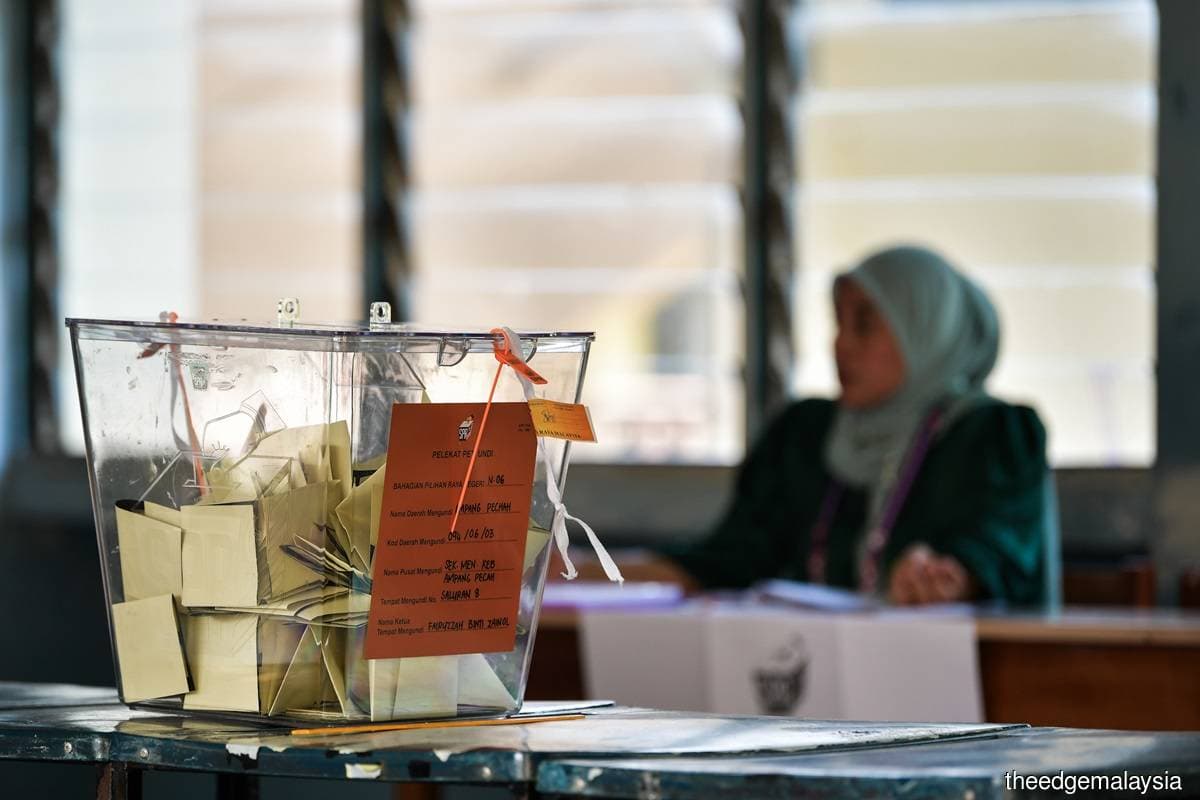
(May 14): The comfortable win by the Pakatan Harapan (PH) and unity government's candidate, Pang Sock Tao, in the recent Kuala Kubu Baharu (KKB) by-election was indeed an impressive one where the overall vote share increased from 54.4% to 56.6% and the previous majority was almost maintained (4,119 in 2023 versus 3,869 in 2024) even though turnout decreased (from 67.6% to 61.5%) (See Table 1 below). This victory was achieved amid difficult external conditions at the national level, including cost of living pressures, accusations that DAP was slowly turning into another MCA, and race, religion and royalty (3R) issues being played up directly and indirectly by the opposition, the Perikatan Nasional (PN) coalition. How did PH achieve this victory? Who are the winners and losers from this by-election? What are some of the likely impacts of this result moving forward?

Improvement in PH’s performance among police, army, and civil servants; among Orang Asli; and among Indian voters
PH improved its performance from the 2023 state elections in a few voter segments. The first voter segment is among the police, army, and the postal voters (mostly civil servants). PH’s majority went from minus 540 in the 2023 state elections to plus 472 in the by-election, contributing a +1,012 change in PH’s majority (See Table 2). This improvement is probably due to a recent announcement by Prime Minister Anwar Ibrahim that the pay for civil servants would be increased by 12% later this year and also the likely scrutiny put on the uniformed personnel by their superiors to “deliver” the vote to the unity government. It is less clear if this performance can be repeated during the next general election where the impact of the salary increase may have waned and where the public scrutiny on the army, police and other civil servants may be less focused.

The second voter segment is among the Orang Asli community where PH overturned a minus 69 majority in 2023 to a plus 150 majority in 2024 in the two Orang Asli majority voting stations in Pertak. PH saw its vote share increase from 29.1% in these two polling stations in 2023 to 70.6% in 2024, an increase of 41.5 percentage points. This was definitely a case of voting for the government, especially at the federal level, and the likelihood of this performance being replicated in the next general election will be higher, especially if PH and Umno/BN campaign together, thus being seen as a more credible option to remain as government.

The third voter segment is among Indian voters in the two Indian majority polling stations in KKB — Lembah Beringin (52.3% Indian voters) and Ladang Nigel Gardner (60.8% Indian voters). PH increased its voter share from 62.0% in 2023 to 64.5% in 2024, an increase of 2.5 percentage points, in Lembah Beringin. In Ladang Nigel Gardner, PH increased its share of vote by a significant 22.6 percentage points from 55.6% in 2023 to 78.2% in 2024. PH managed to win most of the votes which went to the Muda candidate in 2023 in Ladang Nigel Gardner, which is part of the reason for this significant increase. Overall, the share of vote won by PH in these two polling stations increased from 59.6% in 2023 to 69.5% in 2024, an increase of almost 10 percentage points (See Table 4 below).

Small improvement in PH’s performance in Chinese majority polling stations
Not surprisingly, PH managed to maintain its stranglehold on Chinese voters. In the six Chinese majority polling stations with more than 100 voters, PH increased its share of vote from 83.9% in 2023 to 86.2% in 2024, a small improvement of 2.3 percentage points (See Table 5 below). This wasn’t surprising given that the PN had all but abandoned the Chinese vote when it decided to field a Malay candidate in this by-election and did not make any significant effort to campaign in the Chinese majority polling stations during the campaign.

Small decrease in PH’s performance in the Malay majority polling stations
Not surprisingly, PH lost some ground in the five Malay majority polling stations where its vote share decreased by 1.3 percentage points from 40.0% in 2023 to 38.7% in 2024. Even though PH made up some ground in the Kampung Air Jernih and Kerling polling stations, it lost ground in the polling stations of Ampang Pechah and Bandar Utama Batang Kali (with two voting places) where the majority of Malay voters in the KKB state seat are located (See Table 6 below). These three polling stations were also the places where PN focused its campaign on, in terms of ceramahs and other campaign related activities.

In summary, PH made the most gains among the early and postal voters (police, army and civil servants), the Orang Asli voters, and the Indian voters. It experienced slight gains among the Chinese voters but also experienced some losses among the Malay voters.
PH won more than 95% of the Chinese votes, more than 70% of the Indian and Orang Asli votes, and more than 60% of the early and postal votes, while PN won more than 80% but less than 90% of the Malay votes. In a 50% Malay and 50% non-Malay seat like KKB, it is not possible for PN to capture this seat if it just relies on the Malay votes. It will have to win more than 90% of the Malay votes to stand a chance of neutralising PH’s advantage among the non-Malay voters, which it is not able to achieve at this point.
Getting out the vote/turnout rate
One of the key determinants of this by-election was which side could motivate its supporters to come out to cast their votes. It was expected that the turnout rate would fall, but what wasn’t known was how much it would fall by and whether there would be any significant differentials in the turnout rate among different segments of voters. Overall turnout fell by 6.1 percentage points from 67.6% in 2023 to 61.5% in 2024. But the turnout rate fell by the most in the Malay majority areas (7.1%). The turnout rate in the Chinese majority areas fell by 6.1% while it fell by 6.5% in the Indian majority areas. Surprisingly, the turnout rate in the Orang Asli areas increased by 12.6 percentage points from 74.7% in 2023 to 87.3% in 2024! (See Table 7 below)

PH clearly did a better job in getting out the vote in areas where it enjoyed strong support compared to PN. PN was not successful in getting younger voters in the Malay majority areas to come out to vote. This can be seen in the SK Bandar Baru Batang Kali voting place (72% Malay) in the Bandar Utama Batang Kali polling station, one of the largest in the KKB state seat. The decrease in turnout was 23.1% for the youngest saluran compared to a decrease of only 6.0% for the oldest saluran. The youngest saluran is also the where PN made the largest gain in vote share (8.8%) (See Table 8 below).

Who are the winners and losers?
There are some clear winners and losers resulting from the results in the KKB by-election and also some “in-between” cases.
MCA proved itself to be politically irrelevant because its boycotting of the campaign did not result in PH losing any traction among the Chinese voters. In fact, small gains were made by PH in the Chinese majority polling areas. Gerakan also proved itself to be ineffective in terms of its inability to hold on to this seat to contest under the PN ticket and for failing to win even 5% of the Chinese vote as promised by its president Dominic Lau.
The Bersatu leaders — namely its president Tan Sri Muhyiddin Yassin, and PN Selangor chairman Datuk Seri Mohamed Azmin Ali — were also exposed in their inability to run a compelling campaign. Bersatu’s candidate Khairul Azhari Saut captured the headlines for all the wrong reasons — his academic credentials and rumours about this personal life — and he failed to offer any compelling narrative on his vision for KKB despite being a local candidate. The candidate’s inability to showcase himself on social media or to make himself available to the media probably contributed to the poor outreach of PN to the younger voters, especially among the Malay youth.
Bersatu will try to hold on to the narrative that it managed to make some gains among the Malay voters in KKB and will be hoping that PH and the unity government’s current and future unpopularity among the Malay voters will be sufficient to carry PN over the line in the next general elections.
Former DAP leader P Ramasamy also failed in his attempt to persuade the Indian voters in KKB not to vote for PH. While he still may have appeal among the Indian community at the national level, this does not seem to translate into influencing voting behaviour, at least not in this by-election.
DAP and PH emerged as clear victors in this by-election. DAP showed that it could lead a campaign that was cohesive and compelling, and it avoided many potential “traps” that could have played into the hands of the opposition, including avoiding 3R issues as much as possible and fielding a charismatic candidate that gained momentum along the campaign, while the other side lost ground. DAP Selangor secretary Ng Sze Han proved himself to be a capable campaign director with Yeo Bee Yin and Nga Kor Ming providing strong support to the candidate, who is also their former special/media officer.
The Selangor Menteri Besar Datuk Seri Amiruddin Shari also provided strong campaign support and will use this result to cement his own position in the state and also within PKR.
PAS was relatively muted in this campaign, perhaps wanting to let Bersatu take the lead (and take the blame too?). It was hard to see how much more PAS could have done to mobilise the Malay vote, especially given the quality of the PN candidate.
Even though Anwar should take some credit for his timely civil service salary increase announcement on May 1, 2024, his absence in KKB was notable, from the lack of billboards of him together with the candidate and him not appearing even once during the two-week campaign in KKB.
Implications moving forward?
The status quo for the KKB by-election has positive as well as negative implications for PH and BN as well as for PN. The KKB results may be interpreted as a vote of confidence for PH and the unity government and for business as usual to continue. This would be a mistake since the underlying dissatisfaction against the government among different segments of society is real and growing. Many of my colleagues in PH would remember the April 2007 Ijok by-election that was won relatively comfortably by the BN candidate. Less than one year later, in March 2008, in the 13th general election (GE13), BN lost control of Selangor and of the two-thirds majority in Parliament.
Umno would also be mistaken to think that the Malay vote has started to turn in its favour. The results in the Malay majority areas in KKB clearly prove otherwise. The party still lacks a coherent game plan on how it will win back the Malay vote, especially among the Malay youth.
PN would also be mistaken to think that the current government’s popularity would allow it to easily win back power in GE16. While it definitely have the majority of Malay support nationally, it remains to be seen if this will be sufficient for the party to win a majority of seats in Peninsular Malaysia, especially if some of the leadership challenges in Bersatu continues to weaken the ability of the party to campaign and present itself as a credible government in waiting.
The battle ground is among the middle ground, especially the Malay middle ground, which can be swayed by good leadership, good policies, and good implementation. There is a lot of runway before GE16 for all parties and their leaders to make the necessary adjustments to win this middle ground as a pathway to Putrajaya.
Dr Ong Kian Ming is a former Member of Parliament for Bangi