

This article first appeared in The Edge Malaysia Weekly on May 6, 2024 - May 12, 2024
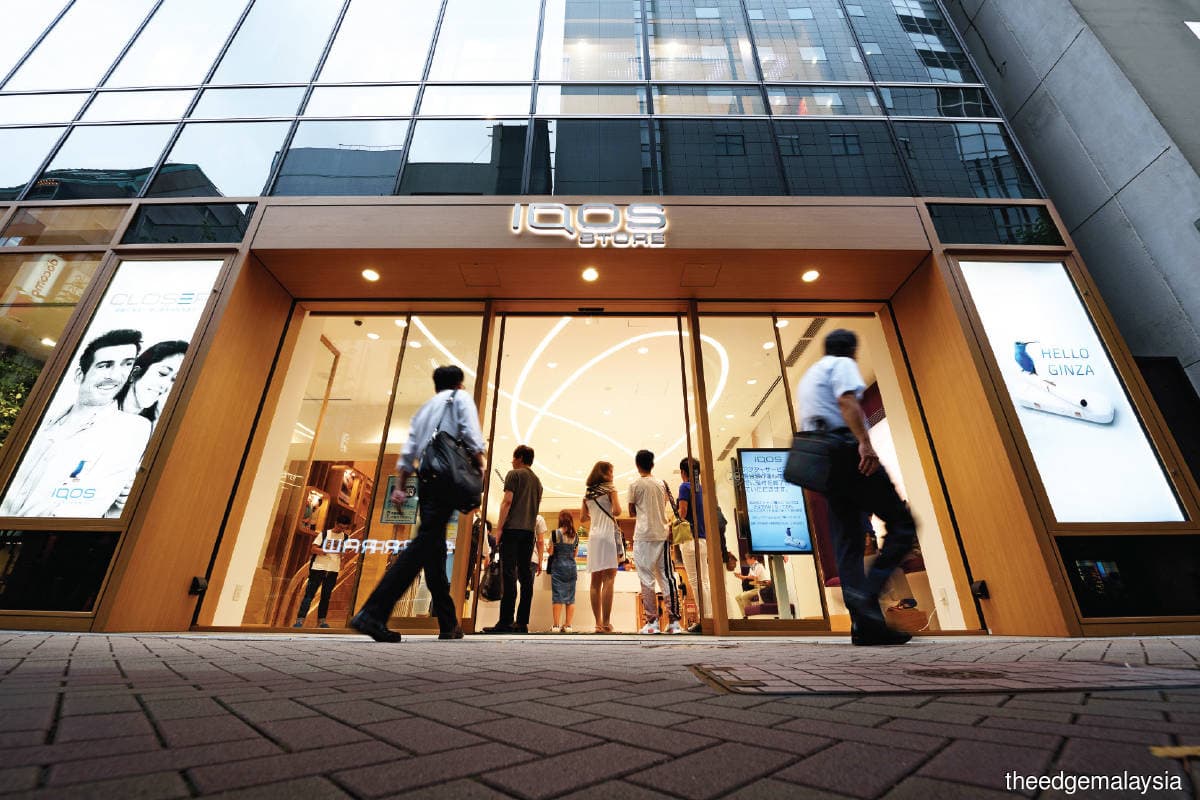
PHILIP Morris International (PMI), one of the biggest tobacco companies in the world, has been seeing robust demand for its heated tobacco products (HTPs), first launched 10 years ago in Japan, where there has been a significant decline in cigarette sales following the introduction of IQOS — its flagship heated tobacco product, also known as a heat-not-burn product.
This is evident in the company’s recently announced net income of US$2.15 billion on revenue of US$8.79 billion for the first quarter of this year (1Q2024), with its revenue and earnings per share (adjusted for one-time gains and costs) of US$1.50 exceeding market expectations of US$8.47 billion and US$1.41, respectively, lifted by demand for the company’s HTPs as well as nicotine pouches.
The tobacco player, whose most recognised product is its Marlboro cigarettes, saw its smoke-free business account for 39% of its 1Q2024 net revenue. And the East Asia and Australia region (which includes Malaysia), which is led by Japan and South Korea, reached about two-thirds smoke-free net revenue. Shipments of PMI’s IQOS units jumped 20.9% to 33.1 billion during the quarter — higher than PMI’s own forecast of between 31 billion and 32 billion sticks — compared with a 6.1% increase seen in 4Q2023.
In Japan, heat-not-burn products have taken up more than 40% of Japan’s entire tobacco market. As at the end of last year, PMI’s smoke-free products made up more than three-quarters of its net revenue from the country. Also at the end of last year, one in three tobacco users in Japan were IQOS users, with about 8.5 million IQOS users spread throughout the country, PMI’s data shows.
PMI is now gearing up to launch IQOS in the US in the second quarter of this year, as it aims to replicate its success with smoke-free products in Japan in all the markets it has a presence in, including Malaysia, where IQOS was launched in 2018. Offtake share in Kuala Lumpur has reached 11.3%, indicating that heated tobacco units (HTUs, or units of tobacco that are inserted into a heated tobacco device) make up about one in 10 tobacco products sold in the retail market.

PMI says IQOS heats rather than burns tobacco sticks, so it produces no smoke but aerosol that is mainly composed of water, glycerin and nicotine, which its studies show has no negative impact on overall indoor air quality. It also claims the product emits 95% less harmful chemicals compared with cigarettes. Even so, the World Health Organization has maintained that HTPs are not risk free, and that the potential health risks associated with their long-term use are still unknown. And HTPs still deliver nicotine, which is addictive. So, some quarters have expressed concern that they might serve as a gateway for non-smokers to become addicted to nicotine and potentially transition to cigarettes.
PMI’s experience in Japan, however, appears to indicate otherwise. Cigarette sales in the country actually began to substantially decline after IQOS was introduced — first as a city pilot in Nagoya in late 2014, before being rolled out nationwide in 2016.
Prior to that, tobacco sales in Japan, one of the world’s largest tobacco markets, were declining at an average rate of 1.8% between 2011 and 2015. While tobacco sales continued to drop at about the same rate after the launch of heated tobacco product, sales of cigarettes fell more sharply — at an average annual decline of 9.5% from 2015 to 2018 (see Chart 1), based on a case study by PMI.
There has also been “a profound decline in adult cigarette smoking prevalence following the introduction of HTPs”, according to PMI, citing the Japanese National Health and Nutrition Survey, with Japanese adults who reported smoking every day or some days dropping to 13% in 2019, from 20% in 2014 — before HTPs were introduced (see Chart 2).
“Cigarette sales after the introduction of IQOS dropped five times faster than they were in the preceding years. In a country that was famous for lots of people smoking, there has been a massive plummet in cigarette sales. Adoption [of HTPs] has allowed people who are adult smokers to switch to a better alternative,” said Jeremy Custance, PMI’s director of communications for East Asia and Australia.
He was speaking to reporters invited by PMI to Nagoya recently to see how IQOS had been adopted in Japan, which banned indoor smoking in April 2020 but allowed the use of HTPs in rooms designated for them in restaurants and bars.
“We are very clear in our messaging, that is, if you don’t smoke, don’t start. If you smoke, quit. But if you don’t quit, change. The change we’re trying to bring about is to get people to move to better alternatives,” he said.
PMI seems to be doing a pretty good job of getting smokers to switch so far, based on the traction IQOS has gained not just in Japan but across the globe.
“We have made a public commitment that we are going to end cigarette sales. That’s a long-term journey for us, but we are making great progress. Japan is a really good example of that. Three-quarters of our business in Japan is now smoke-free products after 10 years. It’s not unthinkable that we can be an entirely smoke-free business in the next few years. And it’s not entirely unthinkable that within, say, [the next] 10 years, Japan can be a smoke-free country. That’s our ambition for everywhere we operate,” said Custance.
Public understanding and regulatory clarity are key
In Tokyo, sales of heat-not-burn products have surpassed cigarettes since January this year, and have continued to grow since. Information has been key to public adoption of HTPs in Japan, said Custance.
“The public needs information, right and accurate information about the products. So do regulators. People need to understand that these products are fundamentally different from cigarettes. They don’t have ash, they don’t have smoke. I think one of the greatest reasons that people in Japan adopt them is hygiene — there’s less smell, and it’s less obtrusive. People around you find it much better if you use that versus smoking a cigarette. How you deal with other people in Japan is very important socially; to make sure you have less impact on others. That’s one of the key drivers for a lot of Japanese people who adopted them,” Custance said.
While Malaysia is different from Japan, with a fundamentally different culture and regulations, Custance, who previously lived for many years in Malaysia, is confident that PMI can replicate its HTP success in Japan in Malaysia, “because Malaysia is a country that is open to new ideas and new things”.
“I think the key for us is getting people to understand what the difference is [between HTPs and cigarettes]. If you get the regulation right and you allow communication about the products, [for] greater understanding by the public — there has already been a significant adoption in Malaysia in a reasonably short period of time — I can see that [adoption of HTPs] accelerating,” Custance said.
“Once you build that understanding, [what happened in Japan] is replicable in Malaysia. It is replicable anywhere in the world.”
In terms of regulatory risks, Custance said regulation is a matter for governments but expressed hope that the understanding of these products would be scientifically backed, with a clear view of what the public needs, so that effective regulation can be put in place.
“With that understanding, and with the backing of scientific substantiation, I think the government needs to consider what is important in terms of [sellers] responsibly selling these products to the public. As a general idea, scientifically substantiated smoke-free products should be considered and regulated in a different way than the most harmful version of using nicotine, which would be cigarettes.”
At the time of writing, PMI, which was trading at US$96.05 per share, had a market capitalisation of US$149.31 billion.
Save by subscribing to us for your print and/or digital copy.
P/S: The Edge is also available on Apple's App Store and Android's Google Play.