

This article first appeared in The Edge Malaysia Weekly on January 15, 2024 - January 21, 2024
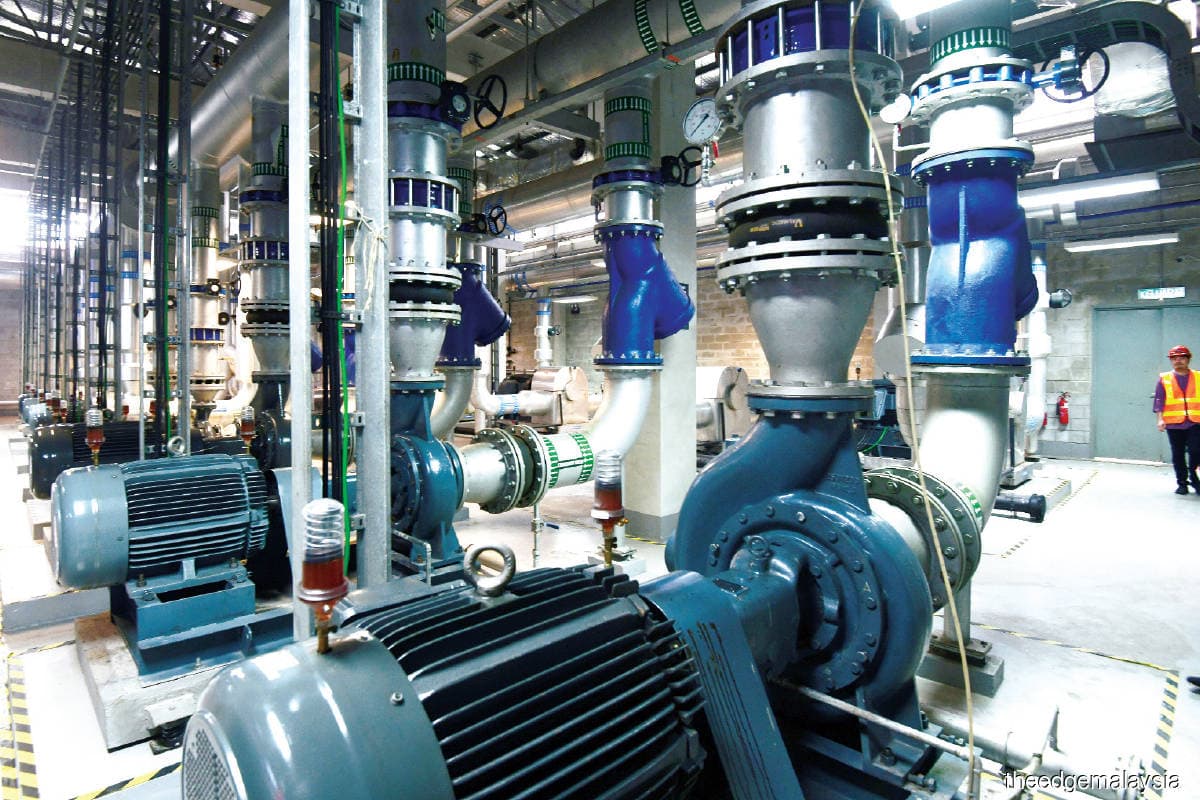
From the outside, the district cooling plant of Pendinginan Megajana Sdn Bhd, which is situated in Cyberjaya, looks like any other office lot in the area. However, the three huge tanks located at the back of the building set it apart, as do the many pipes underground that deliver cool water to buildings around town.
These tanks are thermal energy storage towers that store cold water, which is then pumped into the air conditioning systems of buildings in Cyberjaya as part of the district cooling system.
As compared to each building having their individual cooling systems that must be maintained, district cooling systems are able to reduce overall energy consumption and, in some cases, costs, thanks to economies of scale.

“Like a power bank, thermal energy storage stores the cool energy. At night — when the electricity tariff is lower [and there] is less usage or consumption of electricity — is when we operate. [At this time,] we charge and create a big ice power bank,” says Dr Mohd Hafiz Ibrahim, senior general manager of Pendinginan Megajana.
“During the day, we release this cooling energy to the development areas. Because we work at night, we reduce the stress during peak hours,” he adds.
Solutions such as district cooling may gain more attention now amid the energy transition, and especially as the long-awaited Energy Efficiency and Conservation Act (EECA) was passed by the cabinet late last year.
“It is estimated that the annual electricity consumption for a typical urban development like Cyberjaya can be reduced by at least 10,000 gigawatt hours annually via the implementation of district cooling systems as compared to conventional cooling systems,” says Hafiz.
It is critical to tackle this source of energy use because on average, 65% of the energy utilised by a building in Malaysia is consumed by air conditioning. The use of air conditioners also exacerbates the urban heat island effect. “While we want to cool ourselves, we are actually heating up the world,” says Hafiz.
Many prominent buildings and developments in the country are, in fact, served by district cooling. This includes the Petronas Twin Towers, KL Sentral, parts of Bangsar, Kota Iskandar in Johor and all the government buildings in Putrajaya.
To reduce emissions from the energy sector, relying on renewable energy (RE) is not the only method. Cutting down on energy consumption in the first place by focusing on efficiency and — in the case of district cooling — the sharing of resources are alternatives.
“While it is important to pursue and implement the ongoing policies and regulatory framework of RE in Malaysia, the same level of intensity should be applied in the energy efficiency sector as well,” says Hafiz.
According to the International Renewable Energy Agency’s 2050 global emission reduction pathways, energy efficiency and RE have equal importance and contribute 25% to the overall reduction of emissions.
To raise awareness on district cooling, the Malaysian District Cooling Association (MDCA) was established in 2021 for district cooling system providers in Malaysia to network, collaborate and share information and insights. It will be organising a District Cooling Day on Jan 31.
The six founding members of MDCA are Pendinginan Megajana, TNB Engineering Corporation Sdn Bhd, Gas District Cooling (Putrajaya), Gas District Cooling (Malaysia), Malakoff Utilities Sdn Bhd and Jana DCS Sdn Bhd.

Should district cooling be made mandatory?
Pendinginan Megajana has been the sole provider of district cooling services in Cyberjaya since 1998. The company began with only five customers compared to the 45 it currently has. Pendinginan Megajana is a joint venture between ENGIE Services Malaysia and Cyberview.
However, there are still no acts or policies related to the industry, and it remains purely commercially driven, says Hafiz.
“The industry has been around for more than 20 years with local developers, local talent and improving technology. With global demand for air conditioning projected to triple over the next 30 years, significant planning is required to aggregate demand for cooling, protect developers and customers, and ensure that the economic benefits are equally distributed along the value chain, especially the local component,” he adds.
Hafiz says it can be expensive to install, operate and maintain cooling systems for individual buildings or facilities. In contrast, district cooling systems allow for centralised production of cooling that utilises more energy efficient and environmentally friendly methods. For instance, high-efficiency chillers are designed to minimise energy consumption while maximising cooling capacity.
“For our district cooling plant, the main source of fuel consumption is electricity. The more efficient we are, the less electricity we use and the less fuel we consume,” he explains.
Furthermore, district cooling systems operate on a larger scale, serving multiple buildings and facilities in an area. This results in lower capital costs, reduced maintenance expenses and optimised operation and management, notes Hafiz.
The use of district cooling can result in a reduction of up to 70% in initial capital costs and 60% in operational costs for a building’s cooling system, and carbon footprint reduction.
“By decreasing energy consumption and improving energy efficiency through district cooling, this helps to reduce each individual building’s carbon emissions,” says Hafiz.
In fact, countries such as the United Arab Emirates, Singapore and Sweden have made it mandatory to have district cooling systems as part of their efforts to promote energy efficiency and sustainable urban development.
District cooling is well suited for central business districts, industrial zones, urban regeneration projects and large-scale residential developments, says Hafiz. For existing townships, assessments and feasibility studies can be conducted to determine the cooling demand required.
But it could make more sense if district cooling is integrated into new developments from the start. “As Malaysia continues to develop and urbanise, demand for cooling will increase. Implementing district cooling as a mandatory requirement ensures that new developments are designed with energy-efficient and sustainable cooling solutions from the start. It helps the country to plan for future cooling demands while minimising the strain on energy resources and infrastructure,” says Hafiz.
What is needed to make district cooling the norm? The EECA is a good starting point to propel Malaysia’s aspiration of accelerating the energy transition, he points out.
“A holistic regulatory framework, similar to those for electricity and water utilities, is required as this will address the commercial, legal and technical aspects of district cooling,” says Hafiz.
Save by subscribing to us for your print and/or digital copy.
P/S: The Edge is also available on Apple's App Store and Android's Google Play.