

This article first appeared in The Edge Malaysia Weekly on January 15, 2024 - January 21, 2024
MINISTER of Economy Rafizi Ramli acknowledges that Putrajaya’s attempt to create a Central Database Hub (Padu) is “a humongous exercise” carried out on tight deadlines under imperfect conditions, because of the pressing need to build “data readiness” to tackle problems inherited from decades of inefficiencies and largesse.
“Because we aspire to put digital and tech as our growth engine, there are a lot of things that we have to do on the data front … We cannot wait for everything to be perfect … We have to start somewhere,” Rafizi tells The Edge in an interview at his office in Putrajaya.
Rejecting the notion that Padu is merely a big data collection exercise, Rafizi says the database “is not even just for subsidy retargeting”, even though it is Padu’s first “use case”.
“The driver for Padu is multitude. Let’s take the reform of the public service. Every agency has its own system and database. If you look at other countries, government digital services are usually centralised through one single window, one single website with a single sign on and you get access to everything there.
“We require a central database for that, and unless we have a central database, we can criticise anyone and everyone and we will never be able to provide the kind of 21st century public service that we require,” he explains, pointing out the inefficiencies in public spending from having duplicate systems built in silos from scratch over many years.

“That is why over the years, you end up with 400-plus databases. It is all over the place and that does not include state and local government levels. All the systems that were developed cost all the way from the back end to the front end — that’s not how things should be,” says Rafizi, noting that the government’s IT spending has crossed RM8 billion a year because “everyone builds their own system from scratch”.
He says that going forward, there will be “a better divide between what can be outsourced and what can be done internally”, and Padu will be that common back end supporting more efficient delivery of public services to the people, among others.
Ideally, Rafizi too would have wanted all Malaysians to access Padu using the National Digital Identity (MyDigital ID) online identity authentication facility that Prime Minister Datuk Seri Anwar Ibrahim launched on Dec 1, 2023, but is pending a widespread rollout as its issuance requires physical biometric verification, among other things.
“The first phase of govtech (government technology) implementation has already been approved as wellSo, all these things are basically moving in parallel because we cannot afford to do things sequentially. We could have, if we had started in 2017 or 2010, but don’t blame me for the problems I inherited, legacy problems. So, we have to do things in parallel and manage it so that everything converges,” he says.
“The whole idea is, hopefully, one year down the line, you will start seeing all the government applications through one single sign-on. And when you go from one ministry to another [there will be no need to fill the same forms], you just need to present your identity card because use cases would have been approved for different applications.”
According to Rafizi, the government could have rationalised subsidies in 2023 using the existing data in Padu but wanted to do a better job at retargeting subsidies — with the chance given to people to provide another set of data as reference to Padu — to ensure that those deserving aid are not excluded or left behind while minimising the inclusion of people who are less deserving. The end-March 2024 deadline for Malaysians to register and provide updated data is to ensure “data readiness” towards implementing targeted subsidies in the second half of this year. “In 2023, everyone kept asking why this government lacked the political will to do [targeted subsidies]. It is not true.”
He admits that what Padu seeks to do is minimise exclusion errors using household-related data, potentially on a case-by-case basis, which involves “a lot of work”, hence the reason there was “big resistance” to such an exercise.
“It is easy to just draw a line [using individual income]. But if we were to build society buy-in that the retargeting of subsidies is good for everyone, I don’t think we can just do that [draw a line] because it is not just about aid, we need to convince society that this is a fairer way to distribute assistance,” he says.
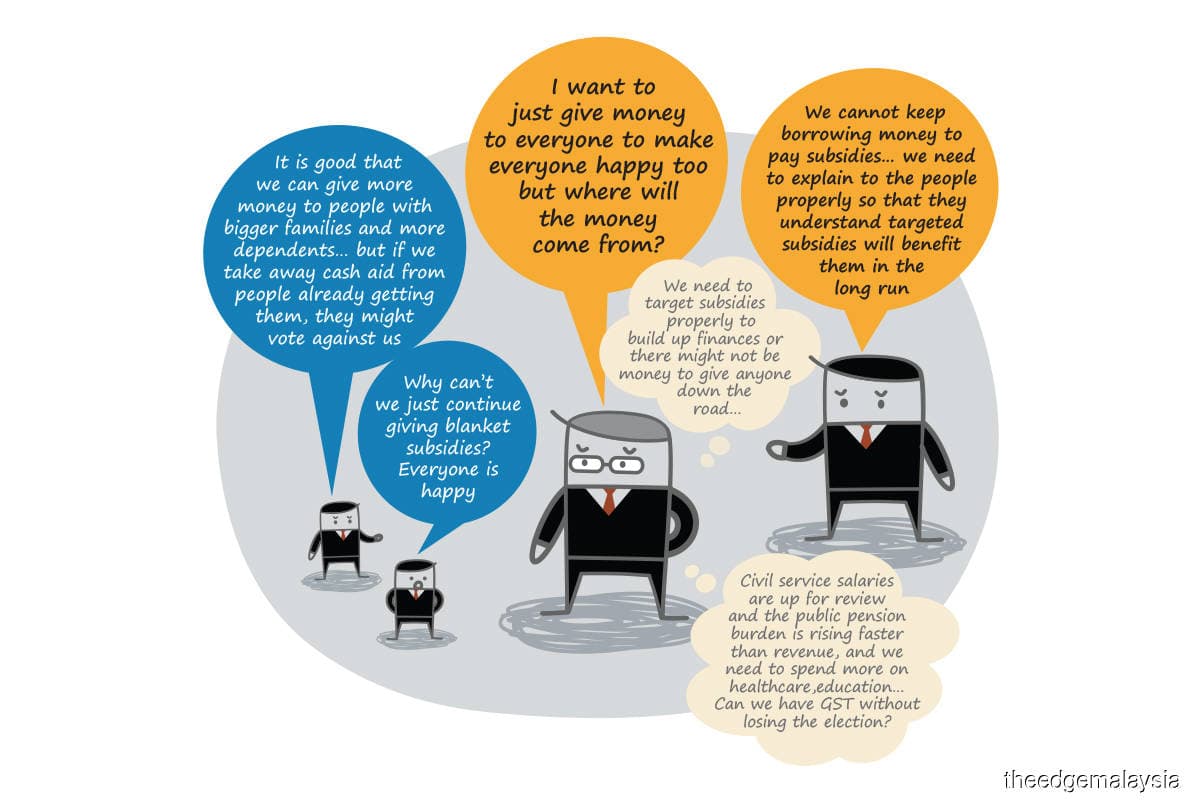
“The reason why there was a blanket subsidy in the first place is precisely because of this problem, because the government feels that it is impossible for us to be fair to everyone. So, to be fair, just give everyone. If the fuel subsidies were just RM3 billion or RM4 billion a year like they used to be, that is not a strain, but when subsidies have reached RM80 billion, you have to cut. So, it is a stage that we have to go through.”
T20 got fuel subsidies worth 1.2% of GDP in 2022?
Indeed, the strain an outsized subsidy bill had on federal government finances was clear, even as it surged to RM70.3 billion in 2022, of which RM25.8 billion was to keep RON95 fuel artificially cheap at RM2.05 per litre (US$0.44/litre) and another RM21.6 billion went to keep diesel capped at RM2.15 per litre (US$0.46/litre).
At 44.1 US cents per litre, RON95 in Malaysia is the ninth cheapest in the world, only 22% of the US$2.025 per litre in Singapore — incidentally, the ninth most expensive in the world, according to data on globalpetrolprices.com as at Jan 8, 2024. Malaysia’s RON95 fuel price is also half of Indonesia’s 86.8 US cents per litre and 36% of Thailand’s US$1.228 per litre on the same day.
If the findings of a 2014 study by Bank Negara Malaysia remain true, only 4% or RM1 billion of the RM25.8 billion spent subsidising RON95 in 2022 benefited the B40 group, less than one-tenth of the 42% or RM10.85 billion that could have gone to subsidising RON95 fuel for the T20 group. The M40, meanwhile, could have seen 54% or close to RM14 billion in subsidy for RON95, our back-of-the-envelope calculations show.
Assuming no leakages to smugglers, only RM870 million or 4% of the RM21.6 billion spent subsidising diesel in 2022 may have benefited the B40 group compared with RM9.1 billion and RM11.7 billion estimated to have gone to the T20 and M40 pumping diesel.
Collectively, the amount that could have gone to subsidising RON95 and diesel for the T20 group alone in 2022 could have been RM21.6 billion or 1.2% of gross domestic product in a year when the fiscal deficit was 5.6%, compared with only RM2.06 billion for the B40 and RM27.8 billion for the M40, using the same 4:54:42 ratio for B40:M40:T20 from that Bank Negara study.
The federal government’s actual spending of RM395.2 billion in 2022 was 19% or RM63.1 billion more than the RM332.1 billion than what was initially announced during the tabling of Budget 2022, largely due to an extra large subsidy bill as commodity prices surged and drove higher the subsidies for fuel, electricity and cooking oil. Part of the outsized subsidy bill was covered by the higher dividends from Petroliam Nasional Bhd (Petronas), which raised its dividend to RM50 billion in 2022 versus the RM25 billion it initially budgeted for. Actual development expenditure of RM71.6 billion in 2022 also fell short of the RM75.6 billion initially budgeted for, despite higher revenue, to cover the surge in operational expenditure, official figures show.
With the 2023 subsidy bill estimated at RM81 billion, the benefits of retargeting subsidies could be even more pronounced using last year’s actual expenditure data that will only be available when Budget 2025 is tabled later this year.

Using that RM21.6 billion in estimated fuel subsidies for the T20 in 2022, cash transfers to the vulnerable groups could have at least been doubled, going by the allocation of RM8 billion for Sumbangan Tunai Rahmah (STR) cash aid in 2023 and RM10 billion allocation in 2024.
If all 32 million Malaysians were given RM100 in e-credit or bank deposit to register on Padu, it would cost the government only RM3.2 billion. It is worth noting that the government allocated RM1 billion to give the eMadani e-wallet cash handout recently, without the obligation of registering on Padu (see table on Page 65).
Rich countries look at household size too
While the attempt to utilise household data — to account for the number of dependents, as opposed to just one’s monthly income, to better determine whether one should get more assistance — is a tedious exercise for the civil service, data from the Organisation for Economic Co-operation and Development (OECD) show that it is common to consider family characteristics when determining the quantum of aid. These include single-parent benefits as well as family benefits that are conditional on the parents’ labour market situation.
According to an OECD paper in 2019, the value of benefits in many OECD countries often increases with family size and number of children in a household. For example, OECD data show that a single-parent family with two school-going children may receive benefits worth 14% of average full-time earnings, on average, with benefits rising to 25% of average full-time earnings, on average, in Germany and 36% in Poland. Family benefits are often lower for two-parent families, especially when there is at least one high-income earner, according to the paper, which also notes how some OECD countries (including Canada) provide more generous benefits to families with younger children while others (including Australia and Switzerland) are more generous to families with older children.
Over in the US, a July 2023 paper by Pew Research Center on the Supplemental Nutrition Assistance Program (SNAP) or food stamps — one of the larger federal social welfare initiatives that has been in existence for over six decades, and benefited 41.9 million people in 22.2 million households or 12.5% of the US population in April 2023 — shows that average benefits can vary by state, taking into account higher food costs and certain expenses in the respective states, alongside the recipient’s income and household size.
According to the paper, 34.4% of the SNAP recipients lived alone and 62.4% only had a high school diploma or less education in 2020. The programme requires recipients to register with local employment agencies to show at least 30 hours of work a week to be eligible for food stamps, which can be used to buy most groceries for household use but not alcohol, tobacco products, pet food or petrol.
In Malaysia, household-related factors and work hours may also be taken into consideration in the future as the capabilities of Padu are beefed up to do more, starting with a better distribution of aid and targeting of subsidies.
Social assistance and social security
Rafizi has said Padu could be used as a base to build a universal social protection system for Malaysia, which will have 15% of its population aged 60 and above by 2030. He is not surprised at the pushback and issues raised over Padu in the first few days of its launch on Jan 2 but notes that more than one million people signed up in the first week.
“We have weaknesses … and we will have teething problems … but let’s not throw the baby out [with the bathwater] straight away because this is important for society, especially as we move towards an ageing society. There will be more and more pensioners who require help and I don’t want society in future to have to apply [for everything] if we know this household deserves assistance. We want to give it straight away and let them manage it. That’s the whole idea … it will take some time,” he says.
“Basically, the decision [on subsidy rationalisation] has more or less been reached, it’s just that we’ve run through different cycles of harmonisation because different agencies, different stakeholders have different views. But I think we have harmonised it and the cabinet paper will be out this month [January 2024]. I don’t want to go into the details but what I can say is it’s a hybrid of social assistance and social security. Social security means anyone that meets certain criteria will get — it is not entirely income dependent but based on [a set of] criteria,” says Rafizi, noting that the idea is for at least the bottom 80% of households to get some form of assistance.
Citing the 80:20 Pareto principle and information based on the monitoring of feedback online, he says the team is focused on making sure the majority have no issues signing up on Padu even as it addresses idiosyncrasies and anomalies that may arise from the remaining 20% whose situation or understanding of household may differ from the majority.
In 2022, 44.6% of households had single income earners while 39.7% of households had dual income. Only 0.9% of households comprised households that consisted of five people or more, with five or more income recipients/earners (see infographic on Pages 68 and 69).
According to Rafizi, the government has “made a decision” on the criteria for aid distribution based on macro simulations but will “refine it” once it has more data from Padu to minimise exclusion errors.
If indeed Putrajaya can go ahead with subsidy rationalisation, starting with fuel, once Padu has “data readiness” by the first half of this year, it will be able to prove critics wrong about there not being political will to make tough but necessary decisions.
Save by subscribing to us for your print and/or digital copy.
P/S: The Edge is also available on Apple's App Store and Android's Google Play.