

This article first appeared in City & Country, The Edge Malaysia Weekly on December 11, 2023 - December 17, 2023

The failure to carry out constant upkeep of buildings may result in the buildings developing a bad reputation, eventually leading to a decline in their appeal and value.
Henry Butcher Malaysia (Mont Kiara) Sdn Bhd managing director Low Hon Keong says: “I cannot tell you how much [capital] appreciation you can get after [refurbishment of a building] but I can tell you, if you don’t carry out the exercise, you will lose out on a good reputation as the building will give a bad impression to potential tenants and buyers. By then, the price would have been affected. For older buildings, you cannot compete with other newer buildings for the design but if the upkeep is good, you can,” he adds. The firm manages about 150 properties nationwide.
As such, it is essential for the management corporation (MC) or the management to conduct regular refurbishment works on their buildings, whether it is a condo, office building or public building. Works include repainting, waterproofing, cleaning and applying a protective floor coating to ensure that the buildings look fresh all the time.


Refurbishment
It is crucial for the MC to engage paint manufacturers to do the refurbishment works that involve painting and waterproofing — covering supply and application — to ensure a holistic repair, treatment and repainting of the façade of the buildings.
Architect Centre Sdn Bhd accredited building inspector Anthony Lee Tee notes that repainting is “not just [applying] a slap of paint”.
“Repainting is the easiest part, but the main thing is the condition of the building, on issues such as cracks and leaks. You don’t just repaint; it is a technical and difficult process. Instead of taking quotations from painters, we advise you to go to the paint manufacturers directly and ask them to supply and apply because painters only give a warranty on their workmanship, and they might cheat on the paint. Or, if you complain, they might tell you the wall condition is not good as the preparation was not done properly,” Lee says.
“Paint manufacturers have their own panel of painters whom they train. Before any repainting, the envelope of the building has to be checked, which includes the walls, windows, balconies, ledges, pipes and roofs. Paint manufacturers that are also total coating and construction solutions companies will do the repair and treat the building envelope before the repainting. It is just like you need to [repair] the dents before your car can be painted.”
He explains that sun, rain, mould and pollution can affect the building envelope. As such, the process of repairing and treatment is not only for aesthetic reasons but also to provide protection to avoid the degradation of the building. The MC must get an independent party to do a surface inspection of the building and generate a building condition report before the commencement of surface preparation works, as a reference for future inspections.
Low concurs, noting that cracks and seepage will reappear in six months if the surface preparation is not done properly. He adds that if the refurbishment works involve other vendors, the MC should sit down with all the vendors, make sure everyone is on the same page and appoint the paint manufacturer as the head of the project.
“Everything is under the paint manufacturer, so the MC only deals with one person. They might charge more but it is fair. [Based on my experience,] at least 30% of the total time is spent on surface preparation, where the exterior will be washed, treated, waterproofed and, finally, inspected. When everything is alright after the inspection, then the building will be painted,” he says.

“Surface preparation includes checking for window frame seepages and cracks, as well as treating and waterproofing them. For example, some building surfaces have plants, which means it has ponding somewhere. So, this needs to be treated first. Also, the MC needs to make sure the best sealant is used … this is very important because it is the foundation,” says Low.
Having a tip-top wall condition before repainting as well as subsequent inspection and maintenance at least every two years is important for the building to continue to look new and to prolong the lifespan of the paint.
“The maintenance is simple — just use an eco-friendly high-pressure water jet to clean the wall. To do the repainting work, you have to plan one year ahead, and must be able to afford it financially. The MC must then present this at the annual general meeting because it is a major exercise using sinking funds. After that, the MC can call for tenders, interview the paint manufacturers and shortlist them. In between, they can pay a visit to their site and negotiate the price. A good repainting exercise involves proper financial planning and a good paint manufacturer,” Low continues.
The specification of the paint is important too. For exterior walls, he says, the MCs should always go for washable, weather-resistant paint to counter Malaysia’s hot and humid weather. Low also stresses the importance of the annual or bi-annual maintenance of the building façade.
“If you don’t maintain the wall, you won’t be able to prolong the lifespan [of the paint] and what’s the point of us asking whether it is washable or weather-resistant?”
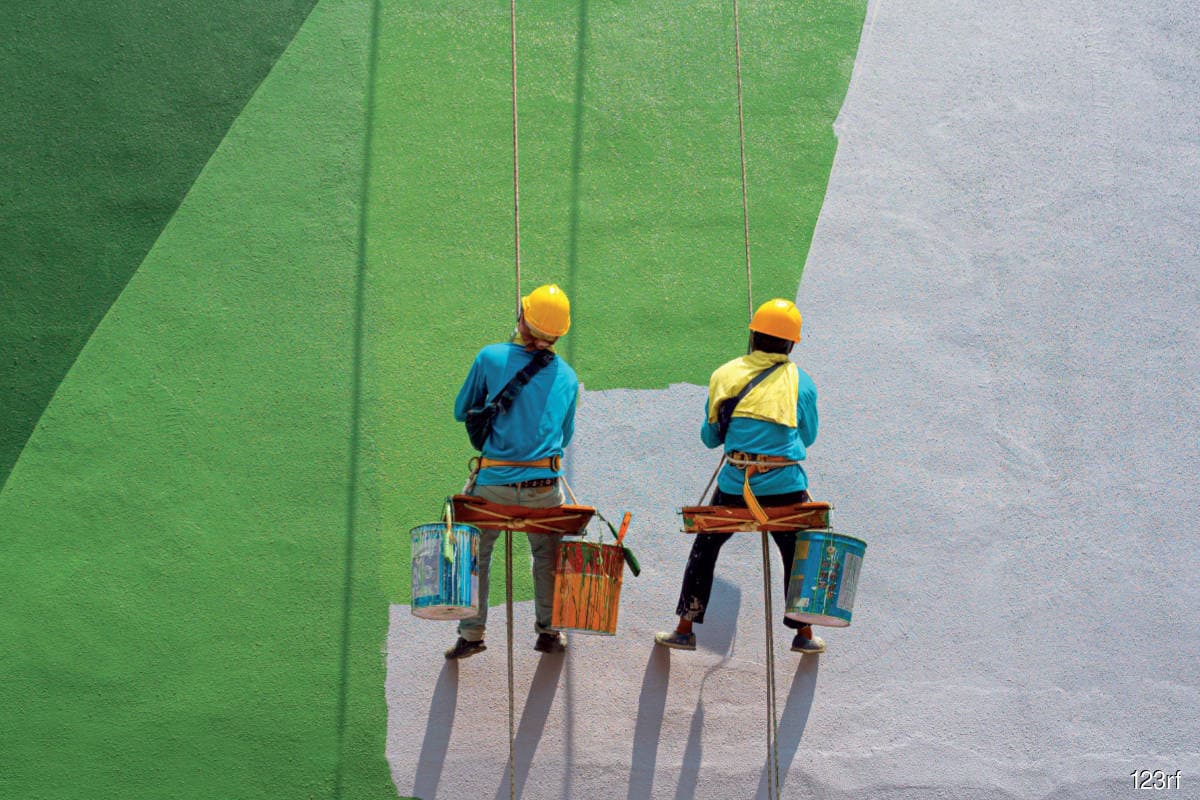
Also, it is worth noting that the method of doing the refurbishment works i s also important as it will affect the cost and safety. The choice of equipment includes a gondola, crane or abseiling and the usage is depending on the building design, Lee says.
“[Using a] gondola is the cheapest and safest but some buildings don’t have a place to hang the gondola, so they have to use a crane, which is very expensive. In the end, the whole exercise is expensive even though the paint price remains [the same]. Therefore, the building design is very important. The repainting works should be done every 10 years, and paint generally should be maintenance-free if it is done properly.”
He explains that surface preparation for poor wall conditions costs more than the actual repainting, and that many MCs might not be willing to fix the wall.
Lee puts the estimated surface preparation (crack repair) cost at an average of RM25 psm or RM2.30 psf, and external wall repainting at an average of RM16 psm or RM1.50 psf. Meanwhile, waterproofing repair is about RM100 to RM350 psm or RM9.30 to RM32.50 psf.
In terms of waterproofing, Lee notes that it should be done properly from the beginning, which is when the building was being constructed.
“Water leaks means water is at places it is not supposed to be at. You need to ask why it is happening at the beginning, identify the root causes, whether it is a new or old problem, determine whether the previous repairs were done properly and whether it is a nuisance or it is safe,” he says.
“It is good to do waterproofing and everything else together before repainting. Inspection is very important. If the defects at the common area affect the private parcel, then the owner of the latter can sue the MC; therefore, it is important to fix the defects as soon as possible. The lifespan of the waterproofing will depend on how it was done from the beginning.”

Property refurbishment
Nippon Paint (M) Sdn Bhd general manager Tay Sze Tuck notes that it is important to refurbish a property for several reasons.
“A primary consideration is the extension of the building’s lifespan. As time progresses, the effects of wear and tear and exposure to different weather situations gradually impact the property’s condition. Hence, it is crucial to address and rectify the issues proactively to prevent them from escalating, ultimately safeguarding the longevity of the building,” he says.
“Furthermore, regular refurbishment is a cost-effective approach to property maintenance. It allows us to identify the issues early on, preventing them from becoming major and costly problems in the future. Additionally, the proactive practice not only ensures the longevity of a building but also enhances resale and rental value, making it more attractive to tenants and occupants, consequently creating a positive image on the property and its management.”
He adds that during the refurbishment process, particular attention should be given to improving indoor air quality. This involves ventilation systems and removing pollutants, creating a healthier and comfortable living environment.
As a total coating and construction solutions company, Nippon Paint provides comprehensive one-stop coating and construction solutions, encompassing plaster, render, coat, tile adhesive, waterproofing, flooring, sealant, adhesive, filler, protective coatings and architectural coatings.
Nippon Paint also provides one-stop refurbishment solutions — which include repainting, re-waterproofing and reflooring — that aim to simplify property maintenance for its customers.
Tay explains that a building requires refurbishment when certain signs and issues become apparent. These signs serve as indicators that maintenance and restoration are needed to ensure the safety of the building. If not addressed promptly, they can lead to more extensive and costly issues.
Some common signs that a building needs refurbishment include:
• Repainting: Cracks or fractures in the existing paint, peeling or blistering of paint layers, efflorescence, failing tiles, hollowness in painted surfaces, the presence of fungal growth on walls, powdery surface texture and corrosion.
• Re-waterproofing: Water leaks in roofs, wet areas, water retaining structure and basements.
• Reflooring: Floor cracks, floor peeling, roadline peeling in car parks; floor cracks and floor peeling in sports floor.
Nippon Paint’s newly improved Weatherbond® Series includes Weatherbond, Weatherbond Hi-Gloss, Weatherbond Solareflect Extreme and Weatherbond® Ultimate.
The new cutting-edge series is specially formulated with the innovative Quartz Technology, offering exterior wall protection of up to 15 years against harsh weather that leads to colour fading, chalking and paint film damage. It leads to colour retention and provides incomparable durability.
It also offers long-lasting vibrant wall colours; robust defence against fungus, algae and dirt accumulation, as well as superb resistance against dirt, alkaline substances and efflorescence, maintaining the walls’ overall pristine appearance.

Nippon Paint also partners with its Chinese counterparts to provide waterproofing solutions for various surfaces, catering to various waterproofing requirements in structures located above ground, in wet areas and below ground to effectively prevent water intrusion, safeguarding the building’s structure and safety.
Nippon Paint flooring solutions fulfil different needs for commercial, residential and industrial properties in Malaysia. These include for car parks as well as sports courts and training trails.
Not only do badly maintained buildings bring result in a bad reputation, they can also cause discomfort to residents and tenants due to the unpleasant conditions. It is crucial for MCs and management to plan their finances ahead for a thorough building refurbishment that creates a fresh, new look.
Save by subscribing to us for your print and/or digital copy.
P/S: The Edge is also available on Apple's App Store and Android's Google Play.