

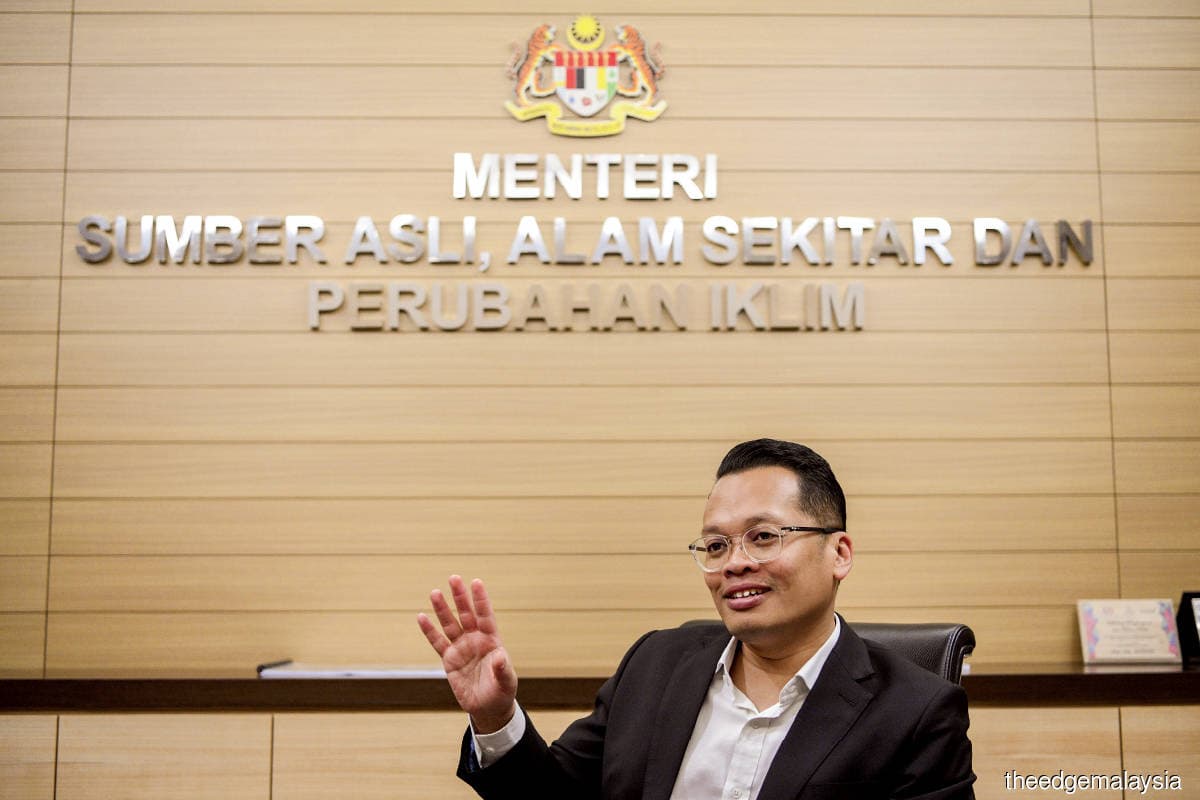
This article first appeared in The Edge Malaysia Weekly on December 25, 2023 - January 7, 2024

It has been a busy year for Natural Resources, Environment and Climate Change (NRECC) Minister Nik Nazmi Nik Ahmad (now Minister of Natural Resources and Environmental Sustainability), who has been at the forefront of promoting the energy transition through renewable energy incentives and programmes, passage of the Energy Efficiency and Conservation Bill 2023, and removing targeted subsidies in electricity, which have been seen as unsustainable.
This is also the year that the National Energy Transition Roadmap (NETR) and the New Industrial Master Plan 2030 (NIMP), which chart the path towards a low-carbon economy in the energy and manufacturing sectors, were released by the Ministry of Economy and the Ministry of Investment, Trade and Industry (Miti).
It is encouraging to see both policy documents aligned with Malaysia’s climate goals, Nik Nazmi tells ESG in an email interview.
“As per [our] Climate Change Policy 2009, our strategy is to mainstream climate change in the national agenda, and this involves the active participation of other ministries to consider climate change in their policies and plans,” says Nik Nazmi.
This engagement with other ministries is also done in the case of carbon taxes, which is a concern for Malaysian exporters. The Ministry of Finance is currently conducting a feasibility study on carbon tax implementation and an emissions trading scheme.
“We have always aligned our views and climate change policies with those of other ministries to ensure that our business is not impacted. In many forums, our ministry has always highlighted efforts done by our private sector to reduce emissions and that the European Union Deforestation Regulation and Carbon Border Adjustment Mechanism are adding burden to local companies, especially small and medium enterprises,” says Nik Nazmi.
“We will continue to support Miti in this regard by formulating policies that would support and facilitate the private sector.”
The ministry, meanwhile, is developing the Long-Term Low Emission Development Strategy (LT-LEDS) and the Nationally Determined Contribution (NDC) Roadmap to take into account all the policies in Malaysia and develop a holistic strategy to reduce emissions. This includes the NETR and NIMP, which detail the transition in the energy and manufacturing sectors.
Industry players have been looking forward to the strategic documents to form appropriate benchmarks and targets that are aligned with the national direction.
“The NDC and LT-LEDS are in the process of development and are expected to be announced next year. The uniqueness of these documents is that they both provide decarbonisation inputs pertaining to five sectors, namely energy; industrial processes and product use; agriculture; land use, land-use change and forestry; and waste sectors,” says Nik Nazmi.
Another long-awaited action from the government is the introduction of the Climate Change Act. The minister says the climate change bill is expected to be completed by early 2025 for review by the Attorney-General’s Chambers before being tabled in parliament.
“The climate change bill is expected to institutionalise the means to operate the Paris Agreement and enhance Malaysia’s climate action,” he says.
“The focus of the bill will be on climate reporting, the carbon market, finance and the establishment of an entity. The act will focus on implementation at the national and subnational level and adopt a whole-of-nation approach in its development by engaging all stakeholders involved in climate change.”
A big showing for COP28
The 28th United Nations Conference of Parties (COP28) was held in Dubai, United Arab Emirates, this year. Nik Nazmi and Yang di-Pertuan Agong Al-Sultan Abdullah Ri’ayatuddin Al-Mustafa Billah Shah were present at the event, as were over 250 stakeholders from state governments, local universities, research institutions, private companies and non-governmental organisations.
The Pavilion Malaysia featured events and speakers to highlight the sustainability efforts in Malaysia. Nik Nazmi says the government’s goal at COP28 was to show the world that Malaysia, despite contributing only 0.7% of global emissions, is committed to efforts to operationalise the Paris Agreement goals.
A key topic at COP28 was the Global Stocktake (GST), which is the first time an assessment will be made on whether governments that are party to the Paris Agreement have met their climate targets, and if more action is needed.
“The GST, which is expected to contain strategies to reduce the implementation gap, is important not just for Malaysia but also for other parties to the United Nations Framework Convention on Climate Change, since it will determine the next course of action to limit global warming well below 1.5°C,” says Nik Nazmi.
Adaptation was a focus for Malaysia, as was the call for developed countries to fulfil their commitment to provide climate finance to developing countries.
Save by subscribing to us for your print and/or digital copy.
P/S: The Edge is also available on Apple's App Store and Android's Google Play.