

This article first appeared in The Edge Malaysia Weekly on December 18, 2023 - December 24, 2023
WHEN CelcomDigi Bhd promised a synergy value of RM8 billion from its merger deal a year ago, it fuelled expectations of upside profitability despite the stagnant revenue outlook for the local telco industry.
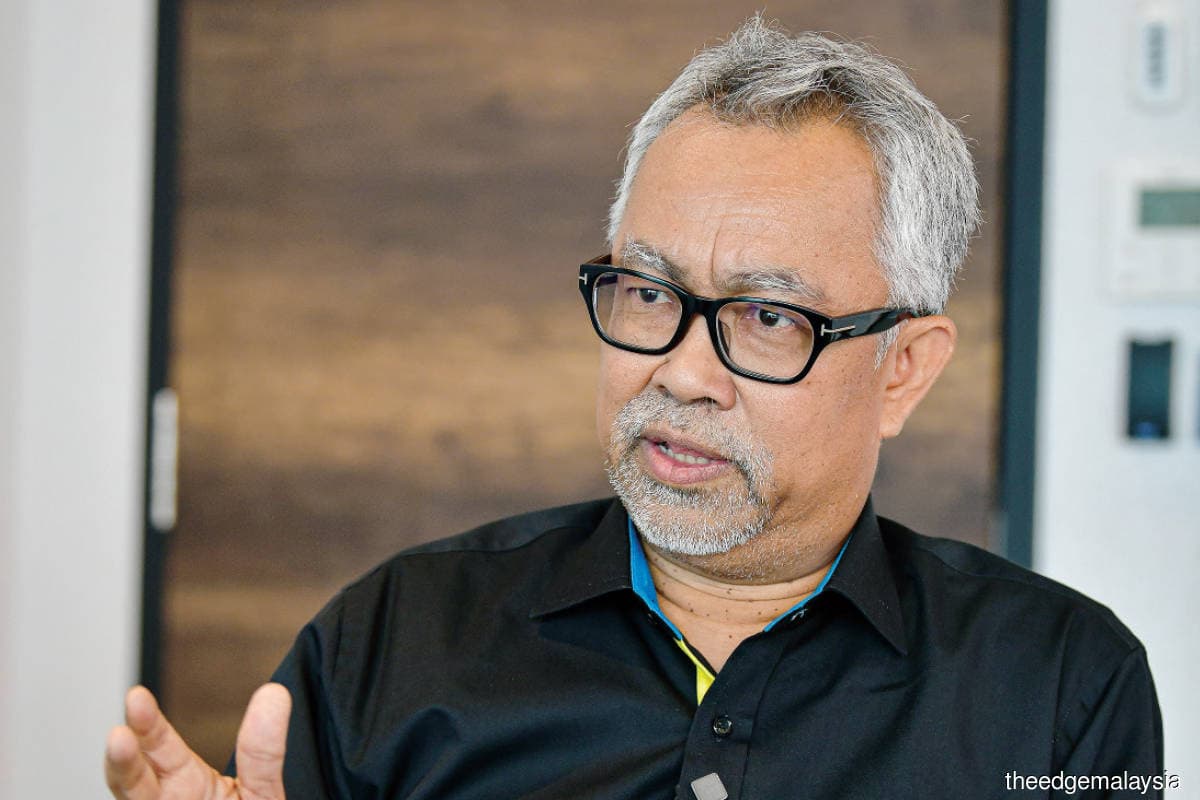
One year on, CEO Datuk Mohamd Idham Nawawi says efforts in realising the synergy is “progressing very well”, while management will remain “realistic” in setting its financial targets for 2024.
“We will always be realistic. It is good to make sure that what we have set is achievable, something that is challenging, but achievable,” he tells The Edge in an interview, but declines to reveal much about the targets for 2024, citing regulatory compliance.
“And we are only in the first year of integration, so next year, it will be a different kind of challenge. So, we will remain with the guidance as we have today, at least for 2023,” he adds.
Idham says post-merger, each entity has about 12,000 network sites, which will be integrated to form a more modernised and efficient network infrastructure. A specialised team has been assembled to work on this three-year project.
“We planned that about 30% of the network should be completed by this year, 40% by next year and the remaining 30% by the end of 2025. It’s good to share at this point in time. We are on track with what we have shared in terms of guidance for Ebitda (earnings before interest, taxes, depreciation and amortisation) growth as well as the investment that we are going to make.

“Slightly ahead of target, in terms of executing the rollout of the new network, we are progressing very well in terms of synergy, which we promised at RM8 billion, as well as managing costs. We have been very, very careful, in terms of making sure that [in] everything that we spend, it will bring the synergy,” he says.
For the financial year ending Dec 31, 2023 (FY2023), CelcomDigi has guided for a flat-to-low single-digit increase in earnings before Ebitda growth. The telco achieved 3.6% for the first nine months of the year (9MFY2023).
CelcomDigi, now the country’s biggest cellular services provider serving over 20 million subscribers, has modernised 4,402 of its network sites as at October — 78% on track to meet its target of more than 5,000 sites this year.
As part of the integration process, the group has also phased out 1,633 network sites as at October, equivalent to about 64% of its target for the year.
Judging by their recommendations, most analysts are not that upbeat about the expected RM8 billion synergy value given the tough operating landscape with minimal growth and fierce competition.
The majority of them, 16 out of 23, have “hold” recommendations on the stock, whose share price has rebounded from a low of RM3.17 in June last year to RM4.50 in mid-September. The other analysts had five “buy” calls and two “sell” calls.
The consensus target price for CelcomDigi increased to RM4.53 as at Dec 13, compared with RM4.02 last year. The target price ranges between RM3.45 and RM6, according to Bloomberg’s poll.
“They promised RM8 billion synergy, but what is their assumption [in deriving this number]? We don’t know that, that’s why for now, we prefer to stay cautious until the so-called synergy materialises. So, for CelcomDigi, it is mainly execution risk,” says a local bank-backed analyst who declined to be named.
Nonetheless, MIDF analyst Martin Foo says CelcomDigi appears to have a relatively better earnings outlook compared to its peers. “The merger’s synergy would help lift profit. This is an aspect of CelcomDigi’s that appears to be better than its industry peers,” he tells The Edge. Foo recommends a “buy” for the stock, pegging his target price at RM4.94.
More synergistic benefits in 2024
Idham says 2023 saw the beginning of the CelcomDigi integration project, and the group is set to see more synergistic benefits going into 2024. “2024 will be the peak of this integration. So, the challenges of 2024 are really in delivering the integration work.”
These integration works are also timely, according to him, especially with the telecommunication industry’s constant struggle to fight margin erosion.
“Historically, telecommunication services has probably been the only service, only industry, that does not move with inflation. Because the increase in utilisation has been exponential, right? So, if you look at the cost per gigabyte, that has been on a negative track over the years.
“So, the challenge for us is, how do we maintain and continue to make this affordable for the consumers? And that’s exactly one of the promises of the merger. Because scale is very important in this business,” he explains.
Kenanga Research in a Nov 20 note says that, apart from synergy, CelcomDigi’s vast subscriber base also gives it the upper hand in pricing power and economies of scale. It has an “outperform” recommendation on the stock and a target price of RM5.34, translating into an enterprise value-to-Ebitda of 12 times, a discount to the sector’s historical average of 13 times.
“The discount is to reflect regulatory uncertainty surrounding the implementation of the new [dual network 5G] model,” says the research house.
5G matters
CelcomDigi and its peer Maxis Bhd have been adamant about maintaining additional fees of up to RM20 for their existing subscribers to be upgraded to the 5G network, despite repeated calls from now Communications Minister Fahmi Fadzil for a waiver.
Idham, however, tiptoes around commenting on the retail tariff of 5G, instead talking about how affordable 5G phones help boost the usage of 5G. “Today, if you ask what is the cheapest 5G phone, we’re talking about mid-hundreds [ringgit]. But 4G is already about hundreds [ringgit]. The affordability level [of 4G phones] is also very low. That’s the first thing that we need to address.”
“So, we can’t make it, everybody uses [5G devices] until those devices have reached a certain level. Then only the main traffic in the country is 5G. That’s why we have affordable devices.
“We have to make sure that some of the devices are subsidised in the market, some devices are free, some devices are one ringgit. So, we are trying to make this very affordable for everyone,” he adds.
According to Digital Nasional Bhd (DNB) — the entity tasked to roll out the 5G network with an 80% targeted coverage of populated areas by year-end — there were 3.6 million 5G service subscriptions as at end-October, translating into an adoption rate of 10.8%.
To boost that rate, DNB said Putrajaya had initiated “cooperation” with telcos to launch the affordable 5G Rahmah Package in August.
So far, the big mobile network operators (MNOs), including CelcomDigi, are pricing their monthly postpaid 5G subscription service above RM50 even under the Rahmah initiative, except for smaller players like U Mobile Sdn Bhd and Telekon Malaysia’s UNI5G and YES 5G, whose postpaid services start at RM35 a month.
Asked about the margin for CelcomDigi’s 5G Rahmah Package, Idham says it is a “trade secret”, but pledged that the group will continue to support the government in raising the 5G adoption rate.
Idham is supportive of the dual network model for the 5G rollout, saying that it will encourage competition and innovation in wholesale products.
There will also be improvement in coordinating with DNB once MNOs like CelcomDigi become a shareholder in the 5G wholesale network provider, says Idham.
“There will be a little bit more coordination between how we manage the 4G to 5G transition and the experience of the customers as they move from 4G to 5G and vice versa.
“Managing network is a living thing, maybe [it is] seamless for the consumer, but in the background, it is a lot. To make that seamless transition is hard enough when you are doing it within your own network, and [now] there are multiple 4G networks [transiting] into [an external] single 5G network,” he says.
“But the ultimate [goal] is when there is a second network, there will be a bit more competition for demand. When it comes to competition, then we should expect more innovation, be it technologies, the deployment of the latest radio network, and so on and so forth. There needs to be some innovation in the product and services between the network provider and also the access seekers,” he adds.
In early December, the Ministry of Finance (MoF) inked agreements to divest its 70% stake in DNB to five mobile network operators, at 14% each.
This is the initial stage of the deal, which involves the MNOs each providing a RM233.23 million zero interest loan to DNB, and each subscribing to a minimal 100,000 new shares for RM100,000.
At the subsequent stage, MoF will have a put option to sell the entire 500 million shares in DNB to the five MNOs at RM500 million, with the MNOs taking over the RM450 million advance the MoF had provided to DNB previously.
In short, based on available public disclosures, the MNOs will each be paying RM100.1 million for the eventual acquisition of a 20% stake in DNB — which has invested RM16 billion in 5G network infrastructure — and a total advance of RM323.23 million.
The initial intention under the 5G Single Wholesale Model (SWM) was to have a government-controlled entity — DNB — as the wholesaler to roll out the next-generation network nationwide, leasing its network capacity at lower costs to MNOs, who would share the infrastructure without needing to fork out big capex outlays while focusing on competing on a level playing field to service retail customers.
The transition to a dual network model, while creating redundancy to avoid a single point failure, raises the question of necessity, as network quality was not any better during the 4G era when multiple MNOs rolled out infrastructure simultaneously. Not to mention many use the electricity sector as comparison, where even for a more critical utility segment, there is only one national grid in Peninsular Malaysia.
As the debate on 5G rollout continues and with the large MNOs’ wishes of having the government give up its stake and spectrum in DNB coming true, it will be interesting to see whether the industry can walk the talk of providing quality mobile service at relatively cheap tariffs — something Malaysians have yet to enjoy.
Save by subscribing to us for your print and/or digital copy.
P/S: The Edge is also available on Apple's App Store and Android's Google Play.