

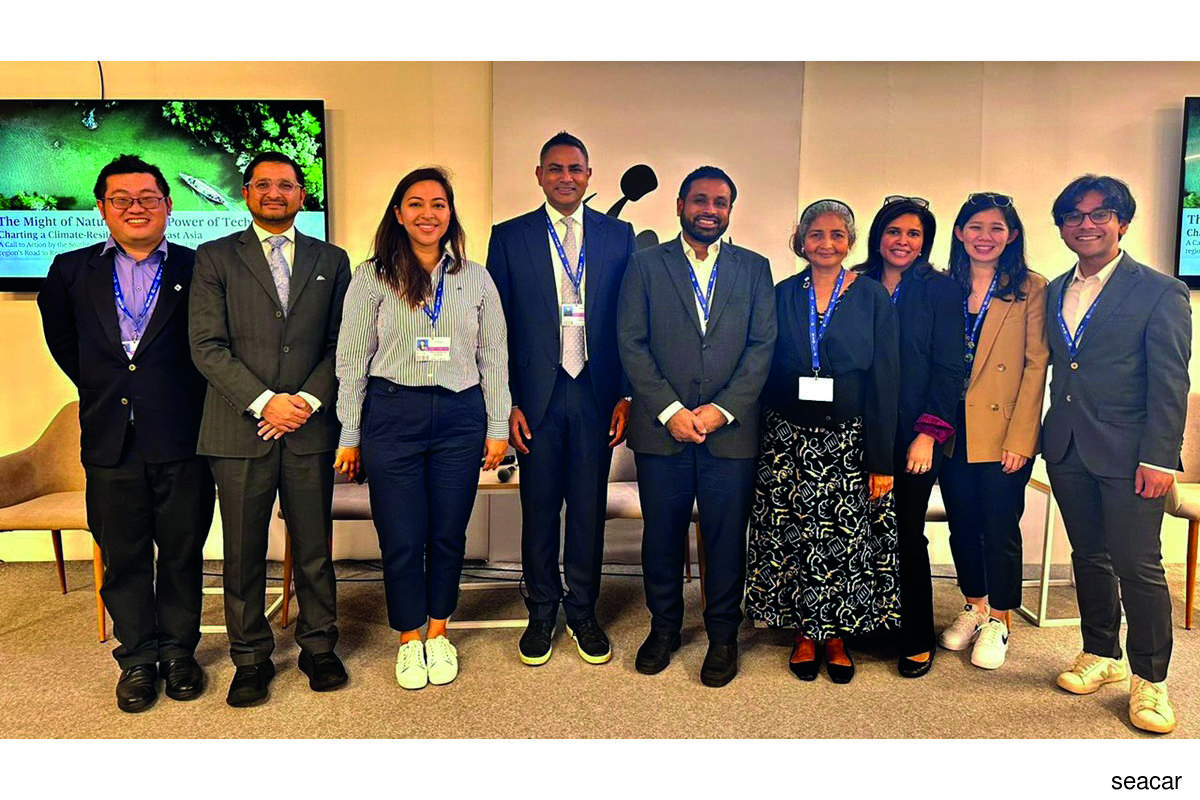
KUALA LUMPUR (Dec 8): The World Wide Fund for Nature (WWF), Boston Consulting Group (BCG) and Think City have formed the Southeast Asia Climate Adaptation and Resilience (Seacar) alliance to leverage on nature-based solutions (NbS), climate analytics and artificial intelligence (AI) in advancing the resilience of cities and communities.
The alliance formed at the Conference of the Parties (COP28) on Wednesday (Dec 6) will be looking into six key themes: natural ecosystems, infrastructure, water, agriculture, health and trade.
“Leveraging our expertise in city-making and NbS for climate adaptation, we aim to actively contribute our knowledge and foster partnerships with cities and urban settlements across the region, as part of this meaningful alliance,” said Hamdan Abdul Majeed, managing director of Think City.
Southeast Asia is ranked first on the World Risk Index as the nation most at risk of disasters, with sea levels rising at the rate of +13mm (milimetre)/year, which is four times the global average, according to a case study on using climate risk modelling for data-driven decision-making in a Southeast Asia coast region city, in the Seacar report, which was launched at the same event.
The report states that over 40% of organisations recognise the potential of harnessing AI in climate related endeavours. Climate AI enhances decision-making by simulating diverse climate scenarios and assessing the costs of inaction, facilitating improved prioritisation and efficient resource allocation for adaptation and resilience (A&R) projects.
Nature-based adaptation measures are much more complex to quantify, compared to mitigation efforts. With the current social and market standards still geared towards productivity and profitability, doubts are raised about the effectiveness and sustainability of NbS, in the face of these climate-related challenges.
However, climate AI solves this issue by creating models that are able to synthesise and quantify costs of inaction. The AI assesses the return on investment (ROI) of A&R initiatives by comparing projected costs of inaction to total initiative expenses, helping inform decision makers of the bankability of projects.
“Southeast Asia is a region that is heavily exposed to the physical impacts of climate change. However, this is also a region rich in nature and natural capital, and we have enormous potential in the region to capitalise on both the oldest and newest solutions to adapt and build
resilience. Specifically, this comes in the form of NbS, and technology in the form of AI to plan, prioritise, and implement measures to adapt and build resilience for people, communities and economies in Southeast Asia,” said Dave Sivaprasad, Southeast Asia lead in climate and sustainability, managing director and partner at BCG.
Advanced technologies like AI modelling are providing increasingly accurate measurements of the varied benefits offered by NbS. This alliance aims to embrace nature, together with AI in creating a sustainable and resilient future.