

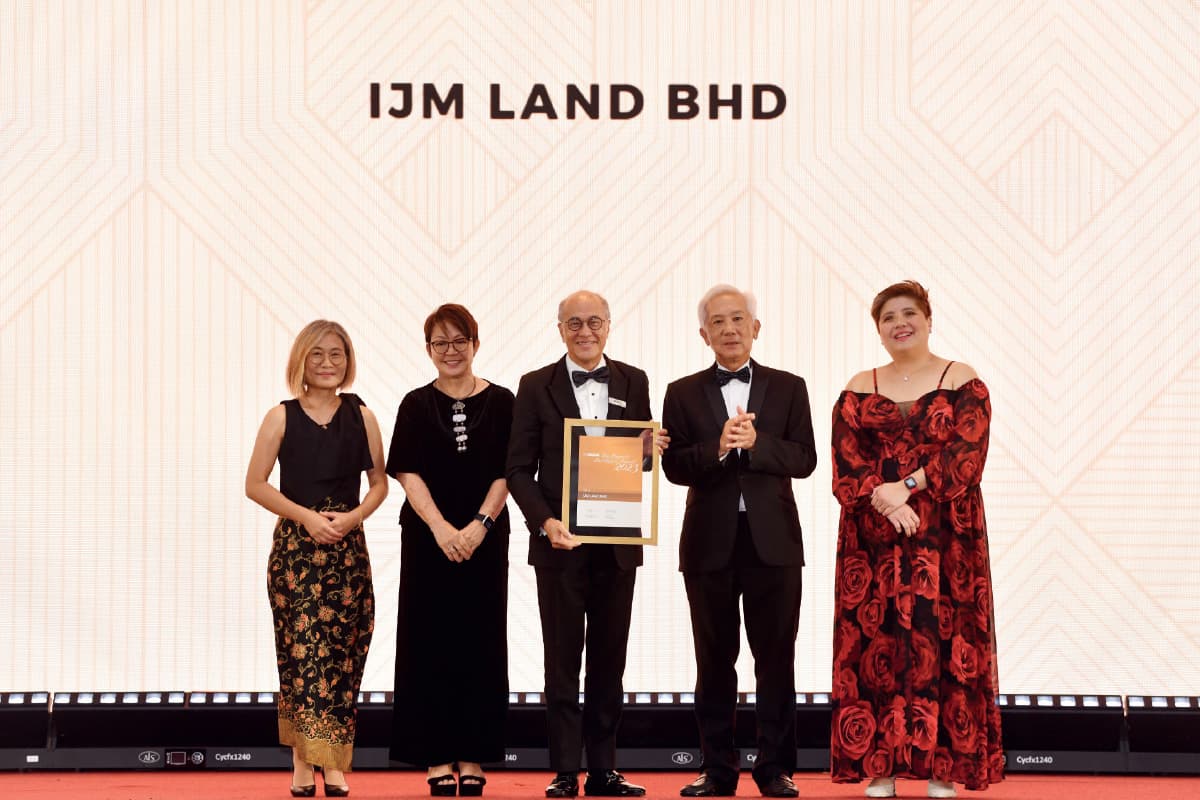
This article first appeared in The Edge Malaysia Weekly on December 4, 2023 - December 10, 2023
Of late, IJM Land Bhd has been busy as it puts greater emphasis on creating a distinct brand identity that the market will recognise and respond positively to. This push was initiated by Datuk Wong Tuck Wai, who took the reins as CEO on July 1, 2022. Since then, he has been streamlining the business to prepare it for further growth through innovation and new product offerings.
In a candid interview with City & Country at the IJM Land Centre of Excellence ICE Sales Gallery in Pantai Sentral Park, Wong talks about, among other things, how the company has embarked on the industrialised building system (IBS) journey with a factory already in operation in Pekan Bestari Jaya in Kuala Selangor, Selangor. This fully automated plant will provide all the components needed to build a complete home.


Other plans include diversifying the developer’s property offerings and creating a growth strategy template for IJM Land to ensure its continuity in decades to come.
City & Country: What challenges have you faced in leading the company, and how did you overcome them?
Datuk Wong Tuck Wai: IJM Land required a branding play, which I was familiar with. So, I brought in what I’d practised in my past career with a different organisation, which worked, as it turns out. As I always say, to sell a brand is not so much a cult of personality. Everything we do is with systems and processes, the lens that you put in place, the way you do things again and again that gives you success.
The team saw the benefit of doing something more innovative and contemporary in terms of capturing the market. And I’m glad to say, while it was hard work, after 17 months on the job, I feel fulfilled because all our team members have come on board and I think we have given the IJM Land brand a fresh look.

How has this new attitude or ‘buzz’ affected sales?
I think my people, with this new brand identity, now tackle their jobs with more gusto, and it’s translating into more effort in doing sales. Also, people who join us have a new perception of IJM Land. That there’s a great team doing better, greater things, and the perceived quality of IJM Land is so much better now. At least, we are doing the right thing in a contemporary way.
So, certainly that buzz is a positive knock-on effect for all my staff. They are more energetic to do [sales]. There are many challenges in the market, and I think sales may take a beating, but everybody is pulling up their socks because it would be a travesty of justice if, after all the hard work we’ve done, this does not translate into sales.


What are the new plans for IJM Land?
I think my vision for IJM Land is to leave not so much a legacy, but a strategic plan or goal for the company to follow, even at the end of my tenure as CEO. My strategic goal was that it was always going to be a distinctively premium developer. I think of the word ‘premium’ not just in terms of a higher price point, but also build quality. If it’s good quality, it’s premium, isn’t it? So we want to be that, not just pigeonhole to price points. But everything to do with the value proposition — our build quality to the purchaser. As a whole, the value proposition. And to achieve that, I have crafted my tactical objectives.
We are rationalising our land bank. Some non-strategic ones have got to go, but this is balanced with new land acquisitions for quick turnaround — fast-moving projects and pushing them into the market. These objectives will be supported by what we call our ‘Zones to Win’, which relate to our products. We have identified four such zones.
There is the Performance Zone — what we work on day in and day out, as our bread and butter through the years and for the following years, is that our townships will have to do the heavy lifting. And there will be individual residential projects here, there and everywhere … like Riana Dutamas. We are pivoting to industrial [developments]. It started with the development of the Malaysia-China Kuantan International Logistics Park via a joint venture with China Harbour Engineering Company Ltd. We want to go bigger on industrial land sales and development, and that means industrial parks.

Then there is the Transformation Zone, which will change the market perception of us again. On top of that is our integrated commercial mixed-use development, with a big one in Pantai Sentral Park called Enlace. Also, we are going into the wellness business using our own properties. Once we have set that up, we will go into wellness precincts in our townships. It will include assisted living and independent living services, and be part of an ecosystem within a township.
Then, we have what we call the Productive Zone. I am almost in the final stage of pulling everything back to the centre. I have centralised things … like our procurement, design development and even for our branding. Lastly, we have the Incubation Zone. We are incubating green townships and attempting to incubate tourism integrated developments. We incubate in our new markets, like in Sabah and Sarawak and Indonesia’s Nusantara. And although we have been in the UK, the next big one coming up is with National Rail, with which we have a joint venture to develop its land.
So, all these zones are to support and deliver the ultimate strategy goal of being a premium developer with a very distinct ratio of the products we have. I hope to put the company in a good place where we have a strong portfolio of investment properties. We will then, in all of our endeavours, have a ratio to deliver the revenue that will actually be culled from or predicated on investment property at a certain percentage; commercial mixed-use development, another percentage.
Then we can pare down the township developments that are important so that we don’t rely so heavily on townships. We can also have commercial mixed-use and investment properties. And lastly, the smaller projects, boutique developments. We will carve out the respective ratio as well as how we will deliver the sales revenue and profits.
What is your outlook on the property market and strategy to mitigate any issues?
The market is not getting any easier. We are already feeling strong headwinds going into the second half of the year. I mean, it’s everything to do with the situation of the world at large, which does not exactly engender confidence for people to invest in properties.
But having said that, I think on the home front, cost is still a challenge. There was an article on the house price-to-income ratio and how challenging it is still for a large strata of society in Malaysia to own a house. I’m not saying that I’m a contrarian to that article, but as a country and as a developer, we can do better to make it more equitable for people in certain segments of society to buy a house. It does not help that compliance costs are so high. These have a knock-on effect on our cost structure that translates into the value of the house. Having said that, I think Malaysia is a home-ownership kind of country. People are very big on owning their own homes.

Our strategy for overcoming this is to try to pare down the cost by introducing an effective construction methodology. We are rolling out IJM Land’s first IBS project, Riana Trees Residences, here in Pantai Sentral Park. And we’re trying to switch to more cost-effective materials.
Looking ahead, we will target all kinds of products for various segments. We don’t want those people who can afford [higher priced products] to be underserved.
Having been in the industry for so long, you still have the drive to develop property. What fuels this drive?
I don’t think you should do things in half measures. When you come into the job, you have an obligation to do your best. You owe the company a duty of care. And I personally have an inclination, I like to share. I think some say that I have a reputation, that I’m a very fierce person, but it is because I care. It’s because I really want to share and hope that whatever I teach you, you will internalise and apply it. That helps everything to be better — for the company, for the market, for the world. Of course, no one is perfect. I have my own foibles and shortcomings. But if you are an intelligent enough person, whatever I teach you, I think it is good.
What I’m trying to inculcate in my people is that, to make themselves successful as employees, first and foremost, they must have the right attitude. Now, I’m not saying they don’t have the right attitude, but I would like to see a better attitude than what they had before. That’s what has helped me. I always have a better attitude — I would like to learn more things, I like to acquire new skills, make myself relevant and climb higher.
I say a better attitude will define my altitude. ‘Altitude’ in this sense is my level of knowledge, competency and skill set. This is my altitude. With a better attitude, you will certainly scale a higher altitude. It’s one of my personal mantras — better attitude defines my altitude.
Save by subscribing to us for your print and/or digital copy.
P/S: The Edge is also available on Apple's App Store and Android's Google Play.