

This article first appeared in City & Country, The Edge Malaysia Weekly on December 4, 2023 - December 10, 2023
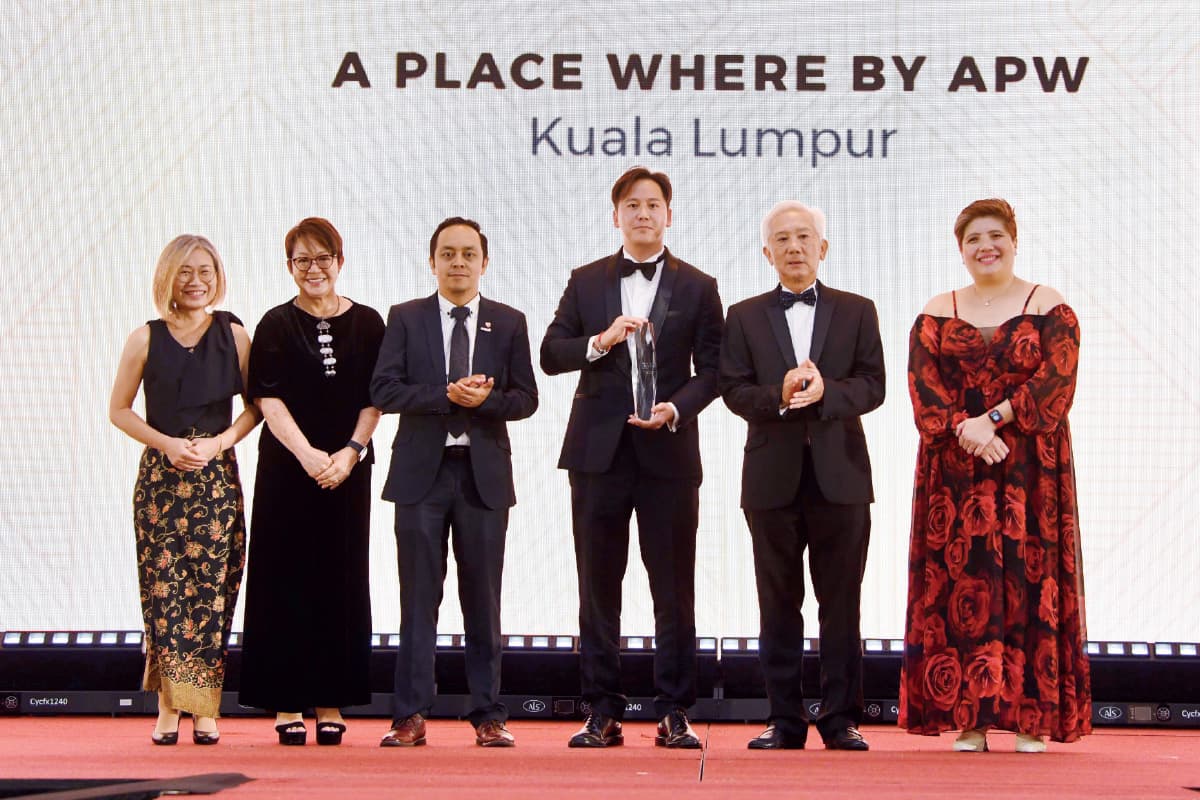
WINNER | A Place Where by APW | Art Printing Works Sdn Bhd
It didn’t make sense to continue championing a sunset industry,” says Ee Soon Wei, CEO of A Place Where by APW, an event and retail space in Bangsar that features several food and beverage (F&B) outlets, retail shops and office spaces.
Better known as APW, the 65,000 sq ft creative and retail hub was originally a commercial printing factory known as Art Printing Works Sdn Bhd, which was established in 1952 and was located in Lebuh Ampang prior to its relocation to Bangsar in 1965. The printing company had found success over the years with several publishing contracts for government schoolbooks, encyclopaedias and English-Malay dictionaries.


When Ee took over his grandfather’s business in 2013, APW’s business had become significantly less lucrative following the rise of modern printing technologies. “Even though my family was a pioneer in the printing business, and we had heavily invested in the required machinery, I knew that printing was a sunset industry.”
APW had turned into a dilapidated printing factory with damp carpets, leaky roofs and paper scattered everywhere, says Ee, adding that the workforce lacked young people. “So, I started wondering, ‘How do I recruit young people to join our workforce when even I do not feel motivated to return?’”
Finding himself at a crossroads, Ee recalled a time in university when he was introduced to the concept of creative campuses. “[It’s] an ecosystem that promotes creativity. That became the concept behind how we started developing our spaces.
“My vision was to create a creative campus to accelerate the creative economy. I believed ideas, conversations and people were great proponents of innovation. So, when the space was not [being used for] commercial [purposes], I thought we could use it for cultural, community or art [events],” he explains.
APW is the recipient of The Edge Malaysia Excellence in Conservation and Adaptive Reuse Award, which recognises the best conservation and adaptive reuse projects that have preserved their heritage and history, and reintroduced them to a new generation.

A thriving art and community space
According to Ee, the decision to transform the place had not been made lightly and was based on extensive research. “Back then, the term ‘adaptive reuse’ and how to repurpose spaces were hot topics. Conservation was also part of that discussion,” he says, adding that his research focused on highly dense urban cities with high per sq ft values such as Singapore and Hong Kong.
Specifically, Ee had noticed the gentrification of the Tiong Bahru neighbourhood in Singapore and the rejuvenation of Hong Kong’s Tai Kwun district, otherwise known as the Former Central Police Station Compound on Hollywood Road. Both neighbourhoods are heritage sites in their respective nations where several old buildings have been revitalised while conserving their historical significance. “[Sometimes] it’s just too costly to redevelop a space, so it makes more sense to repurpose it and bring new life to the place.
“I [also] went to larger countries like Thailand and China. I started looking at the landscape of large, abandoned factories that had allowed the ‘creative ecosystem’ to develop the space. So, I took everything I had learnt and prepared a research paper where I proposed new ventures that I thought APW could venture into. The idea was to streamline the print business, then free up our warehouses and consider a conversion process,” he adds.

After clearing out the factory space, Ee took to social media in 2014 to promote APW as an event space and launched “Paper”, a 3,300 sq ft event hall. Later that year, he introduced a food hall named “Paper Plates”, which spreads across two floors and three buildings at a combined land size of 6,501.4 sq ft. It is one of three sections on the APW campus; the other two are Canvas (13,637.87 sq ft) and Bindery (4,327.09 sq ft) — both were launched in 2022 under APW’s second phase. Staying true to the theme of conservation and adaptive reuse, all the buildings are named in homage to APW’s history as a printing factory and house a mix of retail stores and restaurants.
APW’s big break came shortly after its launch when telecommunications company Maxis held an event there called Hotlink Hot Rod. “Then I realised that this may be an opportunity to generate variable income through events. [Afterwards] I thought about permanent income such as fixed rentals. This meant the quality of tenants could only be determined by the [foot traffic]. So, I began scheduling regular events, whether we made money or not, and made sure something was happening every weekend,” reveals Ee.
He lists some notable events held at APW since then, including art exhibitions such as Escape from the SEA, which was organised by the Japan Foundation Kuala Lumpur and featured the Malaysian art collective Pangrok Sulap’s controversial artwork on deforestation in East Malaysia. There was also the 2022 Meme Bank exhibition by local Malaysian artist Red Hong Yi, which parodied conventional banking, and the immersive, avant-garde theatrical performance by local performing arts company Terryand TheCuz that portrayed the life and experiences of human trafficking victims.
“There have also been independent filmmakers looking for a space to do screenings. So, if our space fits their needs to have the conversation and get the panel going, then we will try to support it. We have commercial rates for commercial branding and [separate rates] for NGOs (non-governmental organisations) or art proponents, and we try to support them when we can,” he adds
To strike a balance between fixed and variable incomes, Ee began scouting for tenants in the F&B and retail sectors once amenities such as toilets, a prayer room and pocket parks were added.

“[In the beginning], I wanted to benchmark the rental for this space at about RM5 psf. A Toyota showroom was [originally] supposed to occupy this space at RM1.80 psf, similar to the rates of the Sungai Besi industrial lots. But I didn’t think we were worth RM1.80. ” he says, adding that local Malaysian companies were not receptive to APW’s price point.
“So, I went to Singapore to look for our first tenants and used the [foreign exchange rate] in my favour to offer it at S$2.50 psf.”
When APW eventually secured its first tenant from Singapore, the two parties agreed on a rate of RM5 psf, with an add-on offer of a completely new roof and the first six months rent-free. The unusual rental rate soon drew in more potential tenants. “When I did that, word got around in Singapore that someone in Malaysia was giving out good rental rates, and then there were a lot of enquiries. When we got our second tenant, who was originally from Australia, I did the same thing with them. We had a wait list by the time Malaysian businesses began approaching us.”
Offering rental rates of between RM10 and RM13 psf, APW currently hosts 13 F&B outlets, six retail stores and three offices for local businesses. The units have built-ups of 300 to 2,000 sq ft. Notable restaurants include Pulp café, Breakfast Thieves, Proof, Olivia Deli, Jus Restobar, Waig by chipta 11a and Bask. Its retail outlets include Khoon Hooi, Chuck’s, Pestle & Mortar Clothing and Handmade Heroes, whereas office tenants comprise POW Ideas, Studio20 and Mat Lab (a material library by POW).

Protecting the spirit of a place
To Ee, adaptive reuse and conservation go beyond preservation and a shift in the building’s utility. He refers to the architectural concept of “genius loci”, where the focus is on protecting the spirit of a place. This concept should include people using the space as well, he says. “So, a lot of times, I think people work on one component, which is the place, but they forget [about] the people. When they talk about the people, they are referring to the external — people who live around the neighbourhood — but what about the people who are part of the organisation?
“[The main] thing that sets APW apart from other adaptive reuse spaces is that we have a workforce that was primarily in the print industry. They are successfully running the APW lifestyle space today. So, the former print manager is now the operations manager of the space, and there are print workers who are now primarily involved with technicians, so we repurposed [our workers] as well,” he adds.
The transition from a printing factory to an event space was not without its challenges. “I think our vision is close to completion. I think most of the challenges over the last 10 years have been more or less overcome. Our biggest challenge had been the family stakeholders and trying to convince them that this [idea] was a possibility. For many years, I think they didn’t support the idea as much. They didn’t see that it was a sustainable business because there was no reference point.”
APW’s only remaining challenge is the lack of access to parking. However, Ee says this issue will soon be solved with upcoming developments in the neighbourhood. “I think within the neighbourhood, some people like us and some people don’t. People who like us like the fact that [we are unique].
“I think of [APW as an] alternative to a shopping mall. The idea is that there are well-curated restaurants for people to experience and try. I see young people and families hanging out, lingering, reading a book and just enjoying our space,” says a smiling Ee.
Save by subscribing to us for your print and/or digital copy.
P/S: The Edge is also available on Apple's App Store and Android's Google Play.