

This article first appeared in City & Country, The Edge Malaysia Weekly on December 4, 2023 - December 10, 2023
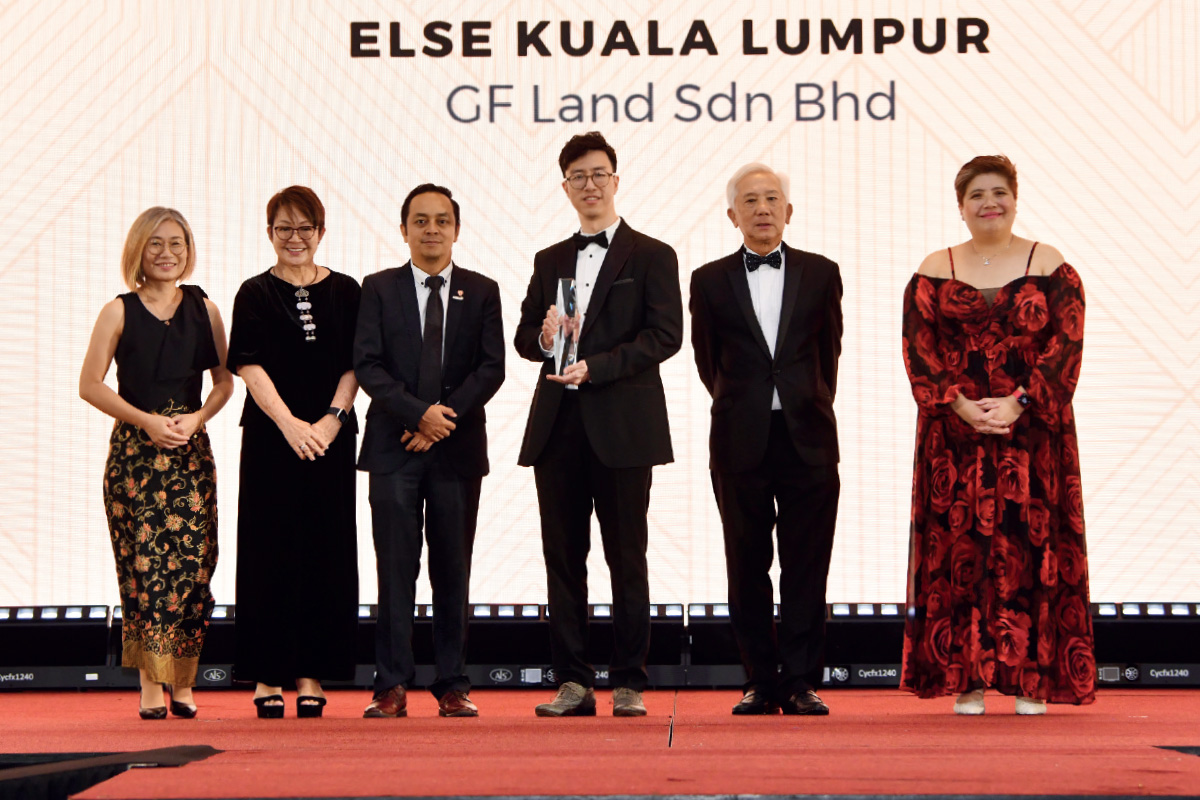
WINNER | Else Kuala Lumpur | GF Land Sdn Bhd
What used to be the headquarters of the Japanese army during World War II is now a chic boutique hotel named Else Kuala Lumpur in downtown Kuala Lumpur. While the entire Art Deco frontage of the building has been maintained, from the structure to the “Lee Rubber Building” signage, it is no longer ivory white. Now, it has been repainted in different shades of grey, sporting a more modern yet rustic look that blends in with the older shophouses in the area.
Built in 1930, the former Lee Rubber Building — at the corner of Jalan Tun H S Lee and Jalan Hang Lekir — was known as the city’s tallest building at that point in time. Designed by Arthur Oakley Coltman of the British architecture firm Booty Edwards & Partners (now known as BEP Akitek Sdn Bhd), the property served as an office building for Lee Rubber Group.

Several years later, it was taken over by the Japanese government. Subsequently, it housed several retail vendors, tuition centres and later a Popular bookstore outlet around the early 2000s.
In January 2016, the historical building was acquired for almost RM30 million by current owner GF Land Sdn Bhd, a wholly-owned subsidiary of Singapore-based Hillington Pte Ltd, of which Else Kuala Lumpur’s co-founder Justin Chen is the director. Chen is also the deputy CEO of Singapore-based investment holding company Arcc Holdings Pte Ltd.

The other co-founder of Else Kuala Lumpur is Javier Perez, an F&B entrepreneur and founder of the Kilo and Grain Traders brands, which have outlets in Singapore and Los Angeles.
To turn the pre-war building into what they envisioned, the duo worked with Malaysian design firm Studio Bikin, which was tasked with conceptualising the design and overseeing restoration works. Faizah Architect was the architect of record.
Else Kuala Lumpur is the recipient of The Edge Malaysia Excellence in Conservation and Adaptive Reuse Award at The Edge Malaysia Property Excellence Awards 2023. The award recognises the best conservation and adaptive reuse projects that preserve our heritage and history, and reintroduce them to a new generation.

Drawing inspiration from all around
Explaining how the site was acquired, Chen says, “We have been doing business in Malaysia since 2008. Our shared co-working space business is called The Co. As I started travelling here more, I thought it would be interesting for us to also invest in properties in Malaysia.
“The Lee Rubber Building was obviously a rare find because very few properties actually end up transacting in the Chinatown area as lot of these buildings have been owned by families for many generations, so they rarely sell them.”

When this property came up, he says it just happened to coincide with them looking for opportunities in the market. “When we came across the building, we were awestruck because of its heritage and iconic stature,” he recalls.
Even when they acquired the property, Chen says, there were no plans to convert it into a hotel.
“We kept it as a commercial building with the existing occupants for almost two years before we actually decided on the end function for the property. At the time, we had also even considered whether it could be used as a co-working space or mixed-use development.”
As Chen and Perez travelled more often to Kuala Lumpur to expand The Co, he says they discovered more creative projects in the city.
“For many years, I’ve had a very Singapore-centred impression of what Malaysia or Kuala Lumpur was, which was represented by KLCC, Bukit Bintang, Changkat and the shopping vibe. I never really had the chance to explore what was actually happening outside of that city pocket.”
Other adaptive reuse projects like The Row, A Place Where by APW, Chocha Foodstore and REXKL served as inspirations for Chen. But that was not all. “The area had a lot of investments from creative entrepreneurs and so what was going on with the neighbourhood was likewise creative. But it tended to skew towards a younger demographic.
“That’s why we felt it necessary, from an outsider’s perspective, to assess how we could bring something new or additional to the community instead of just replicating what others are doing,” he explains.

Creating something Else
The original structure of the Lee Rubber Building comprised four storeys. For the hotel, the designers added two floors atop an existing podium.
Post-renovation, the building now has a total built-up area of 56,000 sq ft. The space is taken up by 49 hotel rooms, two restaurants (The Raw Kitchen Hall and The Yellow Fin Horse), a 25m plunge pool, floating meditation pods, a drawing room, a gymnasium and a boardroom.
Chen says the hotel has an average occupancy rate of 70%, with guests being predominantly locals.
While in the process of transforming the building into the hotel it is today, Chen says one of the biggest changes was creating the huge courtyard-like air well in the centre of the building.
“As a hotel, you need to make it welcoming rather than have very internal and closed-off claustrophobic spaces. While we wanted open-floor plans, we also needed hotel rooms. So, those are very diametrically opposed kinds of needs.
“Our solution was to have a courtyard and so we created an internal cocoon for that inward focus. We mainly decided on this because we needed that contrast of being a refuge within the hustle and bustle of Petaling Street.”
Another crucial element that was incorporated into the building was the theme of dualism.
“We wanted a contrast of old and new because this shouldn’t just be a heritage building; we needed some contemporary or modern elements. And that’s one of the reasons why we added the extensions on the upper floors — to have the contrast of a newer structure with the older podium.”
Although the building structure was solid, Chen says major renovations were still necessary.
“A lot of it was us embarking on a combined excavation and archaeological dig where we tried to unearth whatever we could find and do our best to have some historical aspects reflected in the project.
“We found all these beautiful structures that were like terrazzo benches, which were used for the office canteen back in the day. We decided to preserve and use them in the lounge area beside the pool,” says Chen, adding that the building’s corbels, beams, columns and floors were also maintained with a little touch-up.
Aside from the façade of the building and some of its structure, pretty much everything else is brand new. Chen’s team had to add new structures to hold up the extension and construct a more elevated platform at the pool to get the Kuala Lumpur skyline view.
Chen adds, “This building used to have escalators between floors but these were subsequently removed and the staircases were all relocated. We added a brand new lift core to service the entire building. All the interiors had to be completely redone.”
The duo spent an estimated RM45 million on renovation and refurbishment, he reveals.
Renovation works began in early 2019 but the hotel was only opened in September last year due to the Covid-19 pandemic, he shares.
“The original plan was to open the property at the end of 2020 but the pandemic hit, so construction work had to be put on hold, which delayed our opening.”
The logistics for construction materials and equipment were another major challenge, he recounts. “We were working within the tight constraints of the Chinatown neighbourhood, so there’s very limited road access. Getting big machines into this site meant a lot of coordination.
“The construction process ended up taking quite a bit of time, from us just having to dig and strip back the layers of what the building had, because we actually had to excavate down as well as add a water tank and build some structure. Given some of the building’s history, there were even concerns over what would be found because it was used during the Japanese occupation. But thankfully, we found nothing of major concern,” Chen recalls.


Doing it right
For an adaptive reuse project to be successful, Chen says it is important to consider both its use and the building’s or site’s history.
“I think adaptive reuse is really about rethinking what part of the built environment should be or what its best use is. However, honouring the history or legacy of the building’s purpose is also very important. These projects will always tend to be more complex than one would think. Oftentimes, as you peel back things, you will discover issues that you had not accounted for.
“I think it requires a certain degree of passion to have grit and see the project through because it tends to be somewhat of a long-drawn process. We enjoy these kinds of projects because there’s a story to tell with every building and every site, and that part of it is what inspires us. Sometimes, I would even say that having constraints often makes for more creative solutions than just having a blank canvas. I think as a designer, as a creative, that’s something very attractive about adaptive reuse projects.”
Besides that, he thinks adaptive reuse is a good way to develop urban areas more sustainably.
“I see a growing interest within people to want to reconnect with a bit of history and have a greater appreciation for what was done in the past as opposed to just tearing it down and rebuilding something new. I think that’s signalled by all the creative entrepreneurs who have set up new concepts in this neighbourhood.”
For Chen, Else Kuala Lumpur is just the beginning. “We definitely didn’t start Else to just end with this property. This was really kind of like our maiden hospitality project. But what I would say is for Else, I don’t see that we are purely just a hotel brand. Rather, I would describe it as a hospitality brand because we have aspirations to do more than just a hotel.”
Given that the hotel restaurants contribute more revenue than its guest rooms, Chen’s view is that the Else brand should not be boxed into a single category.
“It’s what we think about our model. We also want to expand more into entertainment, recreation and F&B, sort of like multi-concept projects plus urban retreats. I think that’s how I see Else developing,” he shares.
Save by subscribing to us for your print and/or digital copy.
P/S: The Edge is also available on Apple's App Store and Android's Google Play.