

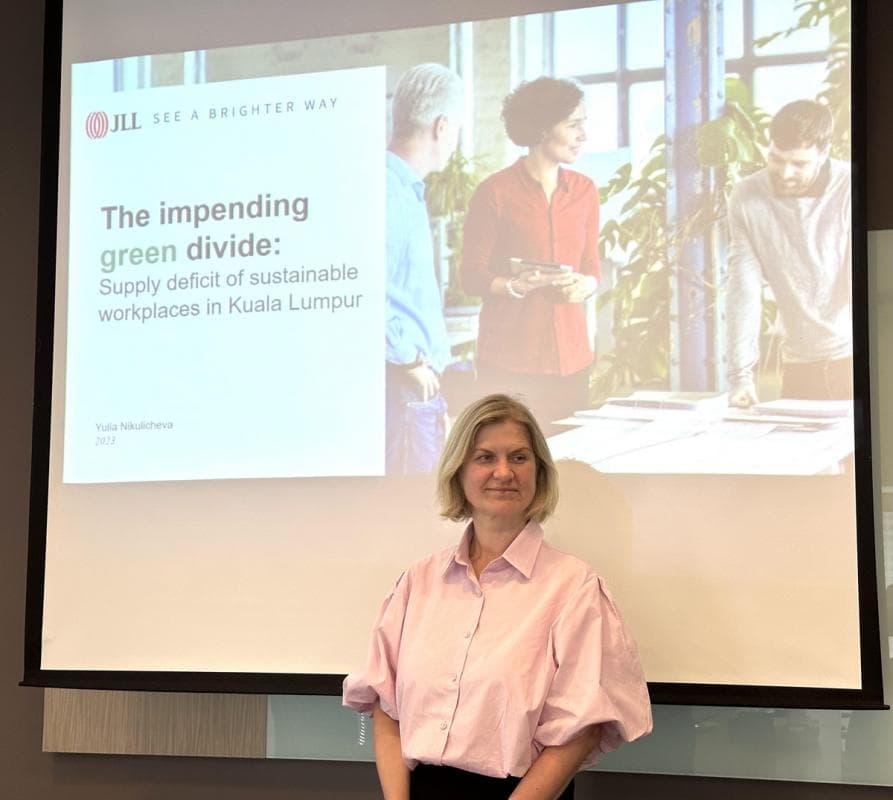
KUALA LUMPUR (Nov 14): There is a growing gap of green office space in Kuala Lumpur as the demand for green office has increased to between 40% and 45% while the supply of green office space stands at 35%, says JLL Malaysia head of research and consultancy Yulia Nikulicheva.
She reported this during a presentation entitled The impending green divide: Supply deficit of sustainable workplaces in Kuala Lumpur on Tuesday.
Nikulicheva noted that the trend of green-certified space has been on an upward trajectory since the Paris Agreement in 2015 and has observed the trend rising in multiple cities in the Asia-Pacific (APAC) region.
Singapore, Melbourne and Sydney are leading the green-certified space with over 80% of green office space. Kuala Lumpur only has 35%.
“A lot of the office stock, especially in the APAC region, was built before the Paris Agreement 2015 came into effect. In Kuala Lumpur, a lot of the older buildings were built 30 years ago with no regard to being green,” said Nikulicheva. She added that some of the landlords of these older buildings are not ready to make an Asset Enhancement Initiative.
Besides the challenge in upgrading buildings to be more green-centric, Nukulicheva pointed out another challenge Kuala Lumpur faces: oversupply of office space. New office launches are limited in the capital city and therefore not many green office buildings are being built to contribute to the office supply.
Nikulicheva said that the way forward is to retrofit the older office spaces to be green-compliant to address the green agenda.
Meanwhile, the findings of a survey that was conducted by JLL Malaysia to understand the environmental, social and governance (ESG) needs of companies was presented. The feedback was collected from APAC companies who have a presence in Kuala Lumpur.
The profile of these companies are 40% domestic and 60% multinational companies. The business sector they represent are banking, insurance or other financial services (40%), technology, media or telecommunication (23%), manufacturing (13%), education (7%), retail or consumer goods (7%), energy and renewable (3%), healthcare, life sciences or pharmaceuticals (3) and professional and business services (3%).
Through the survey findings, 55% anticipate to achieve a green real estate portfolio by 2025, 41% to accomplish it by 2030 and 4% expect to do so after 2030.
The top ESG priorities for the next three years include conducting energy audits of real estate portfolios, leasing green office space, raising awareness of sustainable workplace practices among employees, investing in biophilic design for better indoor air quality and obtaining health and wellness certification.
The top five sustainability challenges for companies' office portfolio in APAC are increased investment required for sustainable fit out, fast changing ESG regulatory landscape, increased investment required to implement ESG initiatives, lack of ESG data and transparency by landlords, and introduction of carbon taxes or other emissions-based fines.
"To catch up with this demand, developers and investors should build new buildings which take into account all the requirements of the occupiers. We expect they would be able to get a higher margin because the demand [of green office space] from companies already exists.
"We also see that the current green building standards are not enough for companies to measure their carbon impact. So, we expect that in the future, we will see new standards for office stock coming into the market and these new stock will have high demand from those companies which have to follow their [ESG needs],” Nikulicheva concluded.