

This article first appeared in The Edge Malaysia Weekly on October 30, 2023 - November 5, 2023
WHEN the Turkish government took the unorthodox approach of lowering interest rates despite rising inflation, it raised concerns over the prospects of IHH Healthcare Bhd’s 90%-owned Acibadem Saglik Yatirimlari Holding AS which is one of the group’s major revenue contributors.
The subsequent devaluation of the Turkish lira exacerbated the inflationary pressure in the country and resulted in a round of hyperinflation.
This year, Türkiye officials are projecting inflation of 65%, cooling from 72.31% last year after President Recep Tayyip Erdogan agreed to a shift in the country’s monetary policy, allowing the central bank to aggressively raise interest rates to combat inflation.
While its management navigates the challenging operating environment, Acibadem is not slowing down its growth trajectory. Founder and chairman Mehmet Ali Aydinlar says his team continues to invest in the group’s ongoing expansion into Europe, further strengthening its foreign currency revenue, one of the levers it relied on to soften the impact from the severe devaluation of the lira.
In order to cope with pricing volatility arising from hyperinflation, Aydinlar says Acibadem also increased the frequency of price adjustments to twice a year from once in the past.
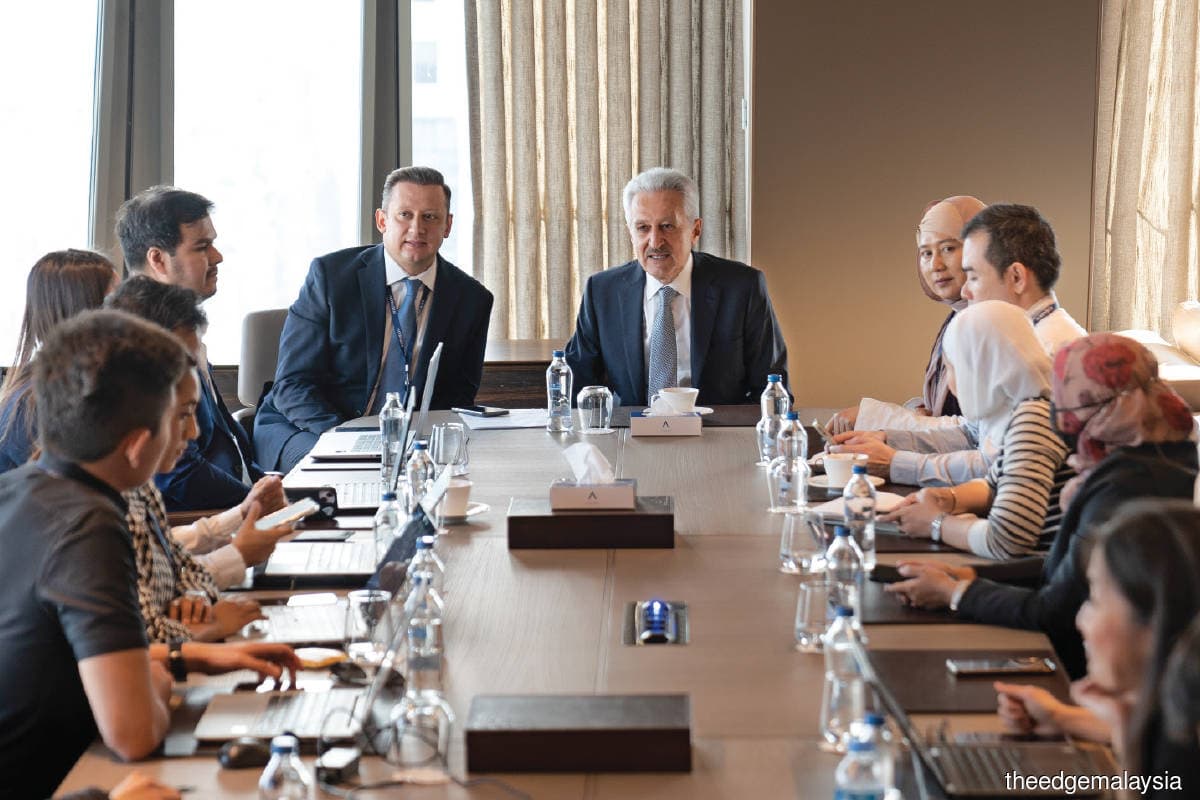
“Inflation is not a unique issue to Türkiye. If you look globally at hospitals, all of their margins are coming down, the main reason being the inflationary effect. Our issue is we have hyperinflation … but the compensation, like incomes, is also constantly being adjusted in line with inflation,” he told Malaysian journalists at Acibadem’s project management office in Istanbul recently.

“Which means, Türkiye continues to grow during this inflationary period. [With] the new economic administration with the right fiscal policies, [the situation] is now much better managed. We will see the real impact very quickly in the upcoming months. We are expecting roughly 65% inflation by the end of the year.
“Next year’s [inflation] expectations will be reduced to 33%. The year after, by the end of 2025, some 15%. So now we have a very strong economic administration team, which is supported by President Erdogan. I am expecting the recovery will happen very quickly.”
Aydinlar says as 50% of Acibadem’s revenue is earned in foreign currencies such as the euro and US dollar, management did not have a problem matching non-lira purchases such as equipment and medicine. “Twenty to 25% of our hospital revenue in Türkiye is collected in US dollars or euros, non-lira; the rest [of foreign currency revenue is from] our foreign investments, which are also in euro.”
Acibadem currently has 25 hospitals in its portfolio, 19 of which are located in Türkiye, while the remaining six are scattered across four other European countries: the Netherlands, Bulgaria, Serbia and North Macedonia.
As at the end of its financial year ended December 2022 (FY2022), Acibadem had 4,780 licensed hospital beds, second only to IHH’s 5,952 beds in India, and exceeding Malaysia’s and Singapore’s 3,000 and 1,017 beds respectively. It also recorded the highest occupancy rate of 74% for FY2022, among the four regions — Turkiye & Europe, Malaysia, Singapore and India.
Lean balance sheet helps cushion interest rate, currency risks
With the Turkish economy recovering, and Acibadem’s strong financial position, Aydinlar says the group will continue to be a significant earnings contributor to IHH’s bottom line.
Aydinlar, who also sits on IHH’s board as a non-executive director, notes that Acibadem has a debt-to-earnings before interest, taxes, depreciation and amortisation (Ebitda) ratio of less than 1.0 times. It has two more instalments left on its syndicated bank loan, which will be paid off within the next year. “I can almost say we have a very strong debtless balance sheet, we have minimal debt. At Acibadem, we always try to keep it lean, as lean as it can be. The last large financing deal that we did for Acibadem was in 2015.
“We have two instalments left, one [due] in January 2024, the other ... in July, and we have hedged both. When the devaluation issue accelerated in Türkiye post-2016, we put on a brake [on taking on more debt].
“We renovated a lot of hospitals, renewed our technology, but with our own money that we earned from the business. We are already generating net cash, but this amount will probably increase even further starting next year once we repay [all] our loans.”

For the second quarter ended June 30, 2023 (2QFY2023), IHH’s net profit slumped 50.7% to RM301.83 million from RM612.10 million a year ago as earnings were impacted by foreign exchange losses following the devaluation of the lira.
According to Bloomberg data, the currency depreciated by 42.5% against the US dollar and 34.8% against the euro last year, before further weakening by 50.3% against the greenback and 49.1% against the euro year to date (YTD).
However, revenue for the quarter was higher, expanding 6.9% to RM4.67 billion from RM4.37 billion, as the group saw more patients across its markets.
Net profit for the first half (1HFY2023) grew 53.1% to RM1.69 billion from RM1.10 billion in the previous corresponding period, thanks to a one-off gain from the sale of IMU Health Sdn Bhd, which was completed in March.
Revenue increased 14.99% to RM9.82 billion for 1HFY2023, from RM8.54 billion previously, mainly on patient volume growth.
Türkiye and Europe collectively were the second largest revenue contributor to IHH for 1HFY2023, bringing in RM2.48 billion, up 21% from RM2.05 billion in the previous corresponding period. Singapore was the largest revenue driver for the healthcare group, contributing RM2.67 billion, up 12% from RM2.38 billion in 1HFY2022.
In terms of profit contribution, Türkiye and Europe ranked as the third largest contributor for 1HFY2023, after Malaysia and Singapore.
IHH CFO’s garden leave part of leadership transition
During the interview, Aydinlar also assured that there was nothing unusual in IHH’s chief financial officer (CFO) Joerg Ayrle going on garden leave from Sept 30, ahead of his contract expiry by end-January 2024. “You know, Oct 1 we appointed a new CEO (Dr Prem Kumar Nair), and it is very natural a CEO would want to establish a new team. The CFO was on a fixed contract, and there was minimal time left.
“So, there is nothing else, no fraud or any issue. It is just nature, ordinary course of the business, it is up to the CEO’s discretion.”
Dr Kelvin Loh Chi-Keon stepped down as IHH’s managing director and CEO on Feb 22; chief operating officer (COO) Joe Sim Heng Joo took over in the interim.
However, prior to Nair’s appointment in October, Sim also tendered his resignation as COO in August “to pursue other career opportunities”.
Unlike IHH, the leadership at Acibadem remains intact, headed by Aydinlar, who is not planning to retire anytime soon.
The 66-year-old and his family collectively own the remaining 10% stake in Acibadem and a 5.96% interest in IHH. The accountant turned entrepreneur started Acibadem in 1991. IHH bought into the group in 2011.
“I will probably work until I die. To me, retirement means waiting for your death. Work makes me more dynamic. But you can ask me that question — what is going to happen to Acibadem after?
“Acibadem has very high governance standards, very institutionalised. If you pull someone, an individual, from a [position] and replace him with somebody else, the replacement knows what needs to be done. So that’s why nothing will happen, the system will prevail,” he says.
“Now that I can feel everything, I can just easily point out an issue. If need be, I can take risky decisions. Maybe those types of things may not happen. But nothing will happen to the system. And personally, I have no intention to exit from Acibadem. And even after myself, I don’t expect my family to sell our stake.”
IHH is tightly controlled by a group of substantial shareholders, with Mitsui & Co Ltd being the largest with a 32.8% stake, followed by Khazanah Nasional Bhd with 25.94%, and the Employees Provident Fund Board with 10.39%.
Together with Aydinlar, these substantial shareholders collectively control over 75% of the shareholding in the healthcare group.
Going forward, he is upbeat on the prospects for Acibadem, given its leadership position in the premium healthcare segment in Türkiye, allowing it to leverage the growing medical tourism demand from Europe and the Middle East.
“In our league, we don’t have competition. You won’t be able to find any hospital at these standards,” he says.
YTD, IHH’s share price has dropped marginally by 0.8% to RM5.96 last Thursday, valuing the group at RM52.49 billion.
Save by subscribing to us for your print and/or digital copy.
P/S: The Edge is also available on Apple's App Store and Android's Google Play.