

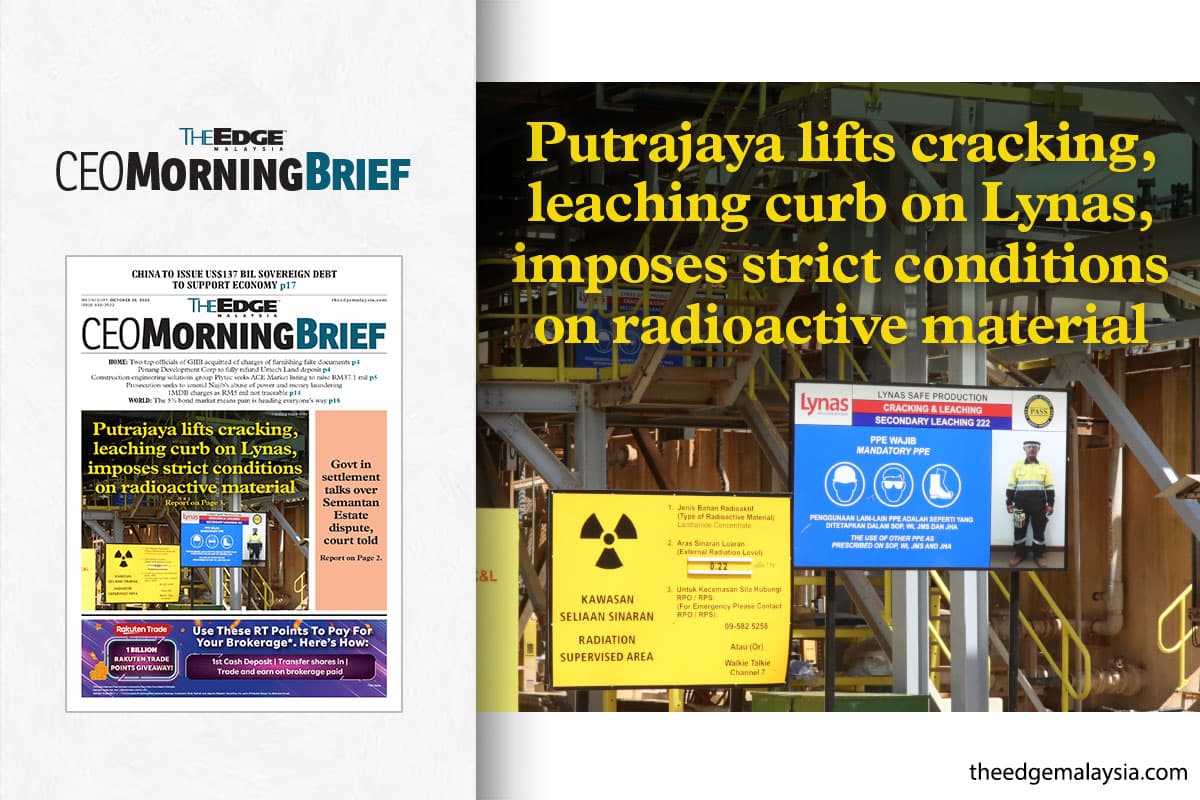
"With the technology today, thorium extraction, they can either extract thorium from the waste, or they can extract from the feedstock, lanthanide concentrate. Once it is extracted, then it will go through C&L [cracking and leaching], and there won’t be any radioactive waste. The waste will be considered scheduled waste, because it (radioactive content) will be under 1Bq/g.” — Science, Technology and Innovation Minister Chang Lih Kang.
KUALA LUMPUR (Oct 24): The government has now lifted the ban on Lynas Malaysia Sdn Bhd's cracking and leaching (C&L) activities.
Furthermore, Lynas is allowed to import naturally occurring radioactive materials (NORM) on the condition that the company is required to extract thorium from the water leach purification (WLP) residue until the radioactive content meets the required level as set by the Atomic Energy Licensing Board (AELB).
Science, Technology and Innovation Minister Chang Lih Kang said the company will be required to ensure that radioactive content in the WLP residue is below one becquerel per gramme (Bq/g).
These are the new stringent conditions, according to Chang, that the government has attached to the renewal of Lynas' licence which will expire in March 2026.
"Before this, our concern was that we do not want continuous accumulation of radioactive waste in Malaysia, so we did not allow them to import and did not allow them to process it, because that will produce radioactive waste.
"With the technology today, thorium extraction, they can either extract thorium from the waste, or they can extract from the feedstock, lanthanide concentrate. Once it is extracted, then it will go through C&L, and there won't be any radioactive waste. The waste will be considered scheduled waste, because it (radioactive content) will be under 1Bq/g," Chang told a press conference on Tuesday.
Earlier this year, the government refrained Lynas from carrying out C&L activities domestically at its Lynas Advanced Materials Plant (LAMP) in Gebeng, Pahang despite receiving a three-year licence renewal last month to operate until March 2026.
This meant that Lynas must stop importing and processing rare earths concentrate after July, and can only refine the materials at LAMP. The C&L of lanthanide concentrate was not allowed to be done there.
Speaking to the media, Chang explained that the decision for the government to relook at Lynas' licence was made by the AELB based on the findings of its preliminary research at the laboratory level which showed that thorium, a radioactive material, can be extracted from WLP residue.
As such, Lynas will now be required to extract thorium from the WLP residue until the radioactive content meets the required level as set by AELB.
Chang noted that it was Lynas who proposed the thorium extraction process.
At this point, the minister said that Lynas has proved the capability of the extraction process at lab scale, and the company is given two years to bring the proof-of-concept to commercial level.
For this, Chang said that Lynas has allocated a ball-park figure of RM25 million for the research and development of this process.
"Slowly we will not need the PDF (permanent disposal facility) anymore. Once they start scaling up and up to commercial scale, then they can also extract thorium from the waste, WLP, so after extracting thorium from WLP, those waste will be (considered) scheduled waste, and will not be radioactive waste anymore. So for the time being, PDF will still be used to store these radioactive waste," Chang said.
Building the PDF is one of the conditions set by the government in granting the previous licence renewal to Lynas. Chang was quoted in February as saying that the PDF is 32% built and is expected to be completed within three years to house the radioactive wastes, which then weighed 1.08 million tonnes, having accumulated at LAMP in Gebeng since it started operations in 2012.
Chang also noted that thorium has the potential to be sold as a commodity to be used in nuclear power plants.
"Mosti (Ministry of Science, Technology and Innovation) is confident that with this development, the related operations will comply with legal controls, protect the interests of the rakyat and subsequently, the country will be able to attract billions of ringgit worth of investment in the local rare earths industry to support the high-tech material manufacturing industry," Chang said.
Last Friday, Australia's Lynas Rare Earths said it planned to shut all operations in Malaysia on a temporary basis, except a mixed rare earth carbonate processing plant in the December quarter, with minimal volumes of the raw material processed during the interim shutdown.
Separately, Lynas Malaysia in August was granted leave by the Malaysian High Court to challenge the government’s decision regarding the operational and licensing terms imposed on the company.
In one of the judicial reviews, Lynas is looking to, among other matters, challenge the ministry’s decision that it can no longer import NORM into Malaysia from Jan 1, 2024, and that its C&L activities should be shifted outside of Malaysia from the same date.
Read also:
Australia's Lynas plans temporary shutdown of M'sian ops, shares fall
Lynas Malaysia secures leave to challenge govt’s decision on its operating and licensing terms