

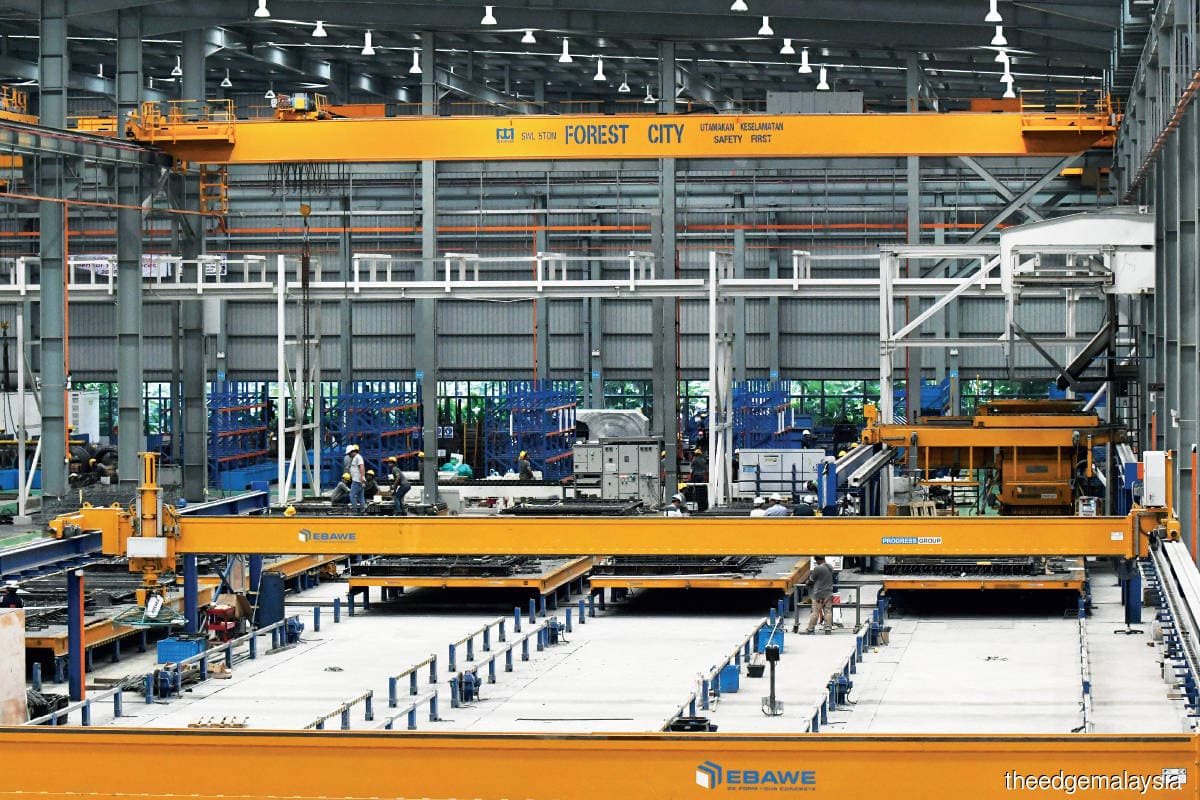
This article first appeared in City & Country, The Edge Malaysia Weekly on October 16, 2023 - October 22, 2023
As with other industries, construction is undergoing a digital transformation. This shift towards digitalisation is driven by the need to overcome various challenges, such as a labour shortage and surge in the prices of building materials, and to pave the way for a more efficient and sustainable future. Recognising this, the government has been promoting initiatives to encourage the adoption of digital technologies in the industry.
Building Information Modelling (BIM) and Industrialised Building System (IBS) are two such technologies that the government has promoted over the last few decades. These have proven to have many benefits, including improved productivity, reduced building material wastage, enhanced safety measures and greater environmental sustainability.
“The Malaysian construction industry started [its digital transformation] some years ago with BIM, the foundation of the digital transformation in the architecture, engineering and construction industries. It is a software to record and manage information on a construction project, throughout its whole life cycle,” Master Builders Association Malaysia (MBAM) president Oliver Wee tells City & Country in an interview.
“BIM provides more than just the modelling on how your building will look once it is completed; it also gives you early analysis to help you save time and money, [helps] avoid afterthought design and minimises disputes between the developer, architect, main contractor and NSCs (nominee subcontractors). Every party will be well informed on any changes or updates to the main drawing because everything will be uploaded to the BIM platform. In other words, there will not be arguments and finger-pointing.”
Nevertheless, BIM is not as widely adopted by the local industry as expected. Wee attributes this mainly to its lack of motivation for change.

“Unlike IBS, the main problem with [the lack of popularity of] BIM is not the initial investment cost because there are subscription plans available now — you don’t have to buy the entire system — but it is true that it is a cost centre [and] many architect firms are not willing to fork out the money.
“This mindset has to be changed because it is an investment that helps to save time, cut down wastage, avoid site accidents and so on. It creates invisible value, which eventually contributes to making a greater profit.
“I think the main problem is a lack of motivation for architect firms to make the change since it is not something mandatory [by the government] and there is no incentive or benefit to use BIM. Many of them have been using the old way to work and they are very comfortable.
“Another reason is some parties do not genuinely want the entire construction progress to be so transparent under the platform,” Wee explains.
He adds that if an architectural firm is not required to use BIM, it is only natural that the main contractor and NSCs will not use it, leading to its slow adoption rate here.

While he is not aware of any government incentive to adopt BIM, Wee says Construction Industry Development Board (CIDB) started the myBIM Centre Malaysia to provide training and courses for BIM operators. In addition, several universities have included BIM in the syllabus of some construction-related courses.
“The intention of myBIM Centre Malaysia to train professionals is good, and in fact there are more talents available now. However, most of the academically trained BIM operators are merely draftsmen as they cannot do design. They still need a designer to convert the drawings into BIM. Perhaps if the government focuses on training those who are already in the industry, and makes it a mandatory course, it will help to speed up the adoption rate, just like in Singapore,” he suggests, adding that in Singapore, the master plans for all new projects must be submitted to the authorities for approval through BIM.
Slow adoption of IBS too
As with BIM, the main obstacle to the widespread adoption of IBS in the Malaysian construction industry is the lack of motivation for change, according to Wee.
“While the government does give out IBS incentives, it is only to the manufacturer, not the developer and contractor. Why would developers spend more to use IBS when there is no incentive, when the old way of building is still relatively cheaper?” he asks.
Wee adds that developers would be the main driver to speed up the IBS adoption rate because they can create substantial market demand, bringing down the overall cost of using the system in the long run.

“IBS is expensive to use because [there is no] economies of scale, which is due to low market demand. While the government has certainly been pushing it very hard by giving out incentives and upping the IBS score for projects, I believe more can be done,” Wee notes.
He says in addition to saving time and money, IBS contributes to a greener environment and transforming the image of the industry, which is traditionally perceived to be dirty, dangerous and difficult.
“Construction digitalisation does not need to use robots to build; it uses technology and software to achieve cost and time savings, as well as to collect useful data along the way to make future building jobs easier and more efficient,” Wee explains.
He says despite their slow adoption, BIM and IBS are the way to go. The Covid-19 pandemic has served as a wake-up call and helped speed up the transformation process.
“The industry has been facing many challenges since the pandemic — limited on-site work time, shortage of labour and volatile material prices. They (industry players) see the [urgency] to do something now to prevent something similar happening in the future. It is a wake-up call for them to do something.”

Increased spending on construction technologies expected
Wee’s observation is in line with the findings in the “How We Build Now 2023” survey report released by Procore, an international construction management software provider, in June.
In the report, Procore highlights that three out of four (75%) construction professionals in Malaysia say they are looking to increase spending on construction technologies over the next 12 months. When it comes to technology adoption, the respondents see construction management platforms (56%) as the biggest drivers of change in the next three years, followed by payment technologies (34%), pre-fabrication (31%), big data (27%) and next-generation BIM (26%).
“Malaysian construction businesses acknowledge the value that frontier technologies, such as drones and 3D printing, bring to the table. However, the industry also understands the need to focus on solving the fundamental challenge: finding the right people, skills and equipment for the job,” Procore Asia regional manager Tan Kin Weng tells City & Country in an email interview.
In addition, he highlights that 56% of construction decision-makers in Malaysia expressed their intention to introduce construction management platforms within their organisations in the next five years. However, the speed of adoption is critical.
“Construction businesses need to prioritise overcoming the barriers to their digital transformation journey. If businesses wait too long for proof before taking the plunge to adopt technology, they risk being leapfrogged by faster-moving competitors. Adopting construction technologies can play a significant role in improving the productivity and efficiency of the industry,” Tan says.

He adds that the top challenges in this digital transformation journey are preferring to wait until technologies are more established and proven in the market, justifying the return on investment for the technologies and the cost of technology adoption.
“In digitising the construction industry in Southeast Asia, particularly in Malaysia, key barriers include a preference for established technologies, a skilled manpower shortage, initial investment costs, and the need to justify the ROI (return on investment).
“While some initiatives, such as CIDB’s Skills Competency Training Programme and MBAM’s various seminars, have been introduced to tackle these issues, further support and direction from key government entities like the Ministry of Works and CIDB are essential to drive successful transformation under the Construction Plan 4.0,” Tan states.
He believes stakeholders can spearhead impactful awareness campaigns and educational programmes, highlighting the benefits of adopting technologies while dispelling any misconceptions, as sharing successful case studies and implementing pilot projects will serve as practical demonstrations, prompting wider adoption among construction professionals.
Tan also reckons that, by establishing comprehensive training programmes and fostering partnerships with government and trade associations, construction businesses can effectively upskill the existing and upcoming workforce in the realm of digital technologies. For instance, apprenticeship programmes can nurture new talent and ensure a smooth transition to a technology-driven construction environment.
Apart from that, the government can provide financial support, grants and incentives to construction companies to offset initial costs, according to Tan. For example, the Ministry of Investment, Trade and Industry (Miti) launched the Industry4WRD scheme to drive digital transformation in manufacturing and related services in Malaysia, to help alleviate the financial burden and encourage wider adoption of technology in the industry.
“Technology drives greater productivity, efficiency and safety through the following ways: improving access to project information; enabling remote working; automating project workflow; capturing, integrating and standardising data across the business; and optimising future projects. By leveraging technology, construction companies create a safer environment, reduce incidents and help decision-makers make data-driven decisions that drive overall progress and innovation for the business, and the overall industry,” Tan concludes.
Save by subscribing to us for your print and/or digital copy.
P/S: The Edge is also available on Apple's App Store and Android's Google Play.