

This article first appeared in The Edge Malaysia Weekly on August 14, 2023 - August 20, 2023
AMID a lacklustre office market in the US, Keppel Pacific Oak US REIT (KORE) is pinning its hopes on the outmigration of the population from American gateway cities into second-tier cities, where its assets are located, for better occupancy rates.
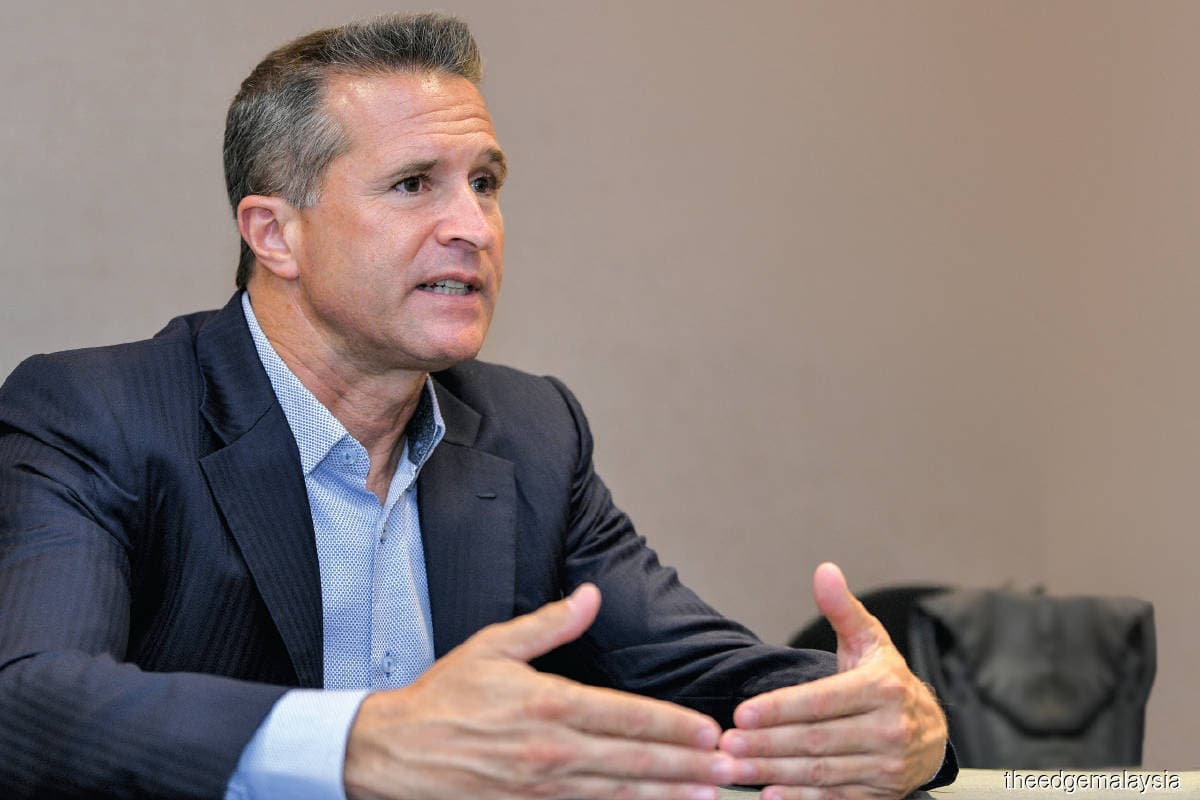
David Snyder, CEO of KORE manager Keppel Pacific Oak US REIT Management, tells The Edge in an interview in Kuala Lumpur that some of the 13 assets under the Singapore-listed real estate investment trust’s (REIT) portfolio have been refurbished to appeal to existing and prospective tenants.
“It was a little challenging when we launched, [and even] now. There [has been] a lot of self-education [as] we don’t invest in markets that Asians tend to be familiar with, such as San Francisco, Los Angeles or New York. But those are the big markets that are losing population, and have high taxes, high regulation and high crime rates. Businesses have been flooding into Sunbelt cities and 18-hour cities,” Snyder explains.
“Sunbelt cities” refer to those located in the US’ southern tier while 18-hour cities refer to vibrant mid-sized cities with above-average urban population growth, attractive amenities and a lower cost of living and cost of doing business than that of gateway cities.
KORE’s 13 assets, which are freehold office buildings and business campuses with a collective asset value of US$1.42 billion (RM6.5 billion) and an aggregate net lettable area of approximately 4.8 million sq ft, are located in eight such markets — Seattle, Washington; Denver, Colorado; Sacramento, California; Nashville, Tennessee; Orlando, Florida as well as Austin, Dallas and Houston in Texas.
“Our low-rise buildings and business campuses are [favoured] by technology tenants. Most technology companies, with the exception of Amazon.com Inc, have low-rise campuses for testing, fabrication or manufacturing on the ground floor, with offices above. It is challenging to sell that [scenario] to folks who are used to pretty, shiny buildings,” Snyder says, adding that while the strong US dollar may not be advantageous to Malaysian investors at this time, KORE offers geographical diversification.
“The US [economy] will have ups and downs as elsewhere, but there seems to be no doubt it will recover,” says Snyder, pointing to data indicating higher gross domestic product, better employment rates, wage growth and lower taxes in the Sunbelt cities, in contrast to news of rising crime rates in gateway cities since the Covid-19 pandemic hit.
KORE, which was listed in November 2017, resulted from a venture between Singapore’s Keppel Corp and Pacific Oak Capital Advisors in the US. Pacific Oak was part of another publicly registered, non-traded REIT formerly known as KBS, where Snyder worked as chief financial officer for about seven years.
Snyder explains that among the REITs that Pacific Oak managed, one had a portfolio of assets acquired after the 2008 global financial crisis. The assets were either facing financing problems or the buildings had been neglected significantly. After turning the properties around, the partners listed the REIT in Singapore — Asia’s largest REIT market — taking advantage of its regulatory environment and tax advantages for investors.
KORE’s competitors are Singapore-listed Manulife US REIT and Prime US REIT, both pure-play US office REITs. According to its website, Manulife US REIT’s portfolio comprises 11 freehold office properties in Arizona, California, Georgia, New Jersey, Virginia and Washington DC, while Prime US REIT has 14 office properties in Denver, Salt Lake City, Atlanta, Washington DC (suburban Maryland and Virginia) and San Francisco.
Amenities, optics to draw tenants in
KORE’s capital investments in its assets, which have typically ranged between US$26 million and US$43 million a year since 2018, are financed by borrowings. The investments include enhancements, building tenant spaces and leasing commissions to brokers.
Snyder explains that KORE’s gearing ratio, at 38.14%, falls “within the REIT’s target of keeping gearing below 40%”. He adds that KORE’s investments typically make up about 30% of gross revenue, and this year, about 40%.
KORE will continue to build spec suites, which are fully fitted out spaces that typically include gathering areas, kitchens, leisure spaces as well as “huddle-type rooms”.
RHB Singapore in a June 19 note said that the amenities are more of a necessity than a perk. With US office spaces turning into collaborative spaces offering in-house cafés, gyms and conference facilities (generally considered a premium pre-Covid-19), it sees KORE upgrading or adding such amenities across its buildings, which RHB says has helped it outperform its peers. RHB Singapore has a “buy” call on the REIT with a lower target price of 56 US cents from 64 US cents earlier.
UOB KayHian Singapore and DBS Bank Research, the only other houses with recent coverage of the REIT according to Bloomberg, have also ascribed “buy” calls on KORE with target prices of 50 US cents (reduced from 68 US cents previously) and 48 US cents, respectively.
The Singapore Exchange offers dual currency trading in Singapore dollar, US dollar, euro, Hong Kong dollar, Australian dollar and Chinese yuan, hence KORE’s trading in US dollar since its operations are in the US and unit distributions made in that currency, as are analysts’ target prices.
“KORE has maintained a [committed] lease rate or occupancy rate of about 90.8% for the [first two quarters] this year, on the back of the US office market’s average of 82.9%,” Snyder says.
Technology, advertising, media and information tenants feature prominently in KORE’s portfolio at 41.3%, followed by professional services (21.6%), finance and insurance (16.3%), others (12%), and medical and healthcare (8.8%).
UOB KayHian Singapore research in a June 7 note pointed out that on a portfolio-wide basis, KORE has strong physical occupancies of 64%, compared with the nationwide average of 50% for the US (Manulife US REIT: 30%, Prime US REIT: 56%).
“Leases accounting for 10.6% of cash rental income are expiring during the rest of the year. Management has actively engaged tenants to assess their long-term space requirements. Portfolio occupancy is expected to stay above 90% due to backfilling of vacant office space,” it said.
Another differentiating factor for KORE is the pool of more than 390 tenants in its portfolio, which Snyder says comes up to about 50% and 200% more tenants than its two competitors, respectively.
“The risk of losing any individual tenant is much lower for us, and it would be much easier [compared with] replacing large tenants. Smaller tenants tend not to downsize. They’re much safer,” says Snyder.
Consistent financial performance
For the second quarter of the financial year ended June 30, 2023 (FY2023), KORE posted a higher net property income (NPI) of US$22.7 million on the back of US$38.86 million in revenue, improving 6.8% and 4.7% year on year from US$21.27 million and US$37.13 million earlier.
For the first six months of FY2023, NPI was US$43.87 million, marginally higher than US$43 million last year, while revenue rose to US$75.91 million from US$74.1 million last year.
For 1HFY2023, KORE announced a distribution per unit of 2.50 US cents, which was paid out on Aug 2.
When asked if KORE was looking to acquire or dispose of any assets following the divestment of its Northridge Center I & II and Powers Ferry in Atlanta in the second half of 2022, Snyder says: “Currently, the level at which our stock is trading is too high for KORE to buy anything new and have it be [value] accretive. Therefore, we are not looking to acquire but rather to reinvest in our portfolio to maintain its growth.”
“When the markets have stabilised, we will dispose of Ironpoint in Sacramento, California, and exit that market to invest [further in KORE’s existing markets]. Other target markets include Charlotte and Raleigh in North Carolina, Tampa in Florida, Salt Lake City [and, more so] Lehi in Utah. Many tech start-ups have put significant offices in Utah, and Lehi has many purpose-built buildings for these start-ups that we would love to own.”
Meanwhile, a recent survey by Knight Frank and commercial real estate firm Cresa shows that half of the big international firms polled plan to shrink their global workspaces in the next three years as productive work is being redefined. Despite some surveys revealing an increase in hybrid work trends and companies adopting work from home policies, Snyder believes that the trend may bend “towards some flexibility, but a true hybrid is unlikely at this point”.
In the last 12 months, KORE’s units have more than halved from 70 US cents to 30 US cents last Wednesday, valuing the REIT at US$313.34 million.
Save by subscribing to us for your print and/or digital copy.
P/S: The Edge is also available on Apple's App Store and Android's Google Play.