

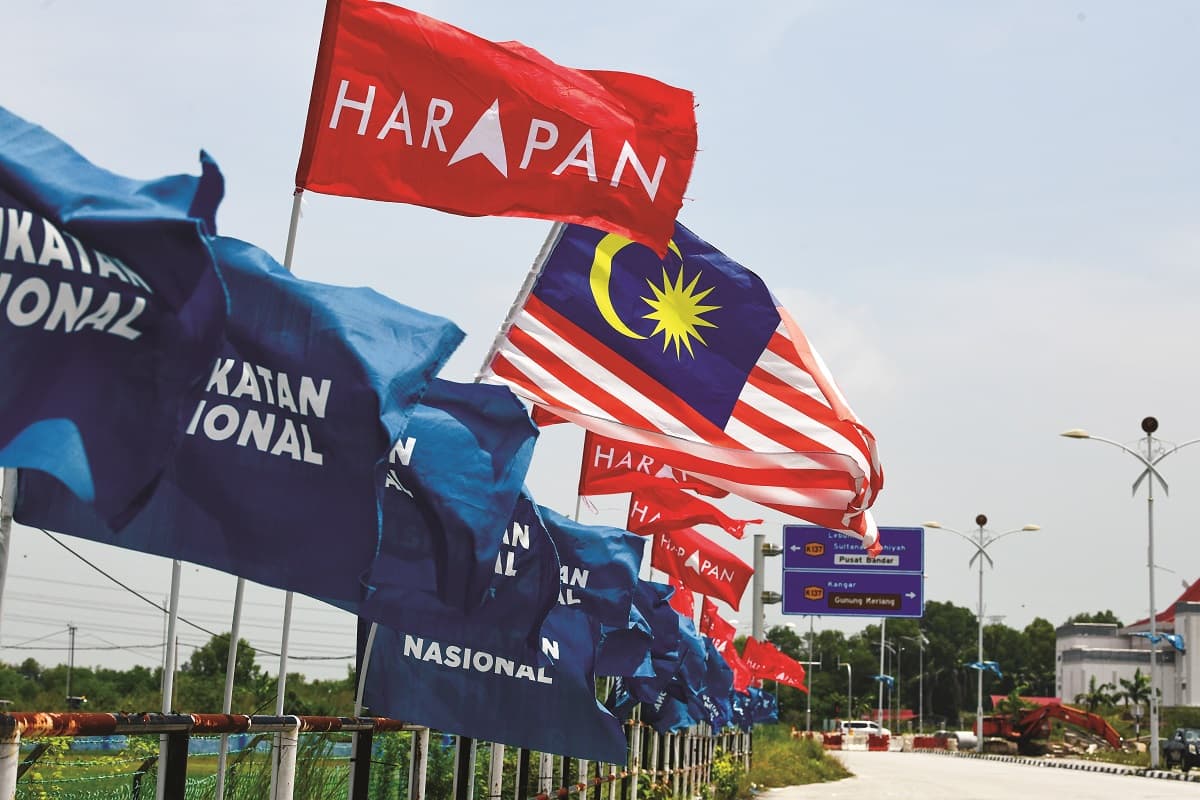
This article first appeared in The Edge Malaysia Weekly on August 7, 2023 - August 13, 2023
THE pulsating sensation of being in the middle of what could perhaps have been a 10,000-strong crowd in rural Kedah brought me back to April 2018 in Johor, when the Pakatan Harapan (PH) coalition kicked off its campaign to break the Barisan Nasional (BN) stronghold for the 14th general election (GE14).
Fast-forward five years. This time, it was no longer PH that pulled such crowds, but rather, Parti Islam Se-Malaysia (PAS) and its Perikatan Nasional (PN) partners Parti Pribumi Bersatu Malaysia and, to a much lesser extent, Parti Gerakan Rakyat Malaysia.
The exultant chorus of “Allahu Akbar (God is Greatest)!” emanated from the Kompleks PAS Kedah field near Kota Sarang Semut (not far from the state capital of Alor Setar) every time a politician or state leader’s arrival was announced.

The PAS security team had a tough job in holding back the crowd, while escorting the leaders, especially caretaker Kedah menteri besar Datuk Seri Muhammad Sanusi Md Nor. Kedah Malays can’t seem to get enough of him, despite the controversies that he has found himself in of late.
If previously Kedah was known as a swing state, this time it seems like Kedahan Malays, who make up 77.7% of the state’s voters, have largely made up their minds — voting for PN; specifically, “defending” the state government led by PAS’s Sanusi.
“If we were to vote for the unity government, what’s going to happen to us Malays? The Chinese are going to kick us out,” says a 19-year-old first-time voter when met at the PAS Kedah headquarters. “PAS will ensure that we Malay Muslims will be defended,” he says.
Challenged by the fact that PN also has Chinese among their cadres, the teenager simply said there were not many of them in PN.

“There are many Chinese in PH, and they control the government,” he says.
This narrative, that the unity government is controlled by the Chinese, is not supported by facts or figures. Of the 147 government members of parliament, only 44 are Chinese.
However, it is an effective narrative among the rural Malays, especially among less educated youth. Since 2008, Kedah has been a swing state — one that alternates between PAS and Umno-led BN. However, as data from GE15 shows, the state has become almost completely “green”.
Out of the 36 state seats in Kedah, PH had only managed to get the largest chunk of the votes in four constituencies, based on the GE15 results of voting for the parliamentary seats. This means that if the state election had been called concurrently with the federal election in GE15, PH might have lost 14 of the seats it had won in GE14.
Party for the masses
While the “Islam is under threat” narrative is there and prevalent among the less educated youth, PAS’s popularity in Kedah is also due to the crippling poverty in the state, especially in rural areas.
Data from the Department of Statistics shows that Kedah has the third-lowest gross domestic product per capita among the states in Malaysia, as of 2022, at RM25,967. Its household median gross income of RM4,402 per month is the second lowest among the states in Malaysia, after Kelantan.
Kedah’s absolute poverty rate of 9% is the fourth highest, after Sabah, Kelantan and Sarawak. In contrast, incidence of absolute poverty is only 1.5% in Selangor, 2% in Penang and 4.4% in Negeri Sembilan.
PAS is seen as a party of the masses, with support for its brand of political Islam cultivated over decades since its inception in 1951, helped through institutions such as free kindergarten education through the Pusat Asuhan Tunas Islam (PASTI) and its volunteer arm, Jabatan Amal Malaysia.
This has led to the people in Kedah, and in other states where PAS is the dominant political force such as Kelantan and Terengganu, to believe in the party’s struggle, as they are often in the front line of helping the poor and the needy, as well as performing obligatory Muslim functions.
“During the Covid-19 Movement Control Order, PAS representatives were the ones who visited us and collected our details so that we could get government assistance,” says roadside stall assistant Aminah (not her real name) when met in Taman Ria Jaya, in the Sidam state constituency.
An issue with the federal government’s cash assistance had also popped up. In Sidam, Pantai Merdeka and Lunas, where I visited, some complained that they stopped receiving the cash assistance this year, or the timing of the assistance was off from when they needed it most.
It is hard to ascertain why they had not received their cash assistance this year — perhaps they are no longer eligible. The e-Kasih database is updated regularly, with community representatives checking the status of the recipients to ensure they are eligible.
Through the federal government’s Sumbangan Tunai Rahmah, households with a monthly income of less than RM2,500 are eligible to receive up to RM2,500 in cash assistance this year, depending on the number of children they have.
There are also specific assistance programmes for old folk living alone, low-income youth, as well as youths with disabilities.
Sanusi — a Kedahan ‘hero’?
As a low income earner with a lorry-driver husband, Aminah’s household cannot meet today’s cost of living. She is therefore very grateful for PAS’s proactive stance when it comes to providing assistance. She claims that she has never been visited by representatives of the Sidam assemblyman.
Between the 2013 and 2023 terms, Sidam was represented by Dr Robert Ling Kui Ee. Winning the seat under Parti Keadilan Rakyat’s (PKR) ticket in May 2018, Ling defected and became an independent assemblyman in 2020, before joining Bersatu as an affiliate member.
Ling ran for the Sungai Petani parliament seat in GE15 last November, but lost to PKR’s Dr Taufiq Johari, who took over from his father Tan Sri Johari Abdul who held the seat for three consecutive terms between 2008 and 2022. Taufiq is the sole PH parliamentarian in Kedah following GE15.
Aminah finds it imperative for her to vote for PN in the coming state election. PN is fielding Juliana Abdul Ghani in the seat from Bersatu, while PH’s candidate is Bau Wong anak Bau Ek, a native Kedahan Siamese from PKR.
This is because for her, the state government under Sanusi has been doing a good job in administering the state. For example, she said the water issue (where supply disruption could happen when there is high demand) is currently being resolved.
The upgrading of water treatment plants (WTPs) and other large-scale water infrastructure that involves a budget of hundreds of millions of ringgit will not be the responsibility of the state government, particularly after the restructuring of the water supply industry in 2008.
However, a close relationship between the state and federal government would smoothen and accelerate the implementation of infrastructure projects that would benefit the people.
“There is a big implication if the people choose wrongly,” says Datuk Shaiful Hazizy Zainol Abidin, the BN candidate for Tanjung Dawai. He is also the Kedah BN information chief.
“If they still choose PN, this means the federal government is going to be of a different party than the state government, and this will make it very hard for Kedah to prosper,” he says when met at the BN command centre in Taman Laguna Merbok, Sungai Petani.
The unity government of PH and BN has launched a manifesto specific to Kedah, which includes the upgrading of five WTPs in the state and the construction of three new WTPs, as well as replacing old pipes and building of river storage systems along the Muda River.
However, Shaiful Hazizy warns that the progress of these projects and more will be affected if the people of Kedah continue to choose representatives from parties that are not friendly with the federal government, and especially if figures like Sanusi helm the state.
Such a situation would be exacerbated by having a menteri besar whose personality grates on his political opponents, said Shaiful Hazizy.
Sanusi’s rise in politics has been meteoric, as he was made the menteri besar of Kedah barely two years after being elected as the state representative of Jeneri, in the rural district of Sik. In 2018, he received 46.3% of all votes. In 2022, PAS’s portion of votes in Jeneri for the Sik parliament was 67.2%.
He is standing again in Jeneri, against BN candidate Datuk Muhammad Khizri Abu Kassim. Malay voters make up 92.7% of the constituency’s electoral roll.
Federal government to fall if PN wins big?
The results of GE15 show that the country has been divided like never before. The rural, Malay-majority seats in the peninsula largely fell to PN, except for a few that are still under BN, while PH managed to defend its urban seats.
Umno registered its worst showing in a general election with only 26 seats, down from the 54 it had won in 2018, before defections largely to Bersatu. Meanwhile, PAS increased its seats to 43, from just 18 in the preceding general elections.
It would not be impossible for Umno to rethink its position within the unity government if the Malay community continues to switch their allegiance to PAS and Bersatu. And this could lead to the fall of the federal government if BN switches sides — provided the East Malaysia bloc follows.
And while the Malays’ support for PN still seems high, the other communities could be enticed to join the movement as it would not be in the best interest of the country for its administration to be divided along racial and religious lines.
The question is: Which way will the Malay votes go?
Minority-Chinese voters in Kedah watch as political game plays, with them on the sidelines
By Hailey Chung
READING the newspaper alone at a coffee shop tucked in a residential area in Kedah, 55-year-old Kim is already warmed up to talk about the affairs of his hometown state when The Edge greets him. Putting down his newspaper on the table, the A3-sized cover page shows pictures of prominent political figures in energetic spirit on nomination day, creating an easier entry to converse about the approaching state polls on Aug 12.
Making up only 14.5% of the voting population, the Chinese electorate in Kedah feels the insignificance of their vote against the massive 77.7% of Malay voters — which the Chinese speculate will have more or less collectively fixed the Malay electorate’s minds to support Perikatan Nasional (PN).
“On the outside looking in, green (referring to Islamic party PAS, which is part of the PN coalition) is strong. But, we don’t know what’s really on the minds of Malay voters,” says Kim, who only wants to be known by his surname.

PAS is contesting 21 out of 36 seats in Kedah, including in Kim’s state constituency of Alor Mengkudu, which comprises 73.1% Malay voters.
Alor Mengkudu is one of the hot seats in the state that will see a straight fight between Kedah Pakatan Harapan (PH) chairman Datuk Mahfuz Omar and former skipper of Kedah’s state football team Muhamad Radhi Mat Din.
In another coffee shop nearby, a group of Chinese voters say even fielding “popular” Mahfuz would have little chance of winning for PH, as the former four-term member of parliament for Pokok Sena was toppled by PAS Kedah state commissioner Datuk Ahmad Yahaya in the November 2022 general election by more than 30,000 votes.
Pokok Sena is just a 28-minute drive away from Alor Setar, the federal constituency of Alor Mengkudu.
“He!” Kim exclaims, pointing to former prime minister Tun Dr Mahathir Mohamad on the paper. “He has changed so many colours,” he says, in describing the elder statesman, who won the Langkawi federal seat under the Bersatu ticket in 2018 but was heavily defeated and lost his deposit in 2022 as a Pejuang candidate against PN’s Datuk Mohd Suhaimi Abdullah.
Kim was born in Langkawi, an island of Kedah, but spent his life in Alor Setar working for a popular Malaysian retail grocery store.
In March, Mahathir applied to rejoin PN. He has openly supported PAS and continues to do so, leading up to the state polls. The nonagenarian has also been active on Twitter to buttress the message that Malaysia is a Malay country.
Kim, and several Chinese in Kedah, also voice their grievances against the double standards the community faces to The Edge, such as the authorities’ removal of wayside shrines that have angered the Chinese, even with the state elections looming.
Kota Darul Aman incumbent state assemblyman Teh Swee Leong, when asked, says the state authorities have demolished “a lot” of the Indian and Chinese shrines built on government and reserve land.
Being part of the PH state government in 2018, which lasted for 25 months before defections by ex-PH members, Teh says there was an intention to draft a policy to solve the situation, such as providing land grants to deal with temple occupancy issues. The Perlis-born DAP politician, 34, is defending his seat, which consists of 57% Chinese voters — the most Chinese-populated area among the three state constituencies under Alor Setar.
In an interview with The Edge during his campaign walkabout, Teh also states his manifesto to drive tourism, and in turn the economy and talent retention, in Kota Darul Aman.
“This (Alor Setar) is a city. It’s the capital of Kedah. So, we (PH) will put emphasis on developing tourism because everyone goes to Kuala Kedah and straight away to Langkawi; but they (tourists) don’t know about Alor Setar,” the banking and finance graduate says.
Kedah has 51.1% of voters under the 18-to-39 age bracket. However, many of the local young Chinese have either left the state or aim to work in Johor, the southernmost state of Peninsular Malaysia, and perhaps even venture to Singapore for better work opportunities.


Visit this link for everything about the State Polls 2023.
Save by subscribing to us for your print and/or digital copy.
P/S: The Edge is also available on Apple's App Store and Android's Google Play.