

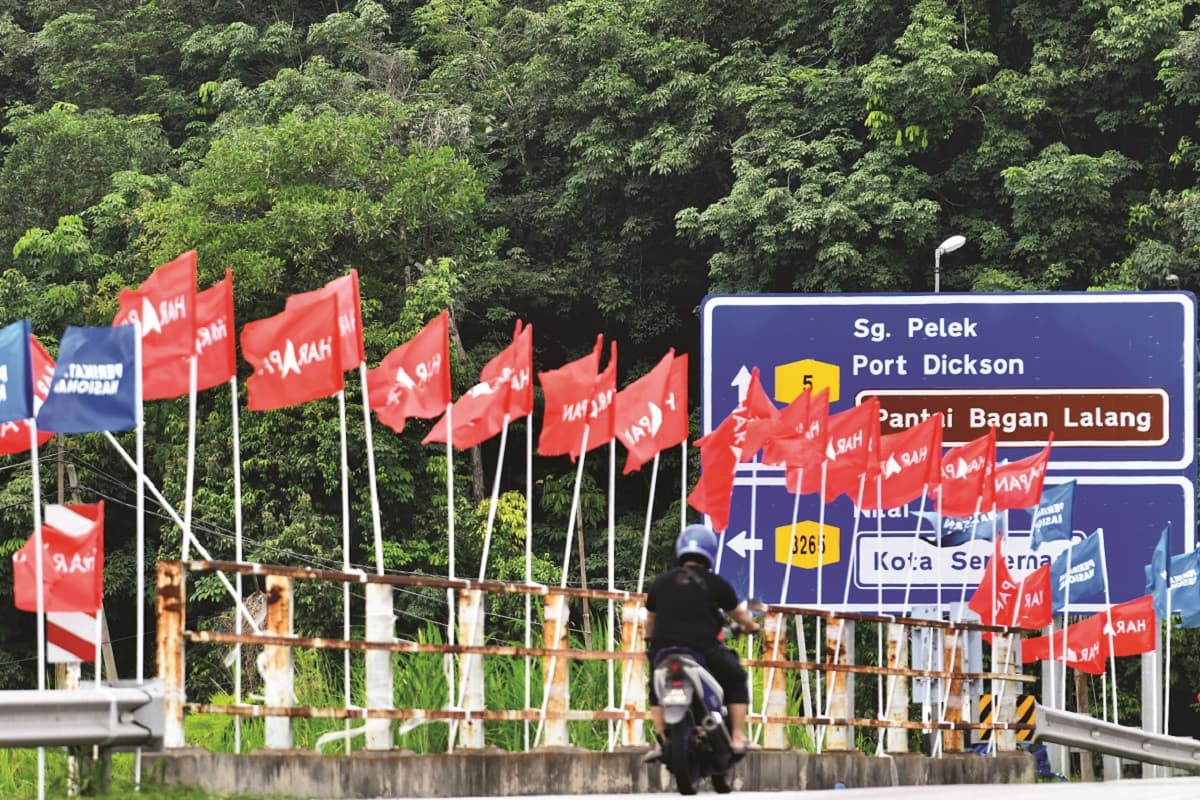
This article first appeared in The Edge Malaysia Weekly on August 7, 2023 - August 13, 2023
IT was mid-morning on Tuesday. Holding on tight to his roll of loose tobacco, preventing it from being scattered by the ocean breeze at a mostly empty hawker centre on Bagan Lalang beach, just a stone’s throw from the Sepang Gold Coast, 45-year-old postman Eijal, as he wants to be known, lamented his disappointment in Umno, a party he has been a member of since the 1990s.
“The Malays are divided. One faction wants to continue with the party legacy of championing Malay rights. The other only cares about their own interest,” he tells The Edge as he lights up and takes a puff during a break before continuing his mail delivery.
“The whole of Bagan Lalang village is Umno. We still take part in events organised by the party. But there are a lot more fence sitters in our village these days, after ‘you-know-who’ sacked all his dissidents and took control of the party.”
Similar sentiment appears to be mushrooming in other adjacent villages, according to Saadiah of Kampung Bukit Bangkong, a 46-year-old janitor who works at the Bagan Lalang hawker centre. “We have a close relationship with Umno. The few villages here are all BN (Barisan Nasional).”
But Saadiah’s reminiscences are of the “good days” during former prime minister Tan Sri Muhyiddin Yassin’s Perikatan Nasional (PN) administration in 2020 and 2021. “Abah helped a lot in those days. We earn about RM1,500 a month here. Now that the price of everything is increasing, it hurts.”
Both of these villages come under the Tanjung Sepat state constituency, situated between the Sungai Pelek and Morib seats.
With Selangor shaping up to be the main battleground between the unity government and PN for the upcoming state election, it appears the opposition has had the upper hand in the early part of the campaign period from July 29 to Aug 12. There are 56 state assembly seats to be won.
The Edge visited 12 state constituencies last week, of which 10 are situated on the outskirts of Selangor, along its west coast and eastern corridor. We got the impression that it is easier to bump into a PN supporter rather than a fence sitter in the rural Malay community. Pakatan Harapan (PH) supporters were a rare sight and shy to admit that they are vouching for the Anwar-led administration.
Not only are incumbents typically at a disadvantage in an election on account of having ruled and had their abilities actually tested, but PH is also faced with a strategic challenger. PN appears to be particularly successful in embedding its narratives, as we encountered rural voters often repeating campaign points from the opposition bloc.

The 15th general election (GE15) last November had already shown a significant swing in popularity away from BN amid Umno’s infighting, with voters switching their support to PAS.
These grouses are mostly national-level issues, including discontent at the appointment of Umno president Datuk Seri Ahmad Zahid Hamidi into the cabinet, and the ongoing economic hardship stemming from inflation and the normalisation of the overnight policy rate (OPR). Along the coast at Batu Laut beach, Lie, a 55-year-old Umno member, says many villagers are in a dilemma today, not because of the collaboration between PH and BN, but particularly on the conduct of Ahmad Zahid.
“Collaboration is normal in politics today. PN might work with DAP as well — we are not really bothered by that — PAS was in the Selangor government once anyway. But why do we need Zahid in the cabinet? Borhan [Aman Shah] is my friend. We have the same hobby. He is a competent assemblyman, but voting for him today is equivalent to supporting Zahid. So, it is very difficult for me,” he says.
Borhan is the PH incumbent in the Tanjung Sepat seat, defending against PAS’ Sabirin Marsono.

In GE13 in 2013, PAS had wrested the Tanjung Sepat seat from BN when the Islamist party was still a member party of the then-Pakatan Rakyat. The then alliance’s grip on Selangor had expanded to 44 seats, from 36 seats in GE12 in 2008, when the state saw the first change of government since the country’s independence.
More than 100km north of the beach, in Bukit Sentosa, under the Batang Kali state constituency, Johan, a 37-year-old engineer employed by a local car production plant, also admits that he will be supporting PN in protest against Ahmad Zahid.
“I was a Pakatan Harapan supporter. You can merge with BN, but you should not make him deputy prime minister. This is a person with 47 criminal charges, and when senior leaders in Umno challenged him, he sacked dissidents like KJ (Khairy Jamaluddin) and [Tan Sri] Noh Omar. These were good leaders in Umno.
“It is not gentlemanly at all — when people challenge you, you should accept it and prove that you are worthy of staying,” he says, echoing a narrative from villagers on the west coast.
Meanwhile, 35-year-old mechanic Fizz of Kampung Jawa, a cyclist hotspot in the mountainous terrain of Dusun Tua state constituency, repeated a similar narrative against the Umno president.
“In the past, yes, our family and neighbours did have the tendency to support Umno, but not anymore. I suppose you read about what happened at the party’s top leadership from social media, right? We felt betrayed after all that happened, so we feel that our loyalty is kind of meaningless,” he says.
The effectiveness of PN’s propaganda on conservative religious values is also apparent on the Selangor west coast, with youth such as 20-year-old hawker Iwan saying there was a growing number of his friends in Tanjung Sepat and Morib leaning towards the coalition led by Parti Pribumi Bersatu Malaysia (Bersatu) and PAS.
“The price of everything has increased. Cash aid is slow to come. When Muhyiddin was taking care of the country, things seemed okay.
“I also hope the government can tighten control on LGBT. [Prime Minister Datuk Seri] Anwar [Ibrahim] seems to be quite relaxed on this,” he said.
At the night market in Bukit Kapar village in Sementa state constituency, 53-year-old factory supervisor Zul says he hopes PN will shut down the sin industry altogether if the coalition takes control of Selangor, Malaysia’s richest state.
“I have friends who gamble and drink [alcohol], and the families are ruined. Some say that events like Oktoberfest could attract tourists and stimulate more economic activities — I have thought through the cost and benefit, and I think it is better we ban this kind of event,” he says.
“This night market is bordered by the Meru seat, which used to be won by PH. I think this time, PN can take over.”
Based on The Edge’s analysis of data from the Election Commission, if Selangor’s state election had been held concurrently with GE15 last year, the Selangor PH seat count would have been reduced by 10 constituencies to 41 seats, instead of the near-clean sweep of 51 seats the coalition won in GE14, when Bersatu was still within the alliance.
Translating votes cast for parliamentary seats in GE15 broken down to the state level, we calculated that BN would have lost two seats, down from the four seats it had won in GE14.
PN, meanwhile, would have won 13 seats, seven of them won by a margin of 11% to 31%, with the remaining six being marginal seats with a less than 10% margin.
In total, Selangor would have had 21 marginal seats if the state polls had been held last year, of which two would have been won by BN and the remaining 13 by PH. So, if there is a swing in the upcoming state election, we predict these to be the most vulnerable to movement.
However, having been an incumbent for 15 years, Selangor is seen as PH’s stronghold and it is widely expected that the coalition has a formidable urban vote bank to depend on.
Based on GE15 voting patterns, 23 of the 41 seats that PH would have won in Selangor still saw a winning margin of over 20%.
Hardcore PH supporters may argue that the views of voters in the outskirts may not be representative of the entire state, with urbanites typically having different considerations in their voting preferences, such as state of development and economic performance.
Judging from the recent cancellation of the controversial multibillion-ringgit Petaling Jaya Dispersal Link (PJD Link), which cuts through four state constituencies — Kinrara, Taman Medan, Bukit Gasing and Bandar Utama — the PH regime may be feeling threatened by its pponent in Selangor.
Nonetheless, there are certain Malay voters in Selangor’s outskirts who disagree with PN’s narrative that the upcoming elections in six of the country’s 13 states are equivalent to a national referendum towards the PH-BN administration.
“If Anwar did not do anything after one or two years in power, yes, something is wrong. But [after only] eight months, I suppose he deserves some more time. They [PN] said he did nothing. [But], who knows, maybe something is coming in the pipeline,” says armed forces veteran Zamirul, a 40-year-old father of three who now operates a satay stall in Kuala Kubu Baharu.
“I am no expert, but I feel anything or whoever, if the tenure is too short, it is difficult to show or do anything. Let’s say I want to build a bridge. I think getting all the necessary clearance itself may take three months already.”
Closer to urban areas, sentiment seems to be more in favour of the unity government, even with less fortunate voters, such as 39-year-old biscuit stall operator Ali in the Sungai Ramal state constituency, adjacent to Putrajaya. Ali was laid off a month ago before starting his current business.
“To me, political stability is key now, for better economic conditions. And as long as the government is competent, it does not matter which party or who is involved. Malay rights are protected under the federal constitution, so there is nothing to be worried about. And I do not think it is healthy to keep harping on the ‘afterlife consequences’ if Malays do not vote for PAS,” he says.
Similar pragmatism was also exhibited by a Hulu Kelang resident, Pikkor, who is in his thirties, who believed that there was no simple solution to the country’s current economic challenges, thus it will be difficult for whichever party that comes into power.
“I am slightly positive towards the unity government, but this area has a balanced demographic between Malays and non-Malays. So, to guess the outcome is quite tricky,” he says when met at a petrol station in Ampang Jaya.
For Azlan and wife Aiman, who are in their mid-twenties and live in the Kuang state constituency, a competent candidate is the most important criteria in opting for a state assemblyman.
“As long as they [assemblymen] work, whichever party is okay. For this area, public infrastructure like road conditions and sewerage requires improvement. The local council does not seem proactive. These are the things that we do not talk a lot about, but we do take them into account when we vote,” says Aiman at the Bandar Tasik Puteri night market.
Has PH done a good job over the past 15 years in Selangor? As Aiman says, voters will make their voices heard at the ballot box.


Visit this link for everything about the State Polls 2023.
Save by subscribing to us for your print and/or digital copy.
P/S: The Edge is also available on Apple's App Store and Android's Google Play.