

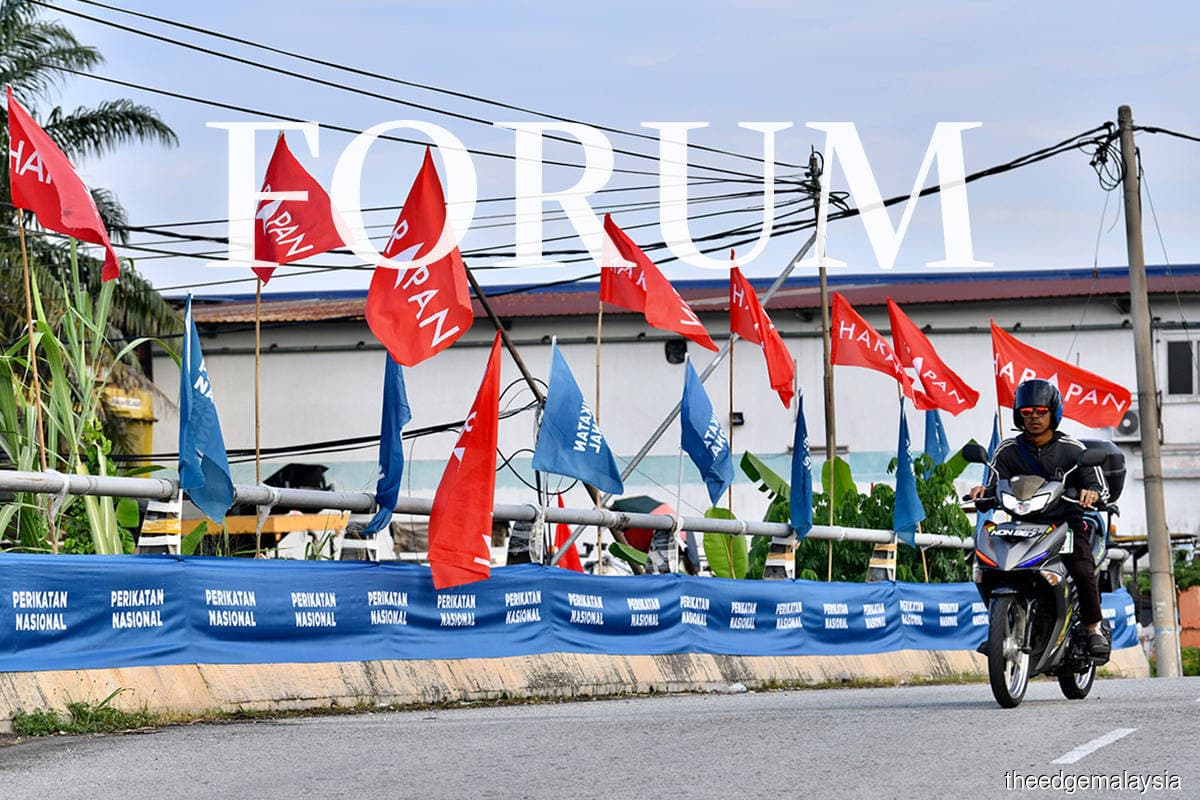
This article first appeared in Forum, The Edge Malaysia Weekly on August 7, 2023 - August 13, 2023
The mining of minerals is a dirty business. It has always been frowned upon even when it is done legally. The subject of mining becomes murkier when it becomes a political issue.
All commercial considerations take a back seat when it becomes a topic of contention for candidates in state elections. The candidates tend to play to the gallery for votes.
But controversy is only temporary.
The state elections will be over by the end of this week and the politicians will move on to the next battleground. However, long after Aug 12, the stakeholders who had invested in projects that were touched on during the political campaigns will be left dealing with the impact on corporate transactions that were brought up during the campaign period.
In the run-up to the state elections, the illegal mining of rare earth in Bukit Enggang, Kedah is the main issue hounding the controversial but popular Kedah Menteri Besar, Datuk Seri Muhammad Sanusi Md Nor. His chief opponent is Pakatan Harapan’s (PH) Datuk Seri Saifuddin Nasution Ismail, who is not contesting but is leading the opposition’s charge by virtue of being PH’s election director for Kedah.
Initially, in late July, Sanusi denied having any knowledge of or involvement in the mining activities of the state. After Saifuddin revealed photographs of Sanusi together with a Chinese national involved in the mining of rare earth elements (REE), Sanusi opened up on the matter.
In the subsequent days, more details surfaced on the progress that has taken place so far with regard to the prospects for REE mining in Kedah. According to reports, the value of REE deposits in Bukit Enggang is about RM60 billion and the company involved, in which Chinese nationals have an interest, has spent some RM30 million on undertaking initial exploration and feasibility studies.
It has the tacit approval of the Menteri Besar Inc (MBI), which is under the control of the state government.
Sanusi has revealed that MBI has an understanding that the project can only take place provided all the requirements have been complied with. Among the requirements is that mining of rare earth needs to get the go-ahead from the Ministry of Natural Resources and Climate Change, which comes under the purview of the federal government.
However, the PH side has contended that illegal mining of REE was discovered early this year despite action being taken for similar encroachment in 2021. They contend that the activities could not have happened without the knowledge of the state government.
In the 2021 incident, the Kedah Forestry Department and State Land and Mines Department fined a company a total of RM630,000 for illegal mining of REE.
Although land matters are under the purview of state governments, ultimately, any decision on the mining of rare earth has to come from the federal government. On this score, the company that is working with MBI has to make peace with the federal government if they are to pursue REE mining in the Bukit Enggang forest reserve.
Despite this setback, Sanusi seems to have the lead over the PH team in his bid to retain control of the state. He is popular and controversial, taking constant potshots at almost all the top leaders in PH, including Prime Minister Datuk Seri Anwar Ibrahim.
In all probability, PAS-led PN will continue to rule Kedah for the next five years and Sanusi will continue to be the menteri besar unless replaced by the party.
The question is, what happens to the REE venture and the investments that the private company has forked out to undertake feasibility and early exploration works? Will REE mining be allowed, especially now that it has become a subject of scrutiny by the PH-controlled federal government?
It is not only Sanusi who has done a U-turn on a matter involving the private sector. In Selangor, Datuk Seri Amirudin Shari has set up a roadblock for the contentious Petaling Jaya Dispersal Link (PJDL) project.
Last Monday, Amirudin issued a statement saying that the state government had rejected the proposal for the 14.9km PJDL as the promoter had not fulfilled the conditions of the Social Impact Assessment (SIA). However, later that day, he clarified that the project could continue if the promoter fulfilled the conditions.
The concession was signed in 2022 under the government of Datuk Seri Ismail Sabri and it is to be implemented entirely with private-sector financing. However, the promoter has to get approvals from the state.
Amirudin probably made the statement on the state rejecting the highway proposal because it is an issue in the state elections, particularly for residents living in the alignment of the highway. The PJDL runs through four state constituencies and all four are under the control of PH.
Three of the four seats are held by DAP while the fourth seat is Taman Medan, which is held by Parti Keadilan Rakyat (PKR). The DAP candidates won the seats with thumping majorities in the 2018 state elections and are likely to retain their seats come Aug 12.
As for the Taman Medan seat, where Malays form just above 50% of the voters, PKR took over the seat from Umno in the 2008 state elections. Since then, PKR has been holding the seat and its majority has grown.
This time, the Taman Medan seat will see a straight fight between PH and PN. The incumbents probably fear that if the “Green Wave” of support for PN seen in the 15th general election in November continues in the state elections, it could cause them to lose the seat.
Nevertheless, Amirudin’s back-pedalling on the PJDL has drawn much criticism, and the menteri besar has thrown the ball back to the PN-led federal government that had signed the concession in 2022.
In any election, politicians on the campaign trail will issue statements to play to the voters. But most voters are mature enough to know that the statements are meaningless unless they are stated in the manifesto.
And even a seasoned politician such as Tun Dr Mahathir Mohamad admitted in 2018, during his second term as prime minister, that manifestos do not necessarily translate into reality.
The slugfest in the run-up to the state elections will continue for the next few days. But what the politicians had said during the campaign trail will pass.
After the elections are over, the government will have to face the reality of balancing the need to boost the economy and infrastructure with the need to mitigate the social impact.
The mining of REE could take place in Kedah if the company meets all the requirements. It is a RM60 billion business waiting to be tapped. Similarly, the PJDL could take off if the concessionaire meets all the conditions.
The protests will continue until the next controversial project comes up.
M Shanmugam is a contributing editor at The Edge
Save by subscribing to us for your print and/or digital copy.
P/S: The Edge is also available on Apple's App Store and Android's Google Play.